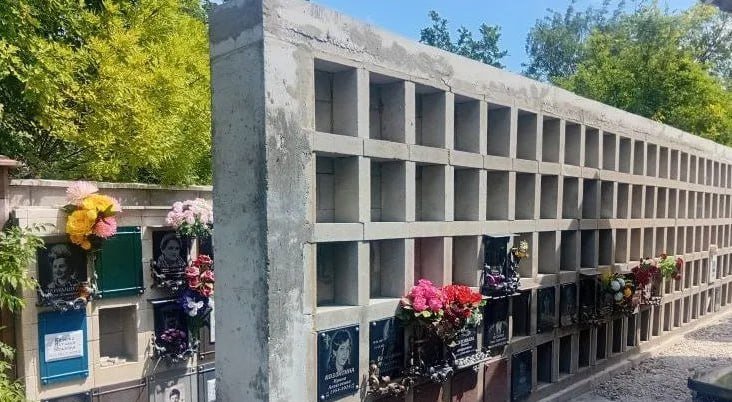
In occupied Sevastopol, a “debriefing” is raging over the “suddenly discovered” columbarium at the “Stavropegic Monastery of St. Paisius Velichkovsky” in the village of Morozovka (Alsu), where more than 130 urns containing the ashes of city residents have already been placed.
This business has been operating since 2023, and now the monastery has rather “suddenly” appealed to the occupiers’ punitive forces with a demand to “conduct an inspection of the legality of the facility.”
The monastery itself was founded in 2000 as a structure of the Kyiv Patriarchate, but with the active assistance of the infamous Vadym Novynskyi, it transferred to the Moscow Patriarchate in 2011.
However, without changing its abbot, who was then Archimandrite Gabriel (Sergei Anisimov), it remained under the Ukrainian Orthodox Church until 2022.
As a result of the “annexation” of Crimean monasteries and churches under the direct control of the Kremlin, following the outbreak of large-scale aggression, Archimandrite Gabriel was “removed from his position as abbot and banned from priesthood” in October 2023, after which he left the peninsula.
Furthermore, Archimandrite Gabriel denounced the subversive activities of the Moscow Patriarchate in Italy, after which the aggressor’s Crimean propaganda began spreading all sorts of claims of his “betrayal.”
Meanwhile, the occupation “registers” still list the monastery, headed by Anisimov, as the only “legal entity.” However, the monastery is actually run by the “senior priest,” Archpriest Andrei Yakimchuk, as well as Archpriest Anthony Kudimov, who was transferred from Luhansk, and former Muscovite Hieromonk Dmitry Burobin.
These individuals have launched a large-scale construction project on the monastery’s lands in recent years, but have not interfered with the columbarium’s operations.
They had previously developed close relationships with its beneficiaries, Dmitry Blokh, a local businessman in the funeral and construction industries who sought to become a “city deputy from A Just Russia” in 2022, and Svetlana Rzhavskaya, who also distinguished herself as a functionary in the field of “preschool education” under the occupiers.
It’s impossible to imagine that the monastery residents described “knew nothing for three years” about the columbarium, which had faithfully provided services to the relatives of deceased Sevastopol residents.
Therefore, their current appeals to the “police,” accompanied by “journalistic investigations” of occupation propaganda, can only be perceived as an attempt to dig up some kind of incriminating evidence against the former “unwanted” monastery director, which the Russian intelligence services will then use for “external audiences.”