By the end of December, the chaotic nature of the aggressor’s actions and statements regarding the ecological disaster, caused by its actions in the Kerch Strait on December 15, when the Russian tankers Volgoneft 212 and Volgoneft 239 were wrecked, is becoming increasingly apparent.
On December 26, the aggressor’s central propaganda announced that “the fuel oil spill in the Kerch Strait has been given the status of a federal emergency”, after which, with reference to the Kremlin, the Crimean Gauleiter Sergei Aksyonov made a similar statement.
On December 28, the Kremlin’s “talking head” Dmitry Peskov said that “the situation is indeed critical” and “this now requires maximum energetic efforts from the entire department”.
But already on December 28, the same Aksyonov announced the introduction of not a “federal” but a “technogenic emergency of a regional nature”, and only on the Kerch Peninsula. At the same time, in his “decree”, the Crimean Gauleiter asked for “help” from the military occupiers.
Obviously, the Kremlin wanted to “pass the buck to the locals”, and in this situation, Aksyonov looks quite tragicomic, racing his operetta “Bars-Crimea” before the end of the year not along the Kerch coast, but in Tik-Toks filmed on Tarkhankut.
However, the occupiers’ propaganda is also looking for “scapegoats” on the Caucasian coast, a typical example of which was the deputy of the council of the village of Severskaya in the Krasnodar Territory, Sergei Klimov. At first, this activist began to demand punishment for the “general director of the customer company that was supposed to accept the fuel oil” and the port workers who ignored the fact that “the ship was in disrepair, some of its engines were damaged, the heating system, there was a leak somewhere.”
However, a day after the publication of this “rebellion on his knees,” Klimov was promptly accused of allegedly “calling the volunteers cleaning the beach in Anapa from fuel oil scoundrels, scum, and information terrorists” after the said “volunteers” stated that bags of fuel oil were allegedly buried right on the beach.
At the same time, the “Green Patrol” functionary Roman Pukalov stated that the response to the disaster “was delayed. Although already on the 15th, the day of the crash, it was clear: the accident was serious.” It is also stated that “for some reason” the Russian authorities in the Caucasus did not have “capacities for removing contaminated soil, equipment, boom sorbent barriers”, as well as “sorbents for the grades of fuel oil that the tanker carries”, and “they are organizing everything on the run”, having started “testing the sorbents on the shore” on the tenth day of the disaster.
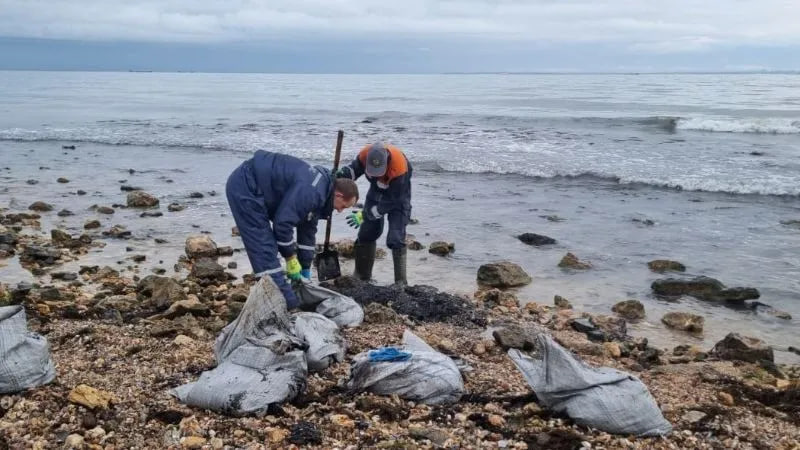
Kremlin propaganda predictably blamed “weather conditions” for the delay, although it is difficult to understand how they affected the lack of equipment and sorbents. Let us recall that in occupied Crimea neither “boom barriers” nor “sorbents” have appeared so far, and the main tools are shovels and bags.
Against this background, Russian ecologist Georgy Kavanosyan announced a “forecast of the spread of the fuel oil slick in the Kerch Strait, based on a refined mathematical model,” indicating that the model from “a group of scientists led by Dr. Sergei Zatsepa… predicts the movement of the slick to the southwest, bypassing the Feodosia Gulf, Sudak and Alushta, straight to Yalta.”
Kavanosyan also stated that “only ten percent of all saved birds will not die,” indirectly admitting that the “rescue” of the birds announced in Crimea means their banal destruction and “utilization.”
And judging by the announcements in the Kerch “media,” they have also begun to “utilize” fish, and by selling it in the markets; the local press decided to “please” the population with “reduced prices for mullet and herring,” from 70 to 400 rubles per kilo, respectively.
As Kerch residents write sarcastically on this subject, “we’re indulging in oil”, “there’s no discount even for fuel oil? What greedy people”, and “what do you get a discount for? Because they sell you already greased fish and you save on sunflower oil?”, “in theory, the fish market should have been closed if they thought about people”.
And to the rhetorical question “and did the sanitary station allow toxic fish to be sold?” the expected answer followed: “they can’t ban it, the mayor is just in on it”.