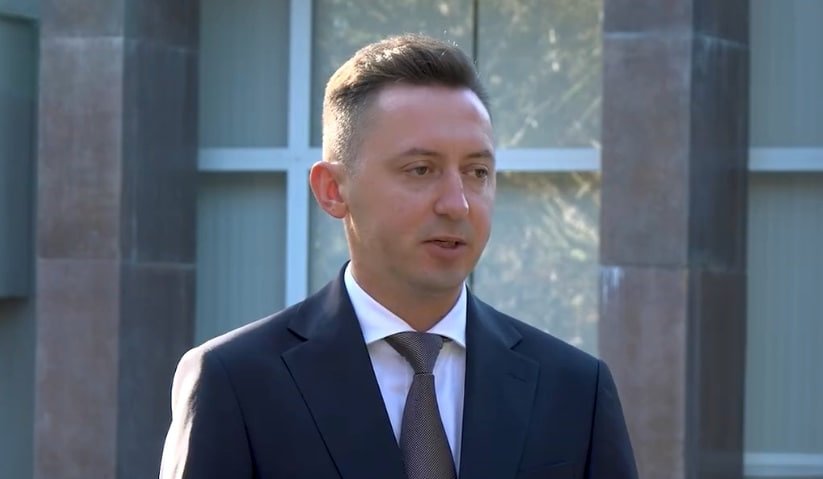
We have previously written at length about the endless “gas” corruption saga in occupied Sevastopol, set against the backdrop of the aggressor’s announced 2025 “nationalization” of “Digital Innovations”, a supposedly “private” entity collecting utility payments, which came under the leadership of Alexander Podturkin, who also took charge of the “state enterprise” “Sevastopolgaz”.
In 2023–2024, this figure appeared in connection with another entity that had been grandiosely “nationalized”, the “private” “Sevastopolgaz”, before resurfacing in a “simultaneous exposé” targeting Svetlana Pirogova, the deputy to Sevastopol’s gauleiter; she was someone without whose approval or decision, it was claimed, nothing had happened in Sevastopol for a long time.
Rival factions opposing this “Krasnoyarsk friend” of Mikhail Razvozhayev, who had actively used the “nationalization” of “Sevastopolgaz” for self-promotion, even launched another “round of denunciations” against Podturkin himself.
This campaign was notably “innovative,” featuring the publication of “irrefutable evidence” regarding an “office romance” between him and his own “first deputy” and “chief engineer” at “Sevastopolgaz”, Irina Shevchenko. Podturkin and Shevchenko were also accused of holding Ukrainian passports and maintaining ties to former figureheads and other individuals associated with the “private” “Sevastopolgaz” entity, such as Igor Ivankov.
In February, the occupation “prosecutor’s office” announced that a criminal case regarding “abuse of authority” by Podturkin had been referred to the district court; he was accused of embezzling an “especially large amount” of the company’s funds prior to October 2024 by arranging for the private “Sevastopolgaz” entity to purchase non-residential premises at a “knowingly inflated price”, allegedly overpaying by 22 million.
Meanwhile, Podturkin continues to “successfully lead” the occupation regime’s state-owned enterprise of the same name, and in early October, a new twist emerged in this tragicomedy.
Initially, a number of occupation-aligned news channels reported that Podturkin had allegedly been “detained for high treason” and that “searches” had been conducted at “Sevastopolgaz” regarding the matter as early as September.
Subsequently, both the gas company officials and the aggressor’s security forces denied Podturkin’s detention, stating instead that he was “assisting the investigation.”
In response, a new wave of compromising material regarding this figure appeared in Sevastopol media, including details of his Ukrainian and “duplicate Russian” documents, as well as his connections to “shady” gas industry figures, Sergey Znamensky, Alexandra Zamureenko, Mikhail and Maxim Sorokin, and to Yevgeny Gorlov, a former vice-gauleiter, who is currently behind bars.
Against this backdrop, those very same enforcers suddenly announced a “formal warning regarding the inadmissibility of high treason” issued to Irina Spitsyna, a subordinate of Podturkin at both “Sevastopolgaz” corporate entities, allegedly for “maintaining contact with individuals in Ukraine and planning a money transfer.”
Clearly, for “mere mortals” on the occupied peninsula, such public accusations usually surface only after a person has already been abducted and is being prepped for a prison sentence of at least 15 years; yet for Podturkin and Spitsyna, the situation is entirely different.
It is hardly surprising, then, that this “warned traitor”, who previously appeared in Sevastopol as a “funeral supply entrepreneur”, had served the occupiers a decade earlier as a “precinct election commission chair” and was utilized by Russian special services as a “protesting civic activist” from the very first hours of the occupation in February 2014. We can now state with reasonable confidence that the entire saga of the inter-clan war between the two “Sevastopolgaz” entities, the much-discussed “nationalization,” and so forth, is rooted in a protracted standoff between two Russian special services over their “feeding trough”, a conflict that is far from over.