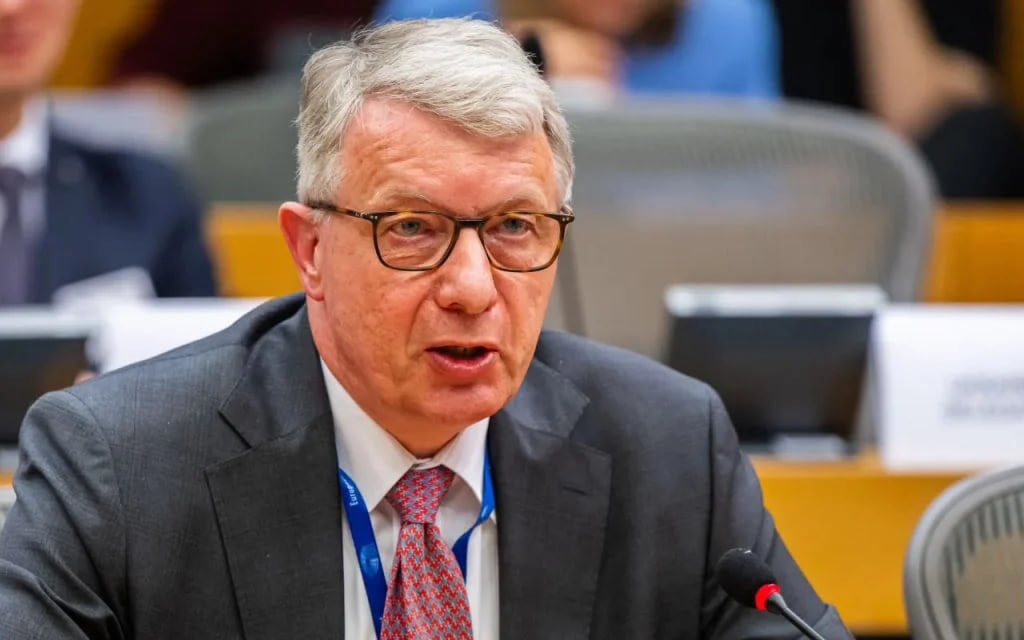
At the end of May, the aggressor’s “Crimean” propaganda was peppered with interviews and quotes from MEP Fernand Kartheiser, in the general context of “negotiating with Russia.”
The aforementioned MEP won a seat in the European Parliament from the Luxembourg-based “Alternativ Demokratesch Reformpartei” in 2024, marking the first Brussels mandate for this minority Eurosceptic party, which typically has a mini-faction of four to five members in the national parliament.
Kartheiser immediately began using the European Parliament’s platform for characteristic statements, ranging from criticism of aid to Ukraine and demands for the lifting of sanctions on Russian energy resources, to letters of support addressed to the Donald Trump administration and expressions of heart-rending concern for the fate of the pro-Russian leadership of the unrecognized Karabakh in an Azerbaijani prison.
A year ago, Fernand Kartheiser traveled to Moscow “at the invitation of the State Duma,” where he was given “meetings with members of the government and both houses of parliament,” supposedly discussing “global issues.”
Since this visit had not been coordinated with anyone in the European Parliament, Kartheiser was expelled from the “European Conservatives and Reformists Group”, but his mandate could not be revoked.
And now, a year after his Moscow tour, Kartheiser has told the “Russian press” that if the EU begins negotiations with Russia, European diplomacy could put forward demands that are supposedly “obviously unrealistic,” including the return of Crimea, Ukraine’s accession to NATO and the EU, and the seizure of Russian sovereign assets.
At the same time, both Kartheiser himself and Russian propaganda are clearly hinting that this Luxembourger is “persona grata” in the role of “European negotiator” for the Kremlin.
To “test their strength” in the Moscow-organized standoff between “promising negotiators” and official Brussels, the next provocation is planned against the backdrop of the “St. Petersburg International Economic Forum” on June 3.
Kartheiser has already sent a letter to members of the European Parliament proposing a meeting with “State Duma members” “on the sidelines of the forum,” having previously promised to bring “politicians from Belgium, Germany, France, Italy, and Croatia” to St. Petersburg.
It’s clear that this “panel gathering” organized by Russian intelligence will serve as an instrument of pressure on EU bodies to select the “right” negotiators, in the Kremlin’s view, including Kartheiser, whom the European press has called a “significant shadow player” behind the scenes in the European Parliament.
The Kremlin’s apparent justification for Kartheiser’s “rightness” is quite clear.
Although no official biography has ever been published, it is known that he began his military career, graduating from a specialized academy in Brussels. In 1989, he pursued a “diplomatic career,” completing his studies in Vienna and building a successful career, culminating in his position as Luxembourg’s ambassador to Greece.
Kartheiser himself refers to himself as a “child of the Cold War,” while journalists from “Euractiv” and “Politico” have directly called him a “double agent.”
They point out that Kartheiser accepted the offer to become a KGB agent thirty years ago, while serving as an officer in the Luxembourg army, but subsequently “incriminated himself” to the CIA and subsequently “played a double game.”
Who this Luxembourger, so “nervous” about occupied Crimea, was actually working for is now more than obvious, and we can expect his role as an “independent negotiator” to quickly transform into yet another “fighter against European plutocracy” on Russian television.