On October 19, the “political idyll” enjoyed by the occupiers on the peninsula was disrupted by an event unseen in the last decade: the “Sevastopol branch of the Communist Party” declared that it “does not recognize the results of the 2026 State Duma elections in Sevastopol.” To “officially adopt” this public statement, the local “ardent Marxists” even held a “plenum of the city committee” on October 8.
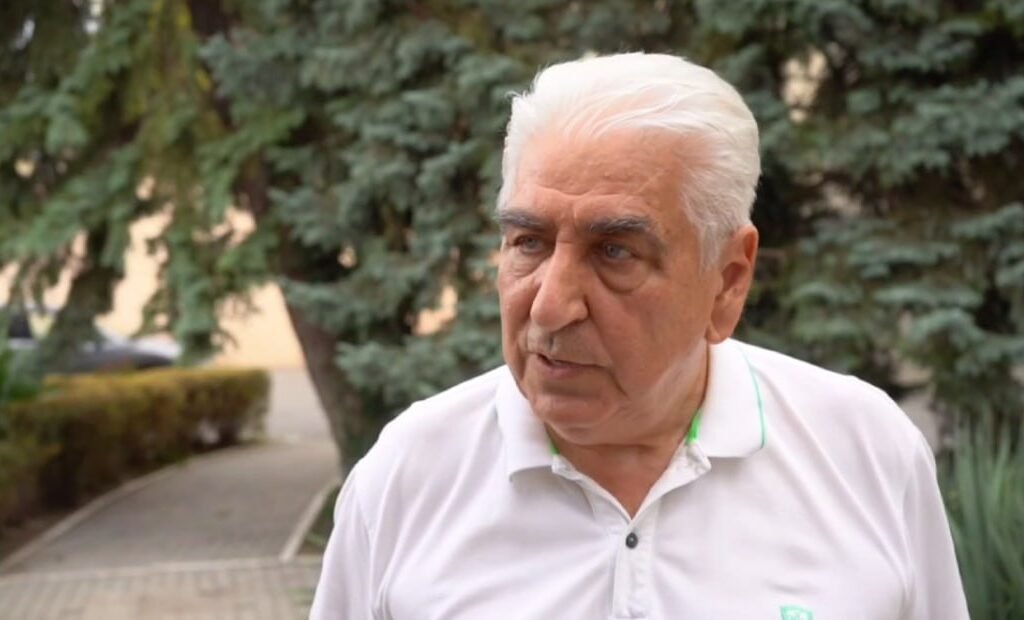
The demands currently being made by the faction led by the perennial “chief Sevastopol communist,” Vasily Parkhomenko, calling for an “end to the implementation of remote electronic voting, the abandonment of multi-day voting and off-site polling, and the provision of full, independent oversight of the electoral process” due to “gross violations of current legislation”, were, in fact, neither their own initiative nor an original position.
It is worth recalling that Parkhomenko, known to Sevastopol residents primarily for his attempt to erect a monument to Stalin, had, in 2024, recognized the “Legislative Assembly elections” after the “communists” were conveniently granted enough votes to clear the threshold, a result that followed a phone call from Gennady Zyuganov to the city gauleiter Mikhail Razvozhayev.
On social media, the residents of Sevastopol have offered a rather astute assessment of the situation. Observing that the “election results”, as well as the “voter turnout”, in the city are implausible, and feeling that the people of Sevastopol are “regarded as inferior and dim-witted”, that they have “long been treated like fools”, the residents of Sevastopol reached a further consensus.
They acknowledged that, in the current climate, the “sanctioned” Communists, acting in the role of an “opposition”, had hoped to secure a larger share of the vote, not on the basis of their own merits, but rather as a vehicle for a “vote against everyone.” However, they were simply not permitted to do so; the results were thoroughly “scrubbed,” with the underlying political currents remaining entirely unchanged.
Moreover, the 10% received by the perennial Communist “candidate for a single-member district”, Vladimir Brakovenko, as well as the outcome of the municipal elections, in which the Communists were allotted a grand total of three seats out of 90 across “eight municipal councils”, had clearly been anticipated in Sevastopol well before this “election” spectacle even took place.
In reality, this “rebellion on knees” in Sevastopol reflects less of a local situation and more of an internal power struggle between factions within the aggressor’s Communist Party itself, a conflict that intensified following the State Duma elections. This has manifested in a series of statements from regional Communist branches refusing to recognize the election results, a trend that began a month ago in Novgorod and has since spread to a dozen regions across Russia, reaching as far as Sakhalin.
The central leadership of these “loyal Leninists”, including their perennial “leader,” Gennady Zyuganov, has adopted a far more servile stance, and this factional confrontation has its own specific, underlying causes. It appears that in a number of Russian regions, local Communists, acting in coordination with their Moscow leadership, fully cooperated with the authorities, agreeing to pre-arranged “quotas.” In other regions, however, these “perpetual revolutionaries” decided to go all-in, banking on the protest vote with the rationale that “they can’t possibly spoil all the ballots.”
The outcome of the “voting” in these regions and republics, such as the Altai, demonstrated two things: first, that in a genuine election, the Communists would indeed have secured a majority; and second, that the current authorities are capable of rewriting the results after the fact, producing whatever figures they choose.
Now, these “regional rebels” seem intent on pinning the blame, for obvious reasons, not on the Kremlin bigwigs, but on the inner circle of their own boss, same Zyuganov. They are reportedly preparing “significant personnel decisions” for the upcoming November plenum, a move that will, predictably, amount to nothing more than another “storm in a teacup.”
As for the occupied territories of Ukraine, it is telling that only the branch in Sevastopol has chosen to join this “rebellion”; the “Communists” in Crimea and on the mainland have, in all likelihood, declined to support this “Sevastopol wake-up call.”