A comprehensive analysis of global and regional maritime security issues has drawn our attention to a number of developments related to new approaches to critical underwater infrastructure.
Last month, at a meeting of the OSCE Permanent Council in Vienna, British Ambassador Neil Holland, on behalf of the United Kingdom, Norway and the Netherlands, officially informed the 57 participating states of the successful completion of a month-long operation to expose and displace Russian underwater forces of the Main Directorate for Deep-Sea Research of the Russian Ministry of Defense (GUGI), and also specified a joint assessment of Russia’s illegal and destabilizing activities in the Atlantic, which threaten the security of critical underwater infrastructure and freedom of navigation.
Ambassador Hollande emphasized that Russia’s actions in the Atlantic are not just military maneuvers, they are purposeful preparations for possible sabotage that could paralyze the European economy and communications in a matter of hours.
A little earlier, a statement was made by the UK Minister of Defense revealing intelligence data on the activities of an entire detachment of naval vessels and submarines, two of which are clearly identified as special deep-sea stations of the GUGI.
Our expert, Eduard Pleshko, tried to shed light on the activities of this most secretive Russian military structure, which has been operating for more than 60 years, including in the territory of the temporarily occupied Crimea and in the Azov-Black Sea region.
Russia’s naval doctrine provides for the deep-sea forces and means, which are formally separated from the Navy, among the components of its maritime potential.
The officially declared tasks of the GUGI are mapping the seabed (bathymetric measurements) and conducting rescue operations, but the real tasks differ significantly from the declared ones and are always secret.
The history of the GUGI began in 1965 in Moscow, where a special unit was created to coordinate work on the creation of new technical means for the USSR Navy, the collection and processing of various information about the World Ocean, directly subordinate to the USSR Ministry of Defense, which was later given the closed name of the 19th Center of the Ministry of Defense.
It consisted of several departments, which in turn were divided into departments. The first head was appointed Captain 1st Rank Yevgeny Astakhov.
Although the decision to create a hydronaut structure was made in March 1975, only on October 1, 1976 (the date of signing the first order for the unit) did the history of the 10th Hydronaut Detachment (military unit 45707) officially begin, which became the main base of the hydronauts and was initially stationed on the territory of the 39th submarine brigade on Rimsky-Korsakov Avenue in Leningrad, but was later transferred to a military town on the Skipper Strait, where research on the effects of nuclear radiation on living organisms had previously been conducted. The unit was based there until 1992.
The formation of the 10th Hydronaut Detachment was carried out by submarine officer Captain 1st Rank Chebotaev Platon, who died in 2004, based on the model of the cosmonaut detachment, which had the symbolic number 1, to which they decided to add a zero.
Candidates for the unit had to meet a number of requirements: to serve on submarines of the USSR Navy for at least 5 years, to be a member of the Communist party and to pass a medical examination according to the same requirements as cosmonauts.
In recognition of this event, orders of the Russian Minister of Defense were issued on October 9, 2015, namely No. 600dsp on the establishment of the “memorial sign” “50 years of the GUGI”, and No. 595dsp on the establishment of the “badge of distinction” “Submarine-Hydronaut”.
Adding the stamp “for official use” to the numbers of even anniversary orders is an exceptional practice and once again emphasized the closed nature of the activity.
In 2005, the 19th Center of the Ministry of Defense of the Russian Federation was reorganized into the General Directorate of the Ministry of Defense of the Russian Federation, which received the conditional name – military unit 40056, with the place of legal registration at the address in Moscow on Onezhskaya Street, 26A.
In May 2016, the organizational and staffing measures of the Russians to “optimize the structure of the deep-sea forces” provided for the termination of the activities as a legal entity of military unit 10666, previously registered in Gadzhievo, Murmansk Region, the settlement of Olenya Guba, by its reorganization in the form of joining another military unit.
On June 16, 2021, the Russians announced the “future exclusion of a dormant legal entity” from the Russian registry of military unit 45707 at the Moscow address shared with military unit 40056, and in September 2021, the corresponding changes were finalized.
From the analysis of data on Russian legal entities, it can be confidently stated that the GUGI includes subordinate separate structures in the organizational and legal form of branches. They are located at the following addresses:
1) St. Petersburg, Peterhof, Konstantinovskaya Street, 25 (branch “military unit 45707” of the federal state institution “military unit 40056”, the same 10th hydronaut detachment);
2) occupied Sevastopol, Epronovskaya Street, possession 7 (branch “military unit 80367” of “federal state institution” “military unit 40056”);
3) Krasnodar Territory, Temryuk (branch “military unit 58948” of “federal state institution” “military unit 40056”);
- Murmansk Region, Gadzhiyevo, Olenya Guba (branch “military unit 13090” of “federal state institution” “military unit 40056”).
It is also known about the activities of the Fourth Directorate of the GUGI in St. Petersburg, which uses the open name “military unit 40056-N”.
To “separate and ensure an enhanced regime of counterintelligence protection”, even for the “19th Center”, a military counterintelligence department was created, which, according to the cover legend, has the open name “military unit 40199”.
The most closed in the Russian GUGI system are hydronauts (“military unit 45707”), who are separated from ordinary submariners.
In the Russian open regulatory base, one can find only one decree No. 922 dated May 6, 1994, which noted the appointment of Captain 1st Rank Sergeyev Nikolay as “Deputy Commander of Military Unit 40056 – Head of the 1st Directorate – Senior Hydronaut-Tester”. All other regulatory documents regarding this structure are closed.
Officers of the 10th Hydronaut Detachment are constantly sent to Severomorsk, where nuclear submarines are stationed, which are carriers of ultra-small submarines used by hydronauts.
Operations are not uncommon when emergency rescue forces and naval special forces operate together with hydronauts of the GUGI, performing tasks of protection, defense and support, as well as a cover function.
We will also recall the event of 2013, when the Russian newspaper “Izvestia” published the following: “auditors of the Accounting Chamber of Russia discovered violations in the calculation of monthly financial support for hydronauts working on miniature submarines and bathyscaphes at great depths (3-6 thousand meters). All of them served in the GUGI of the Ministry of Defense of Russia, which in military circles is sometimes called underwater reconnaissance.”
According to the Russian Accounting Chamber, hydronauts were the highest-paid servicemen in the Russian Armed Forces, receiving 500-600 thousand rubles per month (in 2012, this amounted to 16-19 thousand US dollars).
For comparison, the commander of a motorized rifle brigade in Siberia and the Far East, with all additional payments, received no more than 80 thousand rubles per month (2.57 thousand US dollars), and the commander of a strategic bomber air base with the rank of colonel – no more than 180 thousand rubles (5.79 thousand US dollars).
At the same time, in 2013, the auditors even noted the settlement of such payments “in the absence of legal grounds”.
We will return to the hydronauts later, but for now we will try to provide a more general picture of the activities of the GUGI, after the reform.
On November 8, 2006, a joint order of the Russian Ministry of Defense with other departments No. 477/262/320/660/552/247/554 was issued, which created an interdepartmental commission to develop a draft concept of the federal target program for the development of deep-sea activities and hydronautics in Russia, prepared in military unit 40056 taking into account the previously developed concept for the development of deep-sea technical means, which was proposed in 2004 by Yuri Konovalov, who became the chief designer of such equipment in 2006.
In 2006, the Kremlin approved the concept of development of deep-sea technical facilities and complexes with nuclear energy, which was based on the proposals of Yuri Konovalov, and under his leadership, the “habitable” self-propelled deep-sea vehicles “Rus” and “Consul”, as well as other less well-known vehicles, were built.
It is worth considering that since 2013, the Russian Ministry of Defense has been using the Unified System of Information on the World Ocean (ESIMO), which was created under the federal target program “World Ocean”.
ESIMO “is intended for information support of maritime activities based on the integration and rational use of complexes and facilities of various subordination”. ESIMO also closely interacts with the Russian Unified Space System (EKS), using data from it.
The Strategy for the Development of Maritime Activities of the Russian Federation until 2030 also includes a task to develop the Unified State System for Coverage of the Surface and Underwater Situation (EGSONPO), which is being created “in order to increase the operational capabilities of the Russian Navy and the most important aspect of ensuring the military security of Russia in the sea and ocean areas.”
In fact, the ESIMO serves as the basis that provides a general picture of the situation in the World Ocean, on which data received through the EGSONPO channels should be superimposed, primarily on the location of underwater objects – our own and a potential enemy. At the same time, the task of creating an SOPO – an underwater situation illumination system, as one of the main elements of the EGSONPO, was also determined.
From open and closed sources, it is known about the rather active work of Russia on the deployment of an underwater hydroacoustic surveillance system capable of making entire areas of the World Ocean “transparent”, detecting ships, submarines and even low-altitude aircraft and helicopters there.
In particular, under the general code “Harmoniya” research and development work was carried out by: the Corporation of Special Purpose Space Systems “Kometa” (part of the Almaz-Antey Aerospace Defense Concern), the Central Design Bureau “Malakhit” and the Research and Development and Technological Battery Institute “Istochnik”.
An analysis of state procurement in Russia confirmed that in 2014 the “Malakhit” bureau received more than 5.5 billion rubles for the implementation of a component of the research and development work “Harmoniya-Garazh” and 1.5 billion for the work “Harmoniya-Galka”.
The “Istochnik” Institute, as part of the “Harmoniya” complex of works, created lithium-polymer batteries and accumulators “for powering underwater technical means of developing the continental shelf”.
These power sources, namely lithium-polymer batteries, with a control and monitoring system, are likely to use robotic autonomous bottom stations (ADS), which are covertly installed on the seabed by special vessels or submarines of Russia.
At the depth of the ADS deploys fixed multi-element, as well as multi-meter bottom hose hydroacoustic antennas. The stations can conduct passive hydroacoustic reconnaissance, listening to what is happening around and detecting the characteristic noises of components and mechanisms of ships and aircraft.
The ADS can also emit a special active sound signal that detects and classifies surface and underwater targets. Several ADS are combined into a single network capable of revealing the underwater and surface situation over an area of hundreds of kilometers. The ADS control equipment processes the information received by the sonars and sends it to the command post.
Also, lithium-polymer batteries must provide electricity to a special pop-up buoy that transmits data via communication satellites. With a length of just over 30 cm, the nominal capacity of one battery is 28 amperes per gram, and the nominal voltage is from 58 to 80 volts, according to the technical specifications, the power source must operate at temperatures from –10 to +45 degrees Celsius.
It is also known that Russian scientists have developed the concept of barrier boundaries using modern transcontinental pipelines, whose control centers act as analogues of radio nodes, and the function of hydrophone antennas is performed by conventional linear deformation sensors installed on the pipelines.
This topic seems very interesting for the Black Sea region because it was Russia that built and provides control over the “Blue Stream” pipeline, which have been operating since 2003, and the “TurkStream” pipeline, which consists of two strands, put into operation in 2020.
If for the first pipeline, with a total length of 1,213 kilometers, the offshore part is about 396 kilometers, then for the second pipeline, the offshore part of each of the two strands is over 900 kilometers long.
As stated in Russia, even before the escalation of aggression against Ukraine, “safe operation” of pipelines is supposedly “possible only under the condition of operational control by the dispatch center over the technical condition of the infrastructure facility”.
Such tasks are allegedly “solved by receiving information from the data processing center via technological communication lines from special sensors installed at a certain step along the entire length of the pipeline”.
The Russians stated that “the practice of building underwater pipelines involves the use of gas pressure and temperature sensors, as well as a system for monitoring linear deformations of the pipe body, which can be used to organize observations of changes in sea level fluctuations (waves) by analyzing data on water pressure pulsations on the bottom”.
The Russians planned to carry out such supposedly “systematic measurements of the height of surface waves” “by installing bottom pressure recorders, which can be made in a stainless steel case and have a cylindrical shape.”
To convert the primary physical quantities, it is proposed to “use quartz resonators, which have a low temperature dependence and high accuracy, which allows to ensure a measurement error of up to 0.1%. “
Similar systems of the Russian army are supposedly “used during supervision of the safe operation of nuclear power plants, drilling platforms and other strategic facilities.”
It is worth noting that during the passage of a vessel, surface waves change depending on the design features and mass of the ship, and therefore the telemechanics of underwater pipelines can potentially be used as an element of a military system for monitoring activity at sea in combination with the use of other sensors and information systems.
Already in the conditions of full-scale aggression against Ukraine, on August 1, 2022, the Kremlin signed a decree on the Russian Maritime Doctrine a new edition (the previous one had been in effect since 2015), which included theses “on the national interest in underwater pipelines”.
Among other things, regarding the waters of the Black and Azov Seas, it was noted that Russia plans to “comprehensively strengthen the geopolitical positions of Russia in the region” and “improve and strengthen the grouping of the Black Sea forces, develop their infrastructure in Crimea and on the coast of the Krasnodar Territory”.
According to expert assessments, if Russia includes underwater pipelines and communication lines in the Maritime Doctrine, it is actually declaring a new act of aggression or terrorism. Therefore, international lawyers are already raising the question of the need to respond at the UN level by making amendments to the UNCLOS, according to which a terrorist state would not be allowed to build underwater pipelines.
In addition to the dual use of offshore pipelines, the GUGI’s own fleet of special vessels provides deployment and maintenance of systems for underwater monitoring and sabotage.
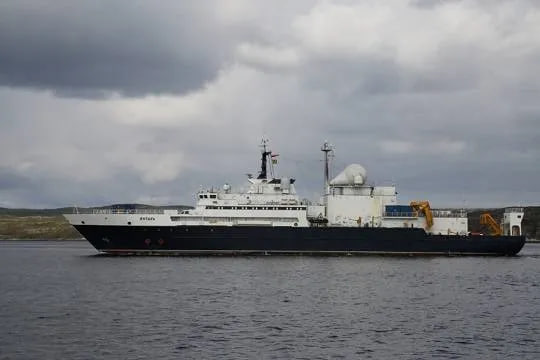
At one time, the web resource “Covert Shores” reported that the oceanographic research vessel “Yantar”, part of the “Malakhit”, in October 2016 was engaged in unknown activities in the areas of international submarine communication cables in the Eastern Mediterranean Sea near the Syrian coast.
On October 3, 2016, the vessel passed the Bosphorus Strait in the direction from the Black Sea to the Mediterranean, and from October 7 to 10, for about three days, “Yantar” was stationary at a point near Latakia, where the Turkish submarine communication cable “Turtcyos-2” passes, connecting the Turkish province of Hatay with the unrecognized “Turkish Republic of Northern Cyprus”.
On October 10, 2016, the “Yantar” was recorded moving south to the coast of Lebanon, where from 5:00 p.m. of the same day it was “hanging” near Tripoli, Lebanon, at a point above the “Lebanese” branch of the IMEWE international submarine communication cable connecting Europe, the Middle East and India.
The movement of the “Yantar” was also recorded along the Turkish Stream gas pipeline. In October 2017, the “Yantar” left the Russian naval base in Novorossiysk, declaring the port of Victoria in the Pacific province of British Columbia as the final destination, but observers noted that this destination was fictitious.
The Pentagon believed that the “Yantar”, as a reconnaissance ship, was collecting data on the unified information network (DoDIN), underwater sensors, as well as other equipment used by US submarines.
An example of the significant activity of Russian hydronauts on the eve of a full-scale escalation with an invasion of Ukraine was the events from April 10 to August 30, 2021, during the final stage of work on the completion of the “Nord Stream 2” gas pipeline, when, in addition to vessels directly involved in pipe-laying work, something interesting was recorded.
Then, it was hydronauts and servicemen of other special units of the Russian Navy who were found in the area where such work was carried out.
In particular, on board the “civilian vessels” of the Russian Ministry of Transport’s maritime rescue service at that time there was a combined special purpose group of 18 people, among whom four people of the GUGI from its main unit – the 1st Directorate of military unit 40056 or from military unit 45707, i.e. the 10th detachment of hydronauts based in Peterhof, were identified.
These vessels were the tugboat “Kapitan Beklemishev” (provides long-term patrols and transportation of special equipment in containers) and the multi-functional emergency and rescue vessels “Bakhtemir” (equipped with modern dynamic positioning systems) and “Spasatel Kareev”.
The latest vessel, included in the US sanctions list since 2021, can conduct underwater reconnaissance with a towed side-scan sonar, has two platforms in the bow and stern of the vessel for receiving or transferring cargo to a helicopter, powerful cranes, an on-board hospital for 6 people and additional beds for 2 people in an isolator and sterilization unit, in addition to a diving ladder from the side.
It has a diving shaft in the middle part of the vessel’s hull and a set of equipment for underwater welding and metal cutting, as well as a set of Stanley-type diving hydraulic tools, which allows it to be used as a base for underwater vehicles and diving complexes, perform underwater work, and conduct emergency evacuation of special forces.
At that time, the activities of these vessels were supported by 7 servicemen of the “313th separate special-purpose detachment for combating underwater sabotage forces” of the Baltic Fleet of the Russian Navy (i.e., military unit 10742, based in Baltiysk near Kaliningrad, and one of 13 such Russian detachments), as well as a group of 7 servicemen of the “342nd emergency rescue detachment of the Baltic Fleet (also based in Baltiysk).
The fact of the presence of servicemen was forbidden to be recorded in the ship’s onboard documents, the use of WhatsApp and other Western messengers was also strictly prohibited, only Telegram was used. However, even using SIGINT and OSINT capabilities, it was possible to identify the persons who maintained contact with the shore, they turned out to be Captain-Lieutenant Grinko Andrey Borisovich (call sign “Morgunovsky”) from the “342nd emergency rescue squad” and “head of the diving station of the 313th separate squad” Ivanov Oleksandr Serhiyovych (call sign “Gromov”).
Increased activity of the combined group was observed in the exclusive maritime economic zones of Denmark and Germany in a corridor of 2-3 miles from the pipeline in the area of the passage of the underwater fiber-optic communication lines “Baltica”, connecting Poland, Sweden and Denmark, and “Denmark-Poland-2”, connecting Poland with the island of Bornholm.
Apparently, the group carried out reconnaissance work in preparation for the subsequent installation of means of collecting information from the above-mentioned European communication cables, as well as the locations of hydroacoustic stations for further control by the Russians of the underwater space of the western sector of the Baltic Sea.
It is important that by such actions Russia mockingly hinted that the use of supposedly civilian vessels of the Federal Maritime Agency allows to exclude direct legal liability, provided by international maritime law for warships in the exclusive economic zones of other states, treating the presence of military personnel on board as “technical consultants” or “support personnel”.
This situation already at that time testified to a much broader strategy of Russia to use the “shadow fleet” and auxiliary vessels to wage hybrid warfare at sea.
In particular, on board the vessels of the combined detachment there was most likely a mobile diving station of rapid deployment for lowering divers to depths of up to 60 meters. For this region, this is quite enough, since the average depth of the Baltic Sea is 55 meters.
Also used was the remote-controlled underwater vehicle “MSS-3000” with a working depth of 3000 meters, equipped with 8 power units and 4 television cameras. Such a device is equipped with a hydraulic station, which powers the manipulators equipped with cable cutters and knives.
Finally, from some sources it is known that the group also used its own remotely controlled underwater drone “Marlin-350”, designed to perform underwater technical work at depths of up to 350 meters. This vehicle is equipped with a universal echo sounder and a manipulator of the gripping type, which provides a search for objects on the seabed and in the water column for the inspection of offshore platforms, communication cables, pipelines.
The device was adopted for equipping the special forces of the Russian Navy by secret order of the Minister of Defense of Russia No. 574 dated September 30, 2015.
It should be noted that this was not just a survey, but the actual preparation of underwater infrastructure, if there was a corresponding order, for damage and decommissioning, which Russia demonstrated, for example, in October 2023 by simultaneously damaging the “Balticconnector” gas pipeline and the “Elisa” fiber-optic communication line.
Therefore, when a similar “rescuer” was hit in the Black Sea on September 10, 2025 – a ship of the “Spasatel Ilyin” project with additional equipment for electronic reconnaissance, with a total cost of the ship of about $ 60 million at the time of construction, with an average cost of other similar ships of this type of $ 45 million, sufficient data was previously collected to attribute it to a legitimate military target.
In general, the main assets of the deep-sea forces can be conditionally divided into the following: submarines-carriers of autonomous nuclear deep-sea stations; autonomous nuclear deep-sea stations; specialized and auxiliary vessels, in particular carriers of deep-sea vehicles; residential (“inhabited”) autonomous deep-sea vehicles; non-residential autonomous deep-sea vehicles.
The above and other intelligence data allowed analysts to clearly understand the doctrine of “underwater isolation” developed by Russia, the essence of which is that in the event of a conflict with NATO, the transatlantic cable system would be the first to be hit, which would lead to the collapse of the US and European financial markets within 48 hours.
It is worth recalling that in a special report dated December 1, 2017, the British politician Rishi Sunak noted: “97% of global communications and $ 10 trillion in daily financial transactions are transmitted not through satellites in the sky, but through cables lying deep under the ocean. Undersea cables are an indispensable infrastructure of our time, essential to our modern life and digital economy, but they are insufficiently protected and very vulnerable to attacks at sea and on land by both hostile states and terrorists.”
Sunak warned that a successful attack on the network of undersea communications cables could deal crippling blows to the country’s security and economy.
Also in December 2017, British Air Chief Marshal Sir Stuart Peach warned that Russia could “instantaneously and potentially catastrophically” hit global economies if 545,000 miles of undersea cables in 213 autonomous systems were severed or damaged.
The following years confirmed the validity of the assessments, however, it was not until the 2023 NATO Vilnius Summit that the allies finally managed to agree on the creation of the NATO Maritime Centre for the Security of Critical Undersea Infrastructure (CUI), which began operating in May 2024.
Based on the analysis of recent events, in order to strengthen the security landscape, our Association is taking the initiative to create “Underwater Infrastructure Security Zones”, which involves initiating at the international level the recognition of territories around trunk cables as zones free from any underwater work without an international observer.
An important measure is also the creation of a public register of detected facts of activity of the Russian GUGI with the creation of an open (or semi-open for journalist-analysts) platform, where all violations of maritime regulations by special purpose vessels of Russia should be recorded, in order to make the price of each sabotage too high in terms of further international responsibility.