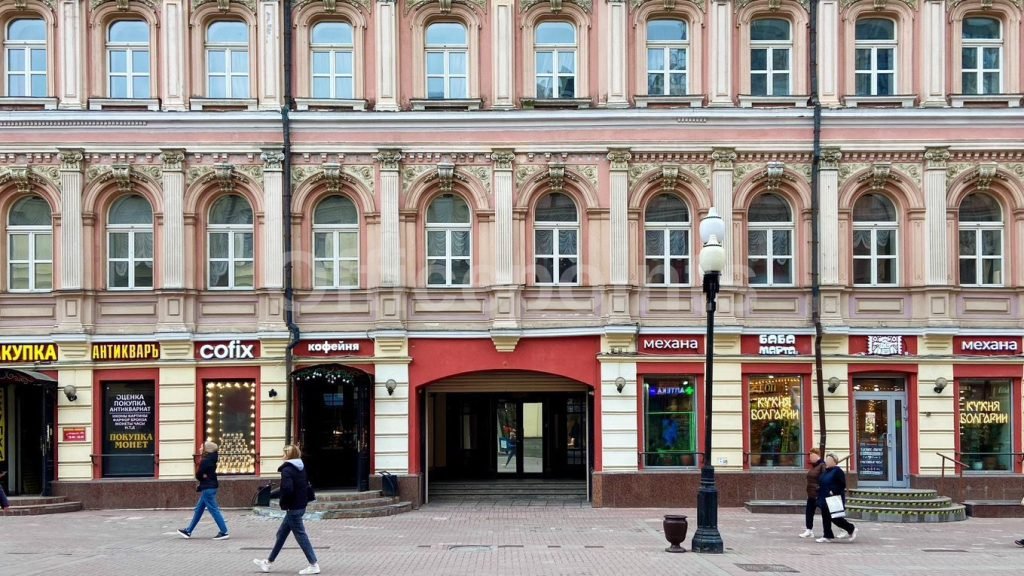
On October 2, aggressor-controlled “media outlets” announced that the “arbitration court” of occupied Sevastopol had “seized the building of the former National Cultural Center of Ukraine in Moscow.” According to occupation “registries,” this “ruling” was signed by a local “judge,” Ksenia Ostapova.
The “interim measures” were adopted “following a petition by the “Chersonesos Taurica” museum-reserve as part of a dispute over the return of museum artifacts” specifically, the “Scythian gold” collection. The “lawsuit” was filed against the National Museum of the History of Ukraine, the Allard Pierson Museum in Amsterdam, and the aforementioned National Center.
In the “ruling,” Ostapova states that the “property held by the defendant… which, despite being a Russian legal entity, is under the control of the unfriendly state of Ukraine” is subject to these measures.
As we previously reported, “lawsuits” filed by the occupation authorities against Ukraine as a state and against Ukrainian state property have only one legal consequence: they provide additional arguments for lawsuits against the aggressor state, particularly in third countries, as the principle of “reciprocity” or “mirroring” comes into play.
However, there is another interesting aspect to this story. The aforementioned National Center on Arbat Street was established in 1998 under a Russian-Ukrainian agreement regarding the founding and operating conditions of information and cultural centers. In July 2024, the Kremlin dictator denounced this agreement; a statement posted on his website, in a “memorandum from the state legal directorate”, claimed that since the agreement stipulated the National Center was to be led by the Ukrainian ambassador to Moscow, such leadership allegedly became “effectively impossibly after Kyiv severed diplomatic relations with Russia and all staff from Ukrainian missions departed for Ukraine, causing the Cultural Center of Ukraine to suspend its operations”.
This statement is false because, under the agreement, the National Center could also be led by the Ukrainian Ministry of Culture, a significant detail, given that a so-called “Cultural Center on Arbat” has been operating on the National Center’s premises for quite some time and continues to do so to this day.
This entity hosts both purely commercial concerts, including those for children, and events serving Russian propaganda, such as the “One Faith, One People” “patriotic forum,” concerts by Russian military personnel, and “memorial evenings” dedicated to Oles Buzina and Kirill Stremousov, among others.
The Russian “press” explicitly states regarding the National Center that, while the entity currently operates under the new name “Cultural Center on Arbat,” the “aggressor’s” registries contain no record of a “Cultural Center” or its management; instead, they list the National Center itself, with Oleg Ovsienko serving as Director General continuously since 2021.
At the same time, in the occupiers’ registries, the National Center, listed as a Russian legal entity, reported revenue of 33.8 million rubles for 2025 and 24.1 million the previous year; meanwhile, occupation propaganda claims that the National Center has been “earning from rent” throughout the years of Russian aggression.
It is worth noting that the National Center’s building is valued at approximately 200 million rubles, even in book value terms, whereas the aforementioned “Sevastopol lawsuit” claimed a mere 16.4 million. Earlier, starting in 2022, Russian entities had filed other lawsuits against the National Center regarding rent and taxes, though these involved sums in the range of one million rubles per case.
Thus, beyond the obvious propaganda function of the current Sevastopol “lawsuit” in general, and the Moscow-based “seizure” in particular, a truly unresolved question arises: who actually controls the Arbat building in question, who manages its revenues to this day, and what is the position of the Ukrainian authorities on this matter.