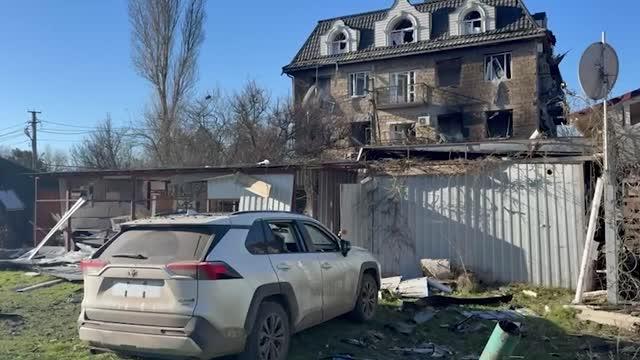
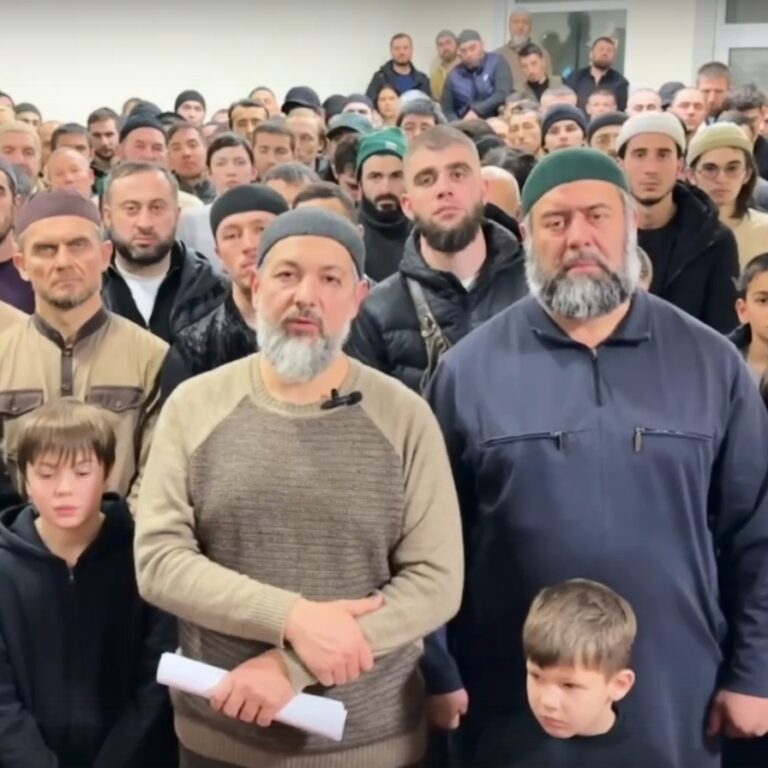
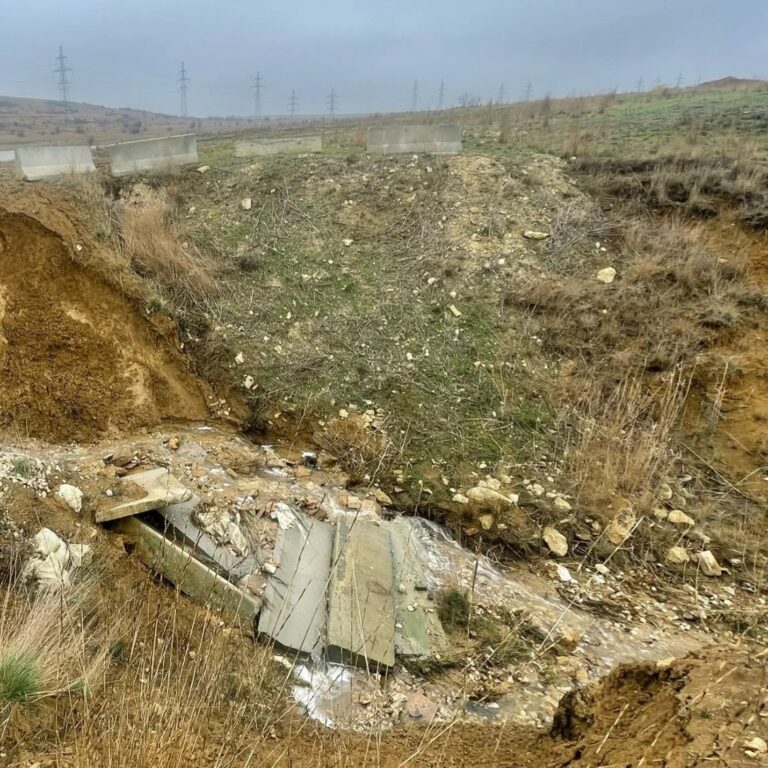
For the first two days of the new year, the aggressor’s propaganda has been promoting narratives about an alleged “drone strike” carried out “at the stroke of midnight” on the “Leo” restaurant and hotel in the occupied village of Khorly, located near Crimea.
It is claimed that “27 people were killed and 50 injured,” allegedly “local residents.”
The Ukrainian Defense Forces, after these statements, did not confirm the strikes on Khorly and once again emphasized the unwavering adherence of the Ukrainian military to the norms of international humanitarian law when choosing targets for attacks.
The main and immediately striking contradiction in this story from Russian propaganda is that it is difficult to imagine “mass celebrations” of the local population precisely in the seaside village of Khorly, which has long been turned by the occupiers into a concentration point for a military group, where a strict pass regime has been established.
Also, long before the current statements of the occupiers, even some of their own propagandists complained that in Khorly, the local population’s premises were being massively seized, both for the deployment of troops and “for the needs” of individual collaborators and colonizers.
The occupiers provided no confirmation of a strike specifically by Ukrainian drones;
it is claimed that the people mainly died allegedly “from a fire,” and experts found individual remnants of military ammunition in the published photos and videos.
By the evening of January 2, the occupiers published a list of 11 people allegedly killed in Khorly, although several of them had not appeared anywhere on social media. Anastasia Sabitova, named by the aggressor, was reportedly the “chief specialist of the municipal property department of the administration” in Kalanchak, while Irina Dyagileva, a “methodologist,” briefly appeared in 2020 as a “technical candidate for deputy” in Armyansk.
Oksana Buganova, also listed as killed and likely the owner of a restaurant, had previously been noted in the occupiers’ “registers” as an “individual entrepreneur” in the occupied Kherson village of Aleksandrovka, while the three men listed as killed are quite distinctive.
Mahmud Admisayev, mentioned by the occupiers, was born and lived in Grozny, Chechnya, since 2003 he had been on the federal wanted list for drug-related crimes, but, as expert publications indicate, in 2023 he “reappeared” in the occupiers’ “databases” with repeated movements from Crimea to the Kherson region in a Peugeot 307 car
with “Russian Crimean license plates,” and he was accompanied by Irina Bot, a native of Simferopol.
Irina Bot became a “school director” in the village of Gavrilovka in the Skadovsk district, served the interests of the aggressor, and was included in the “Myrotvorets” database.
Thus, it is obvious that Admisayev had no problems with the Russian punitive forces at least since 2023, and the only explanation for this is his participation in the armed formations of Russia.
Sergey Bogan, mentioned by the occupiers, is from Yalta, where, before the occupation, he worked for a long time in the police and headed one of the criminal investigation departments.
Since 2014, Bogan began working for the occupiers as a “policeman,” after the start of the full-scale invasion he was “transferred” by the occupiers to the “police” in Henichesk, and no later than the autumn of 2024, Bogan “headed” the “police department” in Kalanchak, where in March 2025 he “reported on the work of the police” to the occupying “authorities”.
The resident of Kalanchak mentioned by the occupiers, Mykhailo Voloshko, was a businessman in the field of computer repair and sales until 2022, but under occupation he went to serve the aggressor in the criminal role of “head of the information technology department of the administration” in the same settlement.
Thus, it is obvious that at least a number of the persons declared dead represented the Russian military and the local occupation “administration” of the Kherson region.
It is possible that this provocation was organized by the aggressor according to the classic principle of the Russian special services, like a number of previously planned and carried out “mass terrorist attacks” in Russia itself, followed by the publication of fake “evidence”.