Recently, Sevastopol gauleiter Mikhail Razvozhaev announced another “reshuffle” in the fake “city government.”
The infamous Muscovite Maria Litovko, previously responsible for “national projects, tourism, international and interregional cooperation,” was sent to Moscow to “act as deputy governor” for a “permanent position.”
As a reminder, Litovko worked for ten years in the Moscow police and then headed the Moscow “Yacht Travel Club.” She arrived in occupied Sevastopol two years before Razvozhaev, apparently through the Russian secret services.
Back in September 2024, “city channels” began spreading inside information regarding her “transfer to the presidential administration,” which Litovko vigorously denied at the time, but, as has now become clear, she ultimately moved to Moscow.
Razvozhaev also announced the “promotion” of Denis Profatilov, previously the fake “director of the department of economic development,” to “acting deputy governor”; this figure was “transferred” to Sevastopol from Kamchatka in 2019.
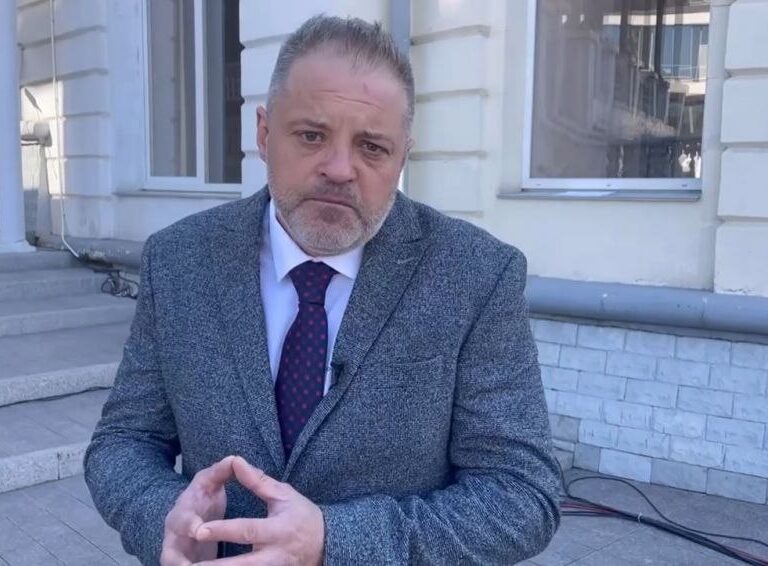
But most telling is the current “appointment” to the same role, but this time “in the medical field,” of Mikhail Sylka, former deputy Minister of Ecology of the Moscow Region, head of the Volokolamsk administration, and then deputy Governor of the Vologda Region.
This figure is notable not for his lack of experience in the medical field he has now been appointed to “lead,” but for a number of characteristic scandals: he was “fired” from the Moscow regional government as a “scapegoat” after a large-scale landfill gas spill in March 2018, which led to mass poisoning of residents.
Meanwhile, in the Vologda government, Sylko oversaw both “environment management and the forestry industry” and “interaction with the Russian Orthodox Church,” and that’s when he was “fired,” allegedly for “low effectiveness in the restoration, reconstruction, and major renovation of churches,” as well as for “a lack of real work in the abortion prevention and anti-alcohol campaign.”
In fact, Sylko was fired from Vologda not for “abortions and alcoholism,” although such a prequel to the “fight for Sevastopol medicine” would have been extremely tragicomic.
The fact is that he developed a deep “epistemological conflict” with the head of the Vologda Metropolitanate, Savva (Mikheyev), precisely over the issue of the “correct proportions” of budgetary allocations for church repairs.
Savva is a functionary quite close to Patriarch Kirill and had long been successfully operating within the “corridors of the Holy Synod.”
It is therefore unsurprising that this “villain” surfaced in occupied Sevastopol precisely under the protection of Patriarch Kirill’s “most bitter friend,” the “Crimean Metropolitan” Tikhon (Shevkunov), who had been staking him out for the past six months, following the “Vologda failure,” as “director of organizational and control work” in the long-suffering “New Chersonesus.”
What this figure will become “famous” for, given the chronic collapse of Sevastopol’s healthcare system, remains to be seen.