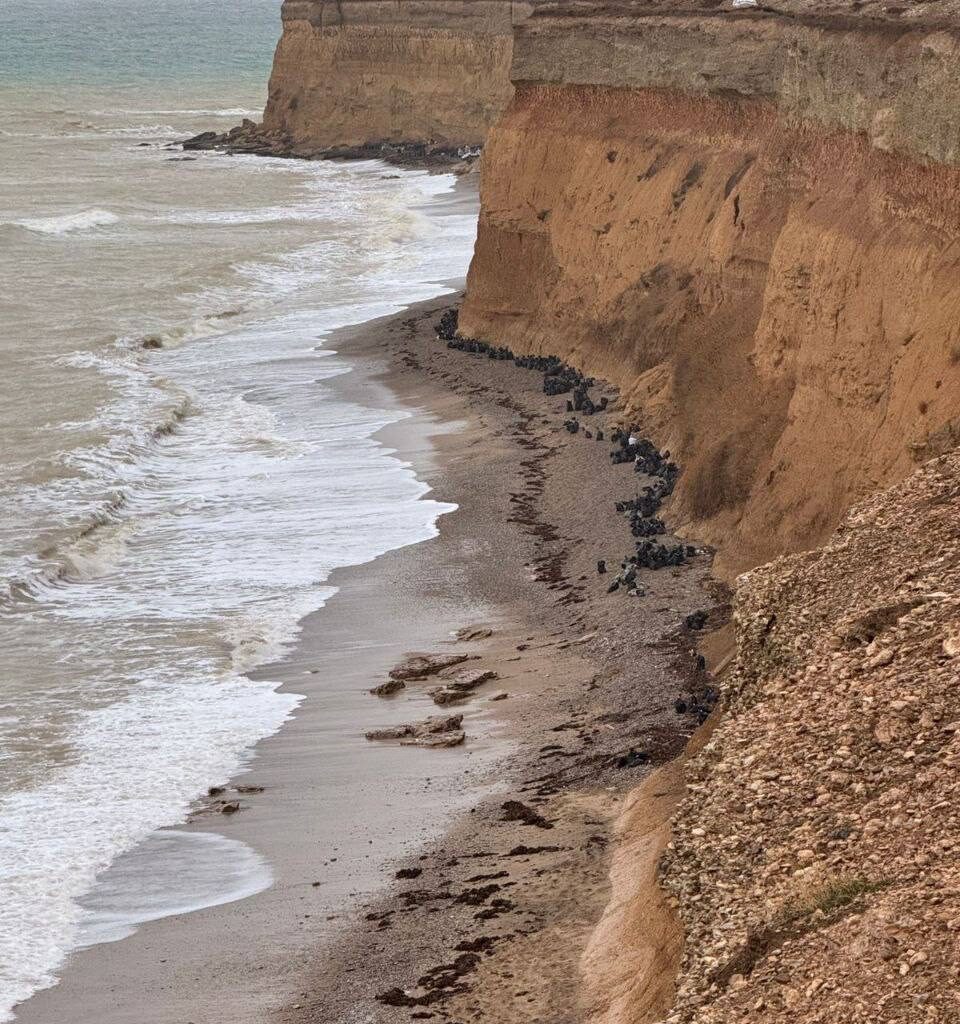
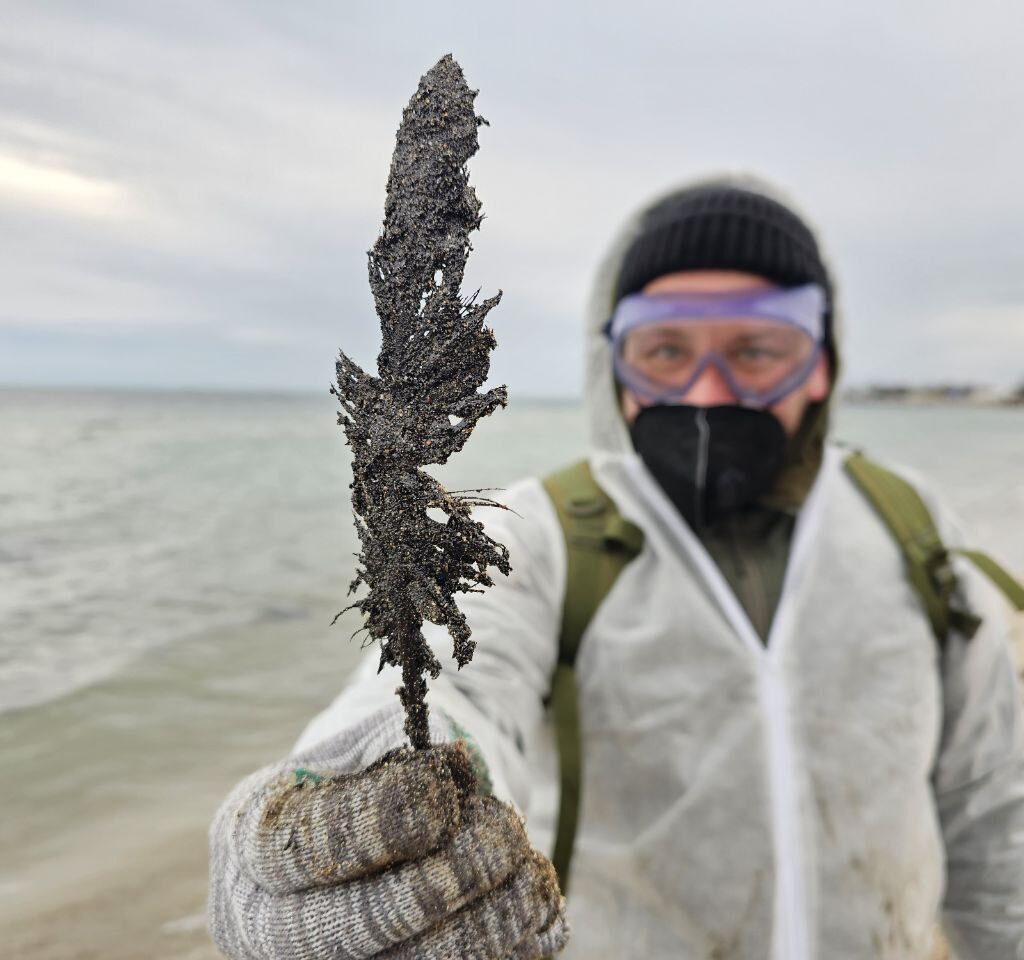
As of January 12, the ecological disaster that began after the sinking of two Russian tankers with fuel oil near the Kerch Strait, continued to gain momentum along the entire Crimean coast.
In addition to the previously described locations, fuel oil emissions were found in Uglove (Adzhi-Bulat), as well as in Donuzlav Bay and in a number of areas of Tarkhankut: in Okunivka (Tarpanchi), Znamenske (Cheger-Adzhi) and Gromove (Kipchak).
On the evening of January 11, the occupiers acknowledged “13 new pollution hotspots” from Kerch to Chernomorske (Ak-Mechet), but, for example, the pollution of Donuzlav, despite the videos posted on social networks, is being denied by the occupiers’ fake “minister of ecology” Olga Shevtsova and her henchmen, and regarding the Opuk reserve, they are downplaying it in every possible way.
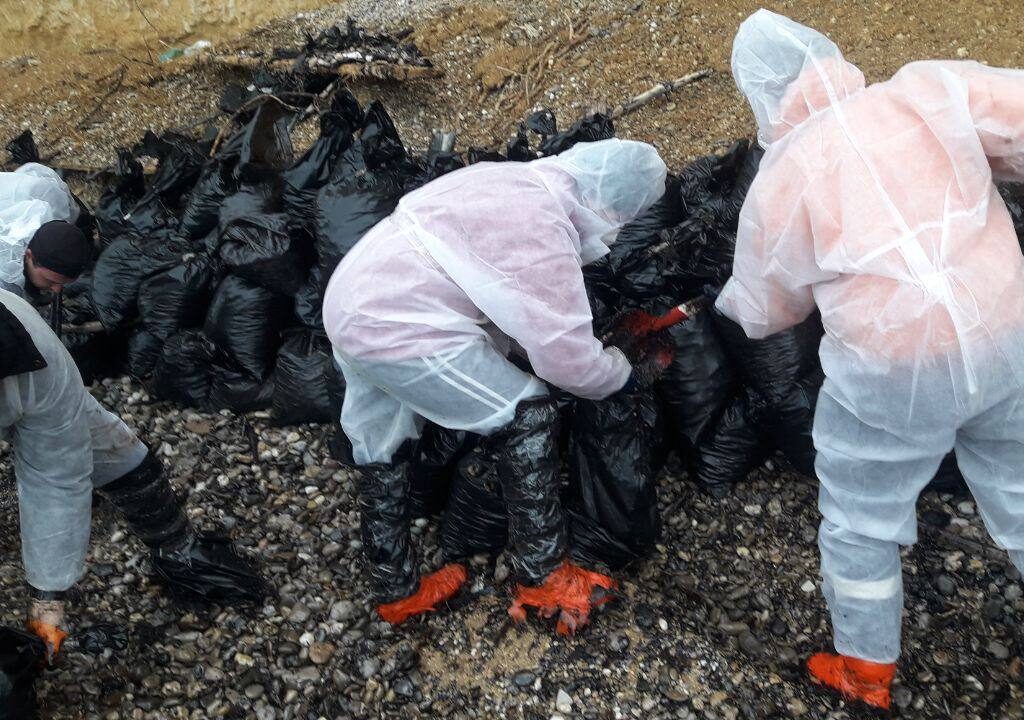
On Saturday, the “emergency situation regime” was also introduced by the occupiers in the “Chernomorskyi district”, and in the same time there are not many “volunteers” “willing to get dirty in the stinking liquid” on the western coast of the peninsula.
Also, on January 12, “Krym.Realii” reported that in western Crimea, in many areas occupied by the aggressor’s military, “not only local residents, but even employees” of the occupation services are not allowed onto these beaches, and “the military themselves, naturally, do not clean the beaches”.
In addition to Crimea, birds contaminated with fuel oil were found along the entire coast of Georgia, including occupied Abkhazia, and fuel oil also appeared in the Sea of Azov, on the shore near occupied Berdyansk.
As for occupied Sevastopol, booms were noticed in Omega Bay, however, no one fenced off the other bays.
The opinions of the city residents were divided on this matter, some point out the belatedness of such a decision, while others write that “on the contrary, the fuel oil will concentrate on the booms and end up in even larger pieces in the bays.”
Regarding the PR campaign from the Sevastopol gauleiter, the population states that the occupiers “cannot be told directly that the services themselves will not quickly and efficiently remove this and will not even identify it.”
At the same time, “associate professor” of the infamous “Sevastopol State University” Vyacheslav Ley, stating the impossibility of collecting fuel oil, “considering the 166 km of Sevastopol’s sea coast, as well as its heterogeneity and inaccessibility in many places”, and also the fact that the sorbents available to the occupiers cannot remove the pollution from the rocks, proposed… “burning out the fuel oil on site, because there are no other alternatives now.”
Meanwhile, aggressor-controlled ecologist Andrei Peshkov the admitted that the consequences of the ecological catastrophe in the Black Sea will have to be eliminated “for many years”, and his colleague Georgy Kavanosyan admits that in the model of pollution distribution used by the aggressor “there is a significant error – everything west of the Khersones lighthouse (Sevastopol, Yevpatoriya, Donuzlav, etc.) is not subject to the calculated pollution”, despite the fact that fuel oil is undoubtedly there.
And even the “freelance adviser” to gauleiter Aksyonov on environmental issues, Elena Evstafieva, “has not yet observed a systematic approach” in responding to the situation. We will add that the Ukrainian ecologist Pavlo Goldin pointed out that the consequences of the current catastrophe will be in the Black Sea waters for more than twenty years.
At the same time, in addition to the previously published tragicomic “reassurances” regarding the “safety of Black Sea fish”, the fake “minister of agriculture” Denis Kratyuk stated that the allegedly existing “25 mussel and oyster farms” of Crimea “are currently … not damaged by the release of oil products from tankers.”
But the mentioned plantations are located precisely “in Yalta, Sudak, Yevpatoria, in the Saki and Chernomorsky districts, as well as in the waters of Lake Donuzlav”, that is, in the epicenter of the current pollution.
And although the occupiers claim that mussels are a “natural purifier of sea water”, to put it mildly, it is impossible to eat them after this, which was also stated by the occupiers-controlled “laboratory employee of the Institute of Biology of the Southern Seas” Oleg Mironov.
Well, in the meantime, the aggressor has clearly found the scapegoat, the captain of the sunken tanker “Volgoneft-212” Leonid Volegov and the operator of this vessel “Kama Shipping”, having announced the revealed “failure to conduct training for the tanker crew on labor protection” and “tax evasion”.
How these violations led to the release of ancient river tankers into the sea by the port authorities and by the aggressor’s classification society, and how they influenced the fact, that the tankers were prohibited from returning from the stormy sea to the port for ten days, despite the captains’ requests, is naturally silent.