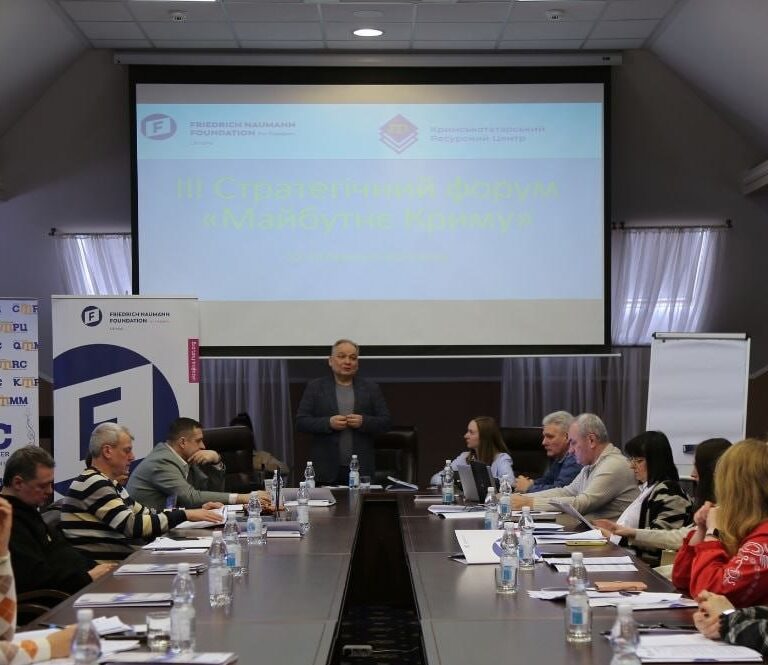
On September 9, our Association’s expert Borys Babin took part in the discussion “Legal Possibilities of Using Russian Central Bank Assets to Enforce European Court of Human Rights Judgments,” held by the Office of the International Renaissance Foundation in Kyiv.
Let us remind, that on July 9, the Grand Chamber of the European Court of Human Rights (ECtHR) unanimously approved a judgment against the aggressor on interstate complaints by Ukraine and the Netherlands 8019/16, 43800/14, 28525/20, and 11055/22.
This decision describes the events of Russian aggression against Ukraine in the East since 2014 and the events of full-scale aggression, in the period until September 16, 2022, when the jurisdiction of the ECtHR over Russia, which was excluded from the Council of Europe, was terminated.
New judgment became unprecedented not only in terms of the volume of materials, but also in terms of the level and breadth of human rights violations established by the Court; it will undoubtedly become a key document in the future in assessing the consequences of aggression and forms of compensation for its victims.
Earlier, on June 2024, the ECtHR published its decision on applications 20958/14 and 38334/18 of Ukraine against Russia regarding Crimea, and it has already been called “undoubtedly victorious and historic.”
Among other things, the ECtHR found, based on applications filed in 2014-2015, that Russia violated the right to life in the Crimea as part of the “administrative practice” of forced disappearances and the lack of an effective investigation into them.
Professor Babin exchanged with the meeting participants his own experience of participation in ECtHR cases, connected with Russian aggression and occupation. The expert also prognosed the prospects of using Russian assets to enforce ECtHR judgments against the aggressor in democratic states that are not members of the Council of Europe.