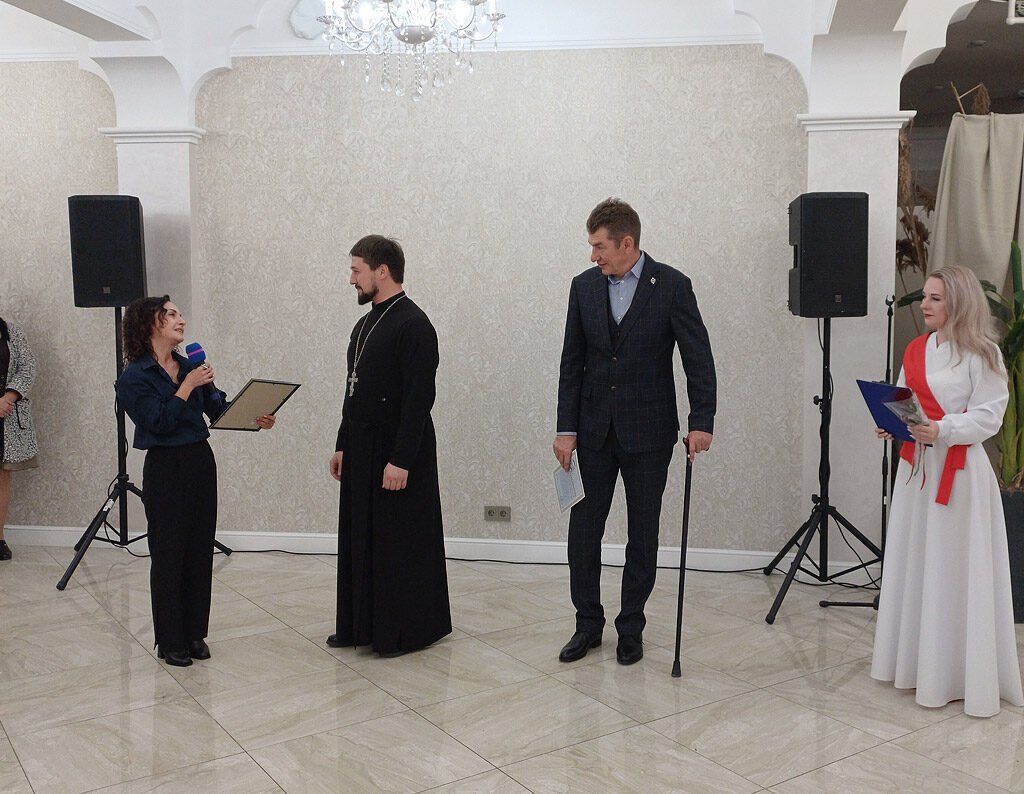
Recently, in occupied Yevpatoria, Crimean collaborators staged a “celebration of Ohi Day” under the direction of Russian special services This event served as yet another provocation aimed at an “external audience,” this time specifically targeting Greece.
In the absence of any genuine participants from Europe, the leading role in this spectacle was played by Natalia Budurova, “deputy” to Ivan Shonus, designated by Russian special services as the “head of the Greeks in Crimea.” Budurova spoke to local “officials” and “veterans” of the Russian aggression about “a small country like Greece.”
Budurova, a “state prize laureate,” and Shonus are presented by the occupation authorities not only as the “leadership of the regional national-cultural autonomy of the Greeks of Crimea ‘Tavrida'” but also as the publishers of a propaganda bulletin titled “Tavrika.”
The local executioners of these “Greek initiatives” are functionaries from two Yevpatoria-based “local national-cultural autonomies”: “Kerkinitida” and “Eleftheria.”
Notably, the latter name does not appear in the occupation authorities’ official “registries,” and, by an “interesting coincidence”, the identities of the current “founders” of both organizations remain hidden.
Previously, the “founders” of “Kerkinitida” included Elena Beloborodova, Lyudmila Sytnikova, and Alexander Yaylenko, the latter currently serving as the organization’s “spokesperson” and having previously been associated with the Moscow-based private security firm “SPN-Okhrana.”
The occupiers have also designated a local collaborator, Anastasia Georgiadi, who holds the title of “head of the sector for public engagement within the city administration’s department for media and public relations”, as a “co-chair” of “Kerkinitida.”
Beloborodova was also a “co-founder” of another “local autonomy” group, alongside its former “head,” Tatyana Muravyova, as well as Pavel Golik and Olga Gayvoronska; meanwhile, a local businessman named Valery Glushchak “heads” the organization “Eleftheria.”
The occupiers had previously pinned certain hopes on the artist Golik, who traveled throughout the Mediterranean region prior to the occupation, regarding their “Greek agenda,” though no public-facing results have emerged.
As for the tour operator Gayvoronska, she is notable for consistently organizing “group trips” for residents of Yevpatoria, not only to “friendly” third-party states but also to Chechnya.
Among the “activists” within “Eleftheria,” special mention should be made of Andrey Permyakov, the current “artistic director of the Crimean theater for young audiences”, who is tasked by the occupation authorities with organizing events in support of Russian aggression. These include “exhibitions of works by war correspondents” and militaristic “children’s drawing contests.”
Furthermore, one of the “sponsors” behind these provocations is a Simferopol resident Odysseus Balabanov, who controls the entities “Tavris Investment Group,” “Hellenic Business Association,” and the transport company “Tavrida.”
A co-founder of “Tavrida” was the collaborator Odysseus Pipia, whom we have previously profiled, who was recently “rebranded” by his handlers in Russian intelligence from a “respected Crimean Greek” into the “leading Crimean Georgian.” Other co-founders included residents of the Kuban region, Konstantin Fomaidi and Vladimir Pakhaturidi.
In “Tavris Investment Group,” Balabanov’s associate is Simferopol native Ilya Metikidis, who has also appeared as a co-founder of the “socio-patriotic organization” known as the “Greek-Russian Alliance” in Thessaloniki.
Interestingly, Valentin Vavrinovich, who, in all likelihood, continues to conduct business in Ukrainian-controlled territory, is linked to “Kentavr,” a subsidiary of this Balabanov-controlled entity.
As for the “Hellenic Business Association,” one of its co-founders was an individual named Alexios Rustis, a person who, in all probability, does not hold “Russian citizenship” and has never appeared in the public sphere.
It is therefore unsurprising that the identities of the “founders” behind the current entities “Kerkinitida” and “Eleftheria” have been concealed by the occupying authorities; it is highly probable that this was done for a very specific reason.