Recently, the occupation “press” touted “successes in the grape harvest,” claiming that the “total harvest area” across agricultural enterprises in the seized AR of Crimea amounts to 16,000 hectares of vineyards; meanwhile, the relevant “ministry” promised to “plant vineyards” on another 900 hectares this year.
The figures cited by the occupiers regarding these areas vary constantly; for instance, late last year, a fake “official” from Rosselkhoznadzor, collaborator Arsen Arziev, announced the start of the “first large-scale inventory of grape plantings,” claiming that “around 28-29,000 hectares” in the occupied AR of Crimea were “occupied by vineyards.”
However, last summer, the occupiers admitted that this “inventory” revealed a shortfall of about a million vines, vines that had existed solely in the invaders’ paperwork, though in terms of land area, this quantity amounts to no more than 500 hectares.
By 2024, even the aggressor-controlled “experts” were stating that there were only about “18,000 hectares” of vineyards on the peninsula. This contradicted the declarations of Alime Zaredinova, a “deputy minister” and collaborator who was later “fired”, who had claimed the figure was “20,800 hectares,” clearly in an attempt to “stretch” the numbers to match the levels seen around 2013.
Thus, the area dedicated to vineyards on the occupied peninsula is shrinking slowly but steadily. We previously reported that maintaining stable planting levels is unrealistic under current conditions due to a shortage of Crimean seedlings and the poor quality of Russian ones, compounded by the fact that the aggressor does not subsidize imported planting stock, despite periodic attempts to bring it in by circumventing sanctions.
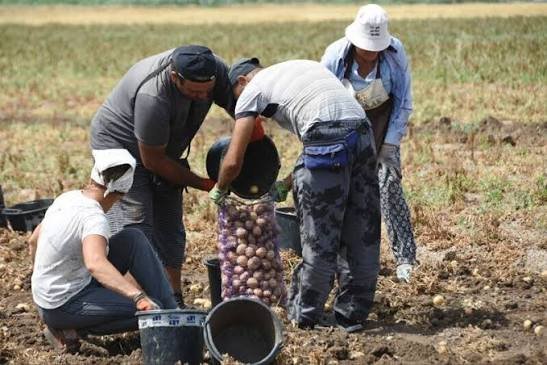
However, a more tangible issue for Crimean residents in the near future will be the reduction of land dedicated to vegetable farming.
As Yuri Komov, the head of the Crimean “farmers’ union,” was recently compelled to admit, although total vegetable planting volumes on the occupied peninsula in 2026 matched the previous year’s figures, “production costs have skyrocketed, meaning some produce will go unsold and spoil. Furthermore, the acreage allocated for vegetables will drop drastically in 2027”, with the inevitable impact on prices.
Meanwhile, the livestock sector, as we previously described regarding sheep farming, is showing sustained “negative growth.” A key factor here is the mounting pressure exerted by the occupation “authorities” on small-scale producers; this stems not only from the “price scissors” effect but also from excessive bureaucracy, which intensified significantly following sweeping “censuses” of livestock and poultry.
For instance, Crimean cheesemaker Eduard Nazarov noted that the “massive volume of paperwork required by Rosselkhoznadzor, including the ‘Mercury’ system”, which necessitates “daily and weekly filing,” is “geared more toward large-scale plants than small operations,” causing “many to leave the business.”
Thus, in addition to the manifold increase in the price of chicken and eggs that has already occurred, a similar situation is unfolding with milk, butter, and cheese.