New publications of European media describe the processes of sanctions circumvention in framework of fuel supply to Russia with the relevant Crimean trace. “Reuters” reported that at the end of July traders unloaded approximately 30,000 metric tons of petroleum products from South Korea into Russia. According to vessel-tracking systems ‘Kpler” and “Vortexa”, two voyages were carried out by the Russian-flagged tanker “Aram Khachaturian”, IMO number 9163752, carrying aviation and diesel fuel loaded from storage tanks at the container port of Ulsan and delivered to Nakhodka and Vladivostok.
The Korean owner of the petroleum products has not been identified. It is considered highly likely that the shipment was handled using the terminal operated by “Jeongil Stolthaven Ulsan Co., Ltd”.
Against the backdrop of Russia’s current energy crisis, this shipment became the first such delivery from countries in the region since February 2022, when a cargo of aviation fuel was delivered to Russia from the South Korean port of Yeosu. In July this year, Russia also attempted to purchase another 200,000 tons of fuel of Japanese origin, again through Korean traders. Those deliveries, however, did not take place, and Japanese authorities stated that relevant restrictions were in force.
At the same time, it is noteworthy that in early August the same “Aram Khachaturian” made a voyage from Vladivostok to Tokyo for an unknown purpose. South Korean authorities did not comment on the July fuel shipment.
The Chinese-built tanker, formerly known as “Maria Desgagnes”, belongs to “Kamchatskaya Neftebaza” LLC of Petropavlovsk-Kamchatsky, a company generating annual profits amounting to hundreds of millions of rubles and controlled by local businessman Karen Arushanyan.
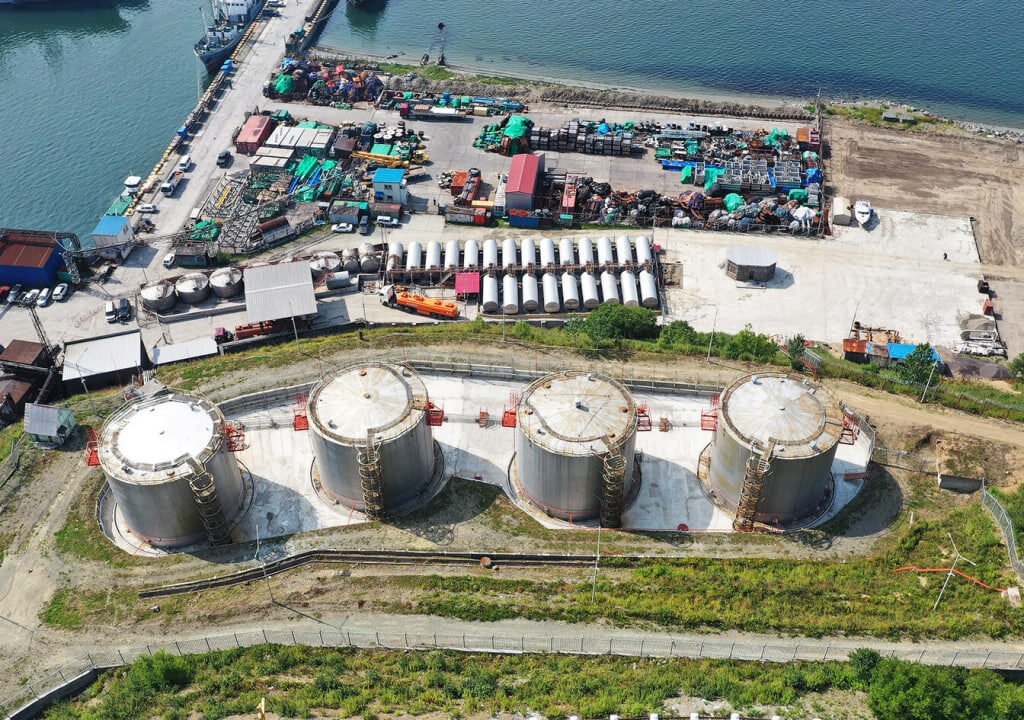
Arushanyan’s business orbit also includes the Kamchatka companies “Brams-Oil”, “Brams-Bunker” and “TB-Prichal”, which are involved in vessel bunkering and fuel trading. “TB-Prichal” is also co-owned by Vasiliy Chernovsky and, through the company “Kolymaneftprodukt”, by Fedosya Sukhankina.
Chernovsky also controls the Kamchatka companies “Morskoy Standart” and “Morskoy Trust”, which are associated with fuel trading and shipping. Magadan resident Fedosya Sukhankina, who is listed among the thirty wealthiest women in Russia, is the widow of Mikhail Sukhankin, a former regional fuel magnate.
The Sukhankin clan controls a range of businesses in the Magadan Region, from oil depots to hotels and pharmacies. Fedosya Sukhankina serves as a deputy in the Magadan City Duma, while her son Vitaliy is a deputy in the regional Duma. Both represent the ‘United Russia’ party.
Their Kamchatka business partner Arushanyan presents himself as an “active member of the Armenian diaspora of Kamchatka,” while part of his business assets are registered in the name of his wife, Sona Arushanyan.
The fleet controlled by “Kamchatskaya Neftebaza” consists of three tankers. In addition to the aforementioned “Aram Khachaturian”, these include the Russian-flagged “Arno Babajanyan”, IMO number 9163764, a Chinese-built tanker with a deadweight of 14,000 tons formerly known as “Lama”, and the smaller Russian-flagged tanker “Brams”, IMO number 8910794, built in Japan and formerly named “San Oh Maru”.
The renaming of the tanker in honor of Armenian composer Arno Babajanyan in 2020 was turned by the Russian side into a propaganda event in Vladivostok. It was attended by Armenia’s then-ambassador to Russia, Vardan Toghanyan, local officials and “representatives of the diaspora.”
It should immediately be added that South Korea does not have an Armenian diaspora or corresponding Armenian lobbying network comparable to those found elsewhere. Therefore, the current fuel transactions involving “Kamchatskaya Neftebaza” were most likely organized through other channels.
It is also noteworthy that in 2025 the “Arno Babajanyan” was placed under sanctions by the European Union, Switzerland, Canada, the United Kingdom and Ukraine for violating restrictions connected with the trade in Russian oil.
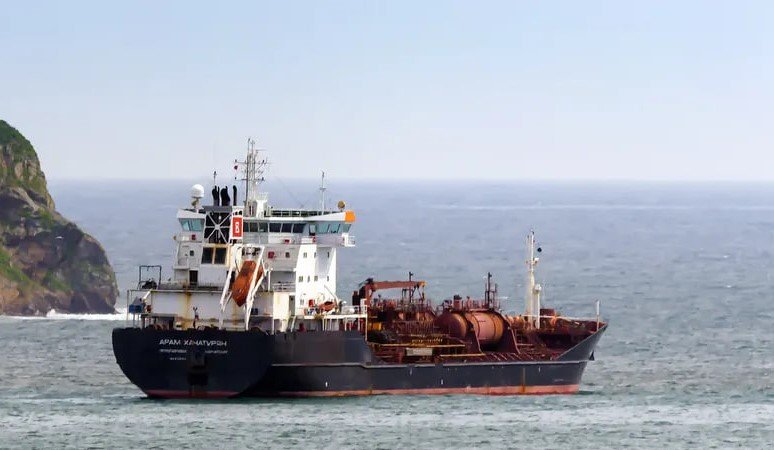
The vessel is used to transport petroleum products from China to Russian ports in the Far East and also participates in Russia’s northern supply operations, delivering fuel to the Chukotka ports of Pevek and Egvekinot.
At the same time, another Kamchatka company, “Morskoy Standart-Bunker”, is listed as the shipowner of the “Arno Babajanyan” and, according to some sources, also of the “Aram Khachaturian”. The company is controlled through the aforementioned structures “Morskoy Standart” and “Morskoy Trust”, as well as “S.V. Kompleks”, by the same Vasiliy Chernovsky.
Despite the actual operation of the “Arno Babajanyan” by structures associated with Arushanyan and Chernovsky, its formally declared owner is the Khabarovsk-based “Universal Leasing Company”, which has formal registration in Moscow, a branch in China and undisclosed beneficiaries.
At the same time, even some Russian sources indicate that “Universal Leasing Company” is controlled through the intermediary structure “Region Kapital” by Khabarovsk regional magnate Vadim Gubkin.
Gubkin controls a broad network of businesses throughout Russia’s Far East, ranging from hotels and restaurants in Khabarovsk and Vladivostok to gold mining, private security, leasing of construction equipment and container terminals on the Chinese border.
It has also been reported that after 2022 Gubkin “actively began trying his hand in Crimea,” while his son Ilya Gubkin lives in Vancouver, Canada, and other relatives reside in Latvia.
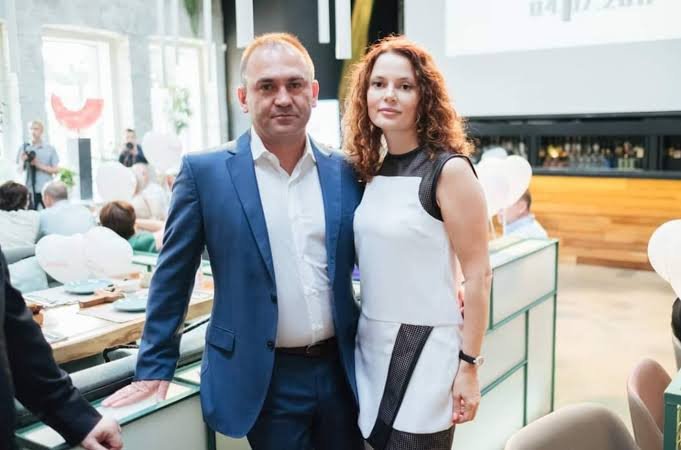
Gubkin’s Crimean connections are concealed relatively carefully, but they can be traced through Russian corporate registries, in particular through the activities of the Moscow-based “specialized developer” “Barkhat” and “NRK” LLC.
Gubkin previously served as general director of “Barkhat”, after which the position was taken over by Andrey Mazunin. At the same time, Gubkin remains a co-owner of the company together with “NRK” LLC, which serves as a financial umbrella for numerous Russian property developers, including companies operating in the Far East.
It is noteworthy that in 2025 “NRK” sued Gubkin and other co-owners in Moscow over ownership stakes in the company’s capital. However, Gubkin won the dispute by using “Vladivostok jurisdiction.” The proceedings bore signs of being used as cover for a redistribution of stakes in “NRK” among its beneficiaries.
In turn, “NRK” is linked to the Russian “PIK Group”, which has been included by the Russian government on its list of “systemically important enterprises,” while activities by the group in Crimea have also been reported.
The involvement of Gubkin’s business empire in sanctioned petroleum-product transportation and in commercial activity on the occupied peninsula therefore warrants further investigation.
It should also be noted that South Korea, despite its government’s declared support for Ukraine amid Russia’s large-scale aggression, has since 2022 imposed sanctions on Russia on a significantly smaller scale than the European Union or the United States.
Experts have previously pointed to active operations in South Korea by Russian businesses controlled by the Kremlin.
Among other things, attention has been drawn to the active presence in the country of the “Russian Maritime Register of Shipping” (“RMRS”), which has been described as an active umbrella structure for subversive activities by Russian intelligence services.
There have also been reports of recent Russian attempts to purchase groups of LNG carriers in South Korea for use in Arctic projects associated with “Novatek”.
For example, in June representatives of the “RMRS” office located in Busan, South Korea, participated in events organized by Seoul’s Ministry of Oceans and Fisheries concerning “cruise ship safety.”
During those activities, they attempted to establish “special contacts” with the Korea Coast Guard, including in relation to the “exchange of information, drawings and the conduct of joint exercises.”
Among other things, “RMRS” has cited its supervisory role over one of the largest cruise liners, “Eastern Venus”, IMO number 9160011, sailing under the Panamanian flag. The ship is owned by the South Korean company “Duwon Shipping Co Ltd” and operated by the Busan-based company “Sungan Shipping Co Ltd”.
The current approach of the authorities in Seoul, which declined to comment on fuel supplies intended for Russia’s Far East, where a significant share of those resources may be used to support Russian military forces, can hardly be regarded as either far-sighted or friendly toward Ukraine and its strategic partners.
This raises the question of including not only Vadim Gubkin, Karen Arushanyan and enterprises controlled by them on sanctions lists, but also their Korean counterparties.
The need for an appropriate response to attempts to circumvent sanctions is further demonstrated by another negative example. In July, approximately 30,000 tons of AI-92 gasoline were delivered to Murmansk from the Moroccan port of Tangier. According to “Reuters”, the purchase and logistics of that shipment were organized by Russia’s “Lukoil”.