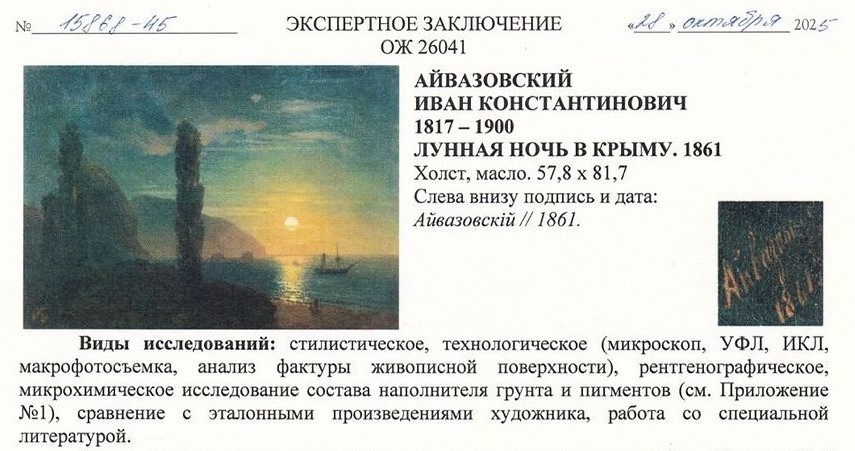
On March 1, Russian “media” reported the sale of Ivan Aivazovsky’s “Moonlit Night in Crimea” by the “Moscow Auction House” for 136 million rubles, with the buyer’s details concealed.
It was stated that the authenticity of the painting, allegedly painted by Aivazovsky in 1861, was established by the “P.M. Tretyakov Independent Art Research and Expertise.” The conclusion was signed by Anna Dergacheva, and it clearly stated that the painting is of “undoubted museum significance.”
The provenance of this painting is unclear, and Crimean “media” published a statement regarding the matter, claiming that “Moonlit Night in Crimea” was “returned to Russia by an Italian collector after confirming its authenticity.” Meanwhile, the so-called “director of the I.K. Aivazovsky Feodosia Art Gallery,” Tatyana Gaiduk, stated that “they couldn’t even participate in the auction,” since the organization’s annual budget was “the same 60 million” as the lot’s initial price, even though “the work is practically priceless to them—especially with such a history.”
However, the story here is rather murky, since Russian propaganda claimed last November that “Milanese collector Paolo Polvani returned free of charge” the painting “Moonlit Night in Crimea” to the aggressor, which had supposedly been “lost” after World War II.
However, that painting, according to last year’s claims, was not by Aivazovsky, but by his student Lev Lagorio, and was painted in 1879. Furthermore, the photographs of the paintings from this aggressor propaganda story and from Anna Dergacheva’s expert analysis differ significantly, and the expert analysis itself was compiled a month before the “return of the painting.”
As a reminder, Ukrainian law enforcement officials previously investigated the theft of Ivan Aivazovsky’s paintings from a Mariupol museum, which occurred back in 2014. At that time, the occupiers allegedly “transferred the paintings to the Simferopol Art Museum.”
Even before the full-scale Russian aggression, we wrote that far from all of these stolen paintings “reached” the “Simferopol museum,” and that some ended up in the “private collections” of Yalta collaborators close to Sergei Aksyonov.
And two years ago, a number of media outlets controlled by the aggressor boasted about the “sale at auction” of Ivan Aivazovsky’s “Moonlit Night” (1878), which was definitely stolen in Mariupol in 2014.
Therefore, it is far from impossible to rule out that the painting now sold in Moscow actually ended up at the “auction house” not get by the aggressor from Italy, but from the occupied territories of Ukraine, and the current stories about its “Italian trace” performed by Crimean collaborators are a typical “covering up of tracks.”