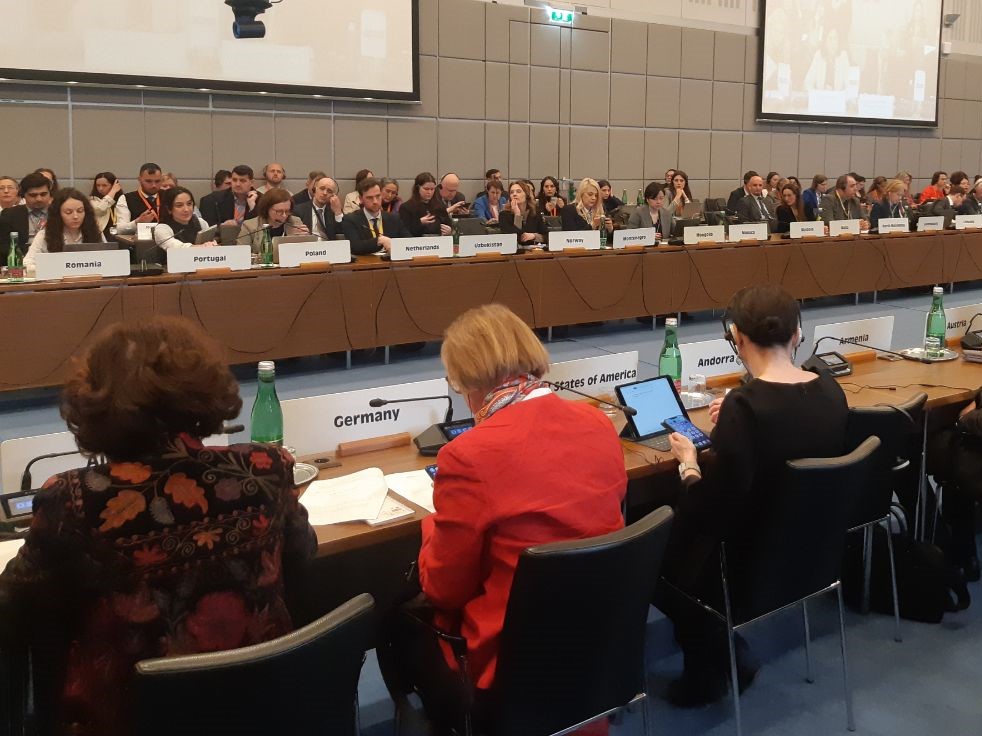
On March 16, expert of our Association Borys Babin reported on the OSCE Supplementary Human Dimension Meeting “Lawmaking for Democratic Resilience” in Vienna about challenges for democratic lawmaking, caused by Russian aggression and its shadow fleet activities.
Professor Babin stressed in his speech on session I of the Meeting, “Safeguarding Democracies: Democratic Lawmaking and the Role of International Actors” that Russian aggression, which started in 2014 with the occupation of Crimea and is the broad-scale conflict in Europe since 2022 not seen by generations, is directly connected with illegal global Russian shadow fleet activities that create relevant challenges to lawmaking processes in the OSCE region.
He pointed out that one example of those challenges was highlighted in current journalists’ investigations about elaborating on the EU Implementing Decision 2024/411 that included in relevant lists of “authorized national shipowners” Russian shadow fleet-connected “BF Tanker” and “Inok TM” companies as allegedly Estonian and Latvian ones.
Such an environmental Eurocommission decision not only allowed the substandard tankers of “BF Tanker” and “Inok TM” to transfer sanctioned oil to European ports but also created strong challenges for maritime safety, security, and the environment, the expert stressed.
Professor Babin also gave the example of the Bulgarian “Lukoil Neftohim Burgas” enterprise, whose nationalization, after relevant U.S. sanctions, was regulated by some national parliamentary and government acts against the background of relevant political crises that established strong challenges for human dimension and national security. Exactly the delay of solving that issue since 2022, granted by some EU sanction-related documents, caused ongoing turbulence in national lawmaking processes, the expert added.
Dr. Babin added that ongoing challenges in areas of maritime security and safety, including environmental issues and seafarers’ rights, are still not solved on levels of national legislation of OSCE participating states.
It became clear after the catastrophic situation connected with Russia’s aggression happened in December 2024, when two Russian tankers, “Volgoneft,” as part of the Russian shadow fleet, sank in a storm near the Kerch Strait, regarding the occupiers’ negligence and Russia’s disinformation campaigns on that issue.
That situation was quite ignored by European states on the level of ongoing development of their national maritime legislation, and any additional restrictions were not implemented.
It may be explained by various reasons, such as by direct Russian lobbyists at national lawmaking levels, by their relevant illicit activities in the IMO and UNECE, by the gross role of Greek and Maltese shipowners in the shadow fleet activities, and also by the involvement of key European maritime companies in relevant crewing and manning services, the expert emphasized.
That’s why the “Russian Maritime Register of Shipping,” banned since 2022 by the IACS and sanctioned by the EU, still continues its shadow activities in OSCE participating states as a common tool of Russian and Chinese intelligence, as many national maritime authorities did not review and amend relevant national legislative acts, the expert added.
Also, as a good example in this sad situation, Dr. Babin pointed to the Register of Damage from Russian Aggression on the Lower Danube created by resolution of the Danube Commission in December 2025.
The resolution, drafted by all democratic participating states, reflected the situation when the Russian attacks on Ukrainian Danube ports led to the destruction of port infrastructure, damage to vessels and cargo, and also created risks for international logistics and the safety of navigation on the Danube.
So the Association’s expert called on all OSCE bodies and participating states to pay special attention to the challenges for democratic and transparent legislation processes from illegal Russian shadow fleet activities and from related corruption and illicit lobbying on national, regional, and global levels.