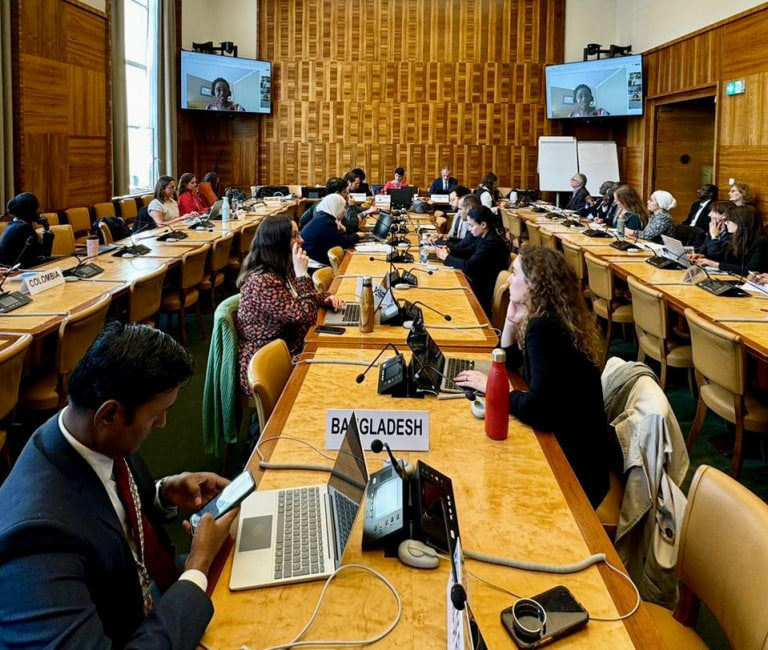
In the framework of permanent cooperation with United Nations’ bodies our Association sent submission this July to Office of the High Commissioner for Human Rights for preparation the high-level discussion on various challenges that local governing faces in promoting and protecting human rights, regarding to the Human Rights Council resolution 57/12.
Our submission, published at official UN sources now, described the issues of human rights violations by the aggressor at the Russia-occupied territories of Ukraine as an example of Russia’s repressions against regional and local mejlises of the Crimean Tatars.
Relevant situations with the Kherson regional and some local mejlises were described in the ARC’s submission on concrete examples, as large-scale Russian aggression against Ukraine resulted in the occupation of the majority of the Kherson region, including the villages and towns, where local mejlises operated.
ARC’ submission stressed that Russia extended its own repressive and discriminatory policy towards the Crimean Tatars to the occupied territories of the Kherson region, as well as it was before in the occupied Crimea.
This repressive policy led to the fact that the leadership and members of local mejlises were forced to cease public activity, and the re-election of such mejlises in the occupied territory, where, as of 2022, the vast majority of Crimean Tatars of the Kherson region lived, became impossible.
At the same time, ARC’s submission stressed that a number of members of local mejlises were displaced constraintly from the occupied territory of the Kherson Region to Ukrainian-controlled territories, remote from the front line, or left for third countries.
Other members of local mejlises, such as Eldar Kostan, Nusrulla Seydaliev, and Bilyal Abdurakhmanov, were repressed by the Russian occupation structures and are in places of detention on politically motivated charges.
ARC’s submission added that the practical inability of the regional and local mejlises to operate since February 2022 in the Kherson region is due exclusively to the illegal and criminal Russian occupation of a significant part of the region and due to the repressions against the Crimean Tatars that continue in the Russia-occupied territory.
ARC’s submission stressed that the reasons that caused the practical inability of local mejlises to operate since February 2022 in the Kherson region were described by those mejlises to the European Court of Human Rights in advance, five years before the occupation, in the applications in the cases 24196/17, 24355/17, 25061/17, and 32319/17, as the broad-scale Russian aggression was the most realistic prospect of further developments in 2017, when the mejlises applied to Court.
Relevant decisions of the Mejlis of Crimean Tatar People about local mejlises were described in our submission. It also stressed that these events were also significantly influenced by the ongoing situation in Ukraine regarding the consolidation of the legal status of representative and executive bodies of self-government of the indigenous Crimean Tatar people, the main participant of which was and is the Mejlis and its members.
ARC’s submission stressed that the next UN thematic reports and research on human rights and local government must express concerns about the conditions of hostilities, interstate conflicts, aggressions, and foreign occupation, also as racial discrimination and repressions against indigenous peoples, and reflect the demands of the UN Declaration on Rights of Indigenous Peoples, the Rome Statute, and the Geneva Conventions. Also, the models of transitional justice must be taken into account, including issues of the right to sustainable development and indigenous rights.