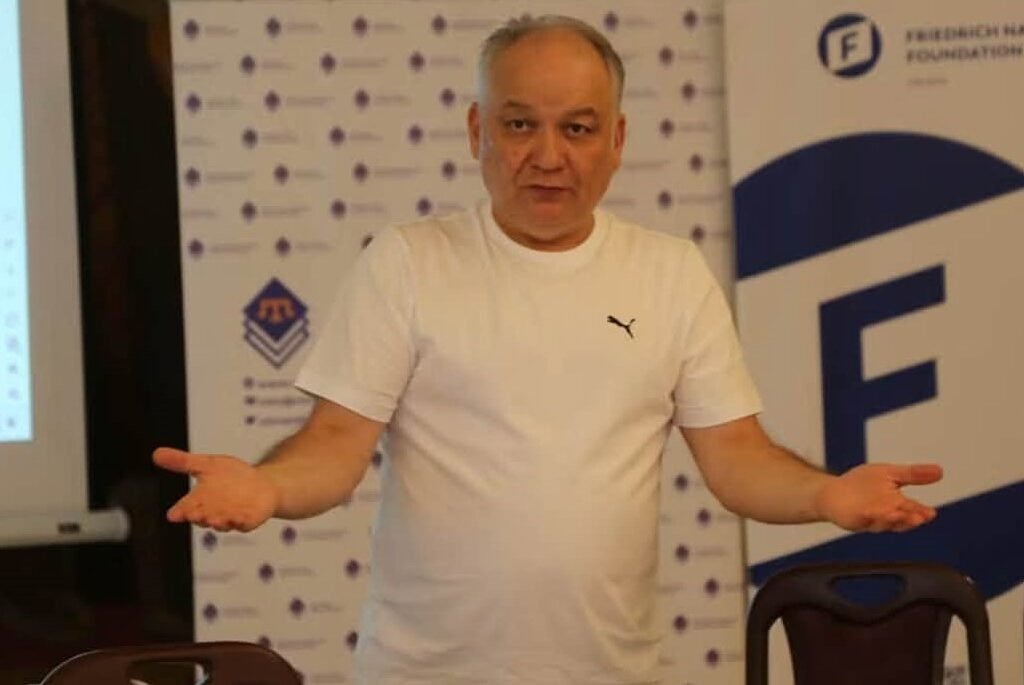
On August 22, the Crimean Tatar Resource Center published the position of its Chairman and member of the Mejlis of the Crimean Tatar People, Eskender Bariiev, on the further development of the representative institutions of this indigenous people of Ukraine.
The position concerned the assessment of a number of statements, in particular those made by individual representatives of the Crimean Tatar diaspora in third countries, regarding the prospects for the re-election of the Mejlis of the Crimean Tatar People and its leadership.
Bariiev emphasized support for democratic procedures, but at the same time emphasized that in the conditions of Russian aggression and occupation of Crimea, the issue of elections to the Mejlis “is much more complicated than it might seem at first glance,” including in the dimension of hypothetical electronic voting for delegates to the new Qurultay, especially in the conditions of active interference by Russian special services and repressions against Mejlis activists as an alleged “extremist organization.”
Bariiev recalled that any changes to the acts of the Qurultay regarding the formation and activities of representative structures of the Crimean Tatars can only be adopted by the Kurultai itself, and it is impossible to convene it today under the conditions of occupation, in addition, he recalled that only citizens of Ukraine can elect delegates to the Qurultay.
On the other hand, hypothetical elections only among Crimean Tatars living in the territory controlled by Ukraine can be formed only by individual local or regional mejlis, for example, Kyiv, Lviv or Odesa. Bariiev expressed the opinion that a hypothetical gathering of members of the Qurultay, elected thirteen years ago, was possible only until 2019, and in the following year it became absolutely unrealistic.
At the same time, Bariiev expressed the opinion that “there are a number of steps that can be implemented right now without violating the regulatory legal acts of the Qurultay”, in particular by reviewing the internal structure of the Mejlis, involving young activists in practical work, completing the creation of the Civil Council and the Youth Council under the Mejlis, and updating the procedures for reporting the leadership and members of the Mejlis to society.
The Mejlis member also emphasized the need to resume the activities of the World Congress of Crimean Tatars, established in 2015, the powers of whose leadership “actually ended in 2020”. He recalled that the congress “is not tied to Ukrainian citizenship, does not depend on the situation in occupied Crimea and allows for the full involvement of Crimean Tatar communities from different countries of the world”.
Bariiev summed up his position by saying that “the representative institutions of the Crimean Tatar people need to be updated. But this must be done in such a way that after that no one – neither in Ukraine, nor in the world… – could question their legitimacy.”