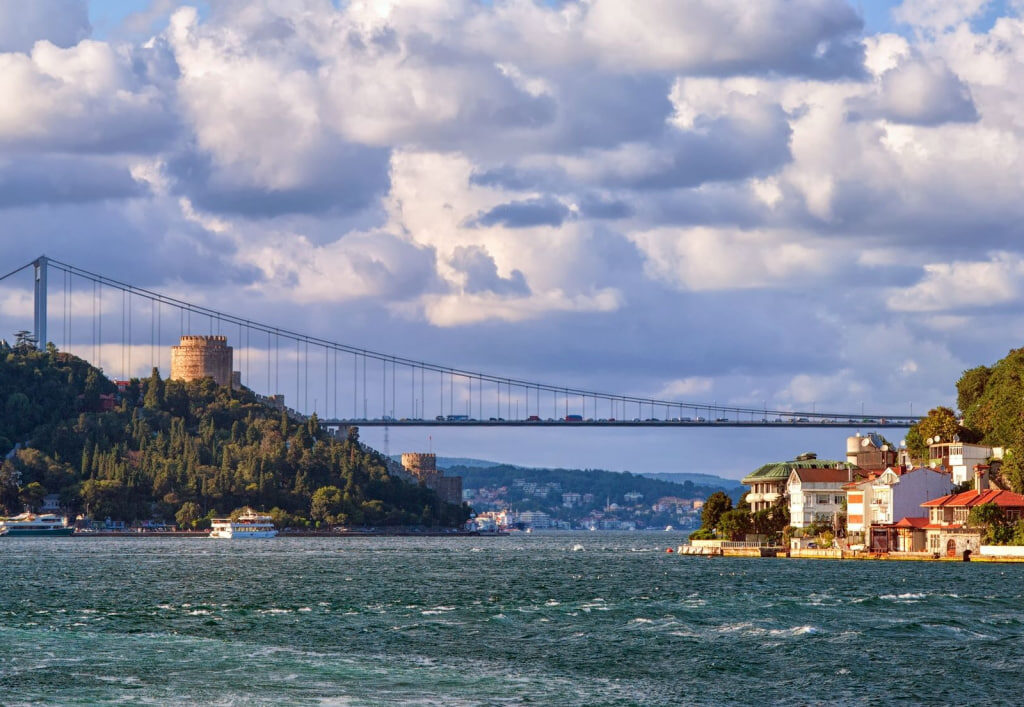
In January, Russian propaganda “suddenly” decided to discuss the Black Sea Straits, citing the December issue of the Moscow magazine “Marine Science and Technology,” published under the auspices of the Marine Board of Russia with funds from the “scientific and technical center” “Neftegazdiagnostika,” registered to Viktor Leshchenko, who has distinguished himself as the talking head of the aggressor’s “interdepartmental expert council on the safety of offshore underwater pipelines and facilities.”
This issue, in addition to heart-wrenching stories about “birch bark icon exhibitions,” featured an “article about the Straits” from two collaborators: the criminal “Chairman of the Sevastopol Legislative Assembly” Vladimir Nemtsev, previously featured in the scams we described involving the long-suffering “Sevastopolgaz,” and Alexander Irkhin, who received all his academic credentials before 2014 in Ukraine and is now listed as a functionnaire of the illegal “Sevastopol state university” and “Crimean federal university.” This opus, in addition to poorly concealed phantom pains about the events of two centuries ago, when “a 30,000-strong Russian corps landed in the Bosphorus region,” presents a “creative vision” of the 1936 Montreux Convention, which regulates passage through the straits, with the claim that its “principles and limitations” allegedly “do not meet the interests of the major powers of Western civilization.”
Let us recall that Turkey, guided by this convention, closed the straits in February 2022, four days after the start of Russia’s large-scale invasion of Ukraine, confirming the military conflict in the Black Sea.
In the first months of the Russian invasion, this closure was quite angrily “denounced” by the propaganda of the aggressor, whose naval group was stationed in the Mediterranean,
with the clear intention of participating in the naval aggression against Ukraine. Subsequently, following the “particular successes” of the aggressor’s Black Sea Fleet, which by 2024 had been driven back to its Caucasian bases, this Mediterranean group was gradually withdrawn by the Russians from the area near the straits, and the collapse of the Assad regime posed the Kremlin the painful question of its logistics in the Mediterranean at all.
And now, in a clear “sour grapes” move, the aforementioned “programmatic article” reflects “revised” Russian wishes for the supposed “parity” of the Russian and Turkish navies in the Black Sea, which supposedly “essentially creates a power condominium (joint control) of the Black Sea region at the expense of the two main regional powers.”
This opus also declares the alleged “open discontent of non-Black Sea global and regional powers, which, in all likelihood, will undertake efforts to denounce or dilute the key articles of this document.”
Of course, one could discuss the convention’s legal force for Ukraine or Georgia, or the fact that neither the United States, nor Italy, nor Spain, nor a number of other Mediterranean and leading global maritime powers have ever acceded to this treaty.
One could also argue that the aggressor has been constantly undermining the very ideas of this convention since 2022, deploying military vessels to the Black Sea via its internal waterways, while attempting to block and disrupt Black Sea and Danube shipping, and that the ninety-year-old convention says nothing, for example, about unmanned vessels or maritime patrol vessels.
But in reality, something else is clear: none of the world’s key maritime powers today intends to challenge or revise Turkey’s position on the application of the 1936 Convention, either in letter or in spirit, in the decisions Ankara adopted in 2022.
Therefore, the aggressor’s current philosophizing that the Kremlin will allegedly “oppose a revision of the convention” is reminiscent of the classic joke about the “elusive cowboy,” where “Russia’s diplomatic successes” will consist of maintaining the status quo, which no one intends to revise.
However, it is possible that these propaganda efforts could become a prelude to new Black Sea provocations by the Russians “for the convention’s anniversary,” including situations involving pipelines and passenger shipping.