In April we wrote that in long-suffering Yevpatoria, which is constantly left without water supply, the local gauleiter Alexander Yuryev decided to take up the “most pressing” issue, namely, regarding “creating a park dedicated to the heroes” of Russian aggression in Ukraine.
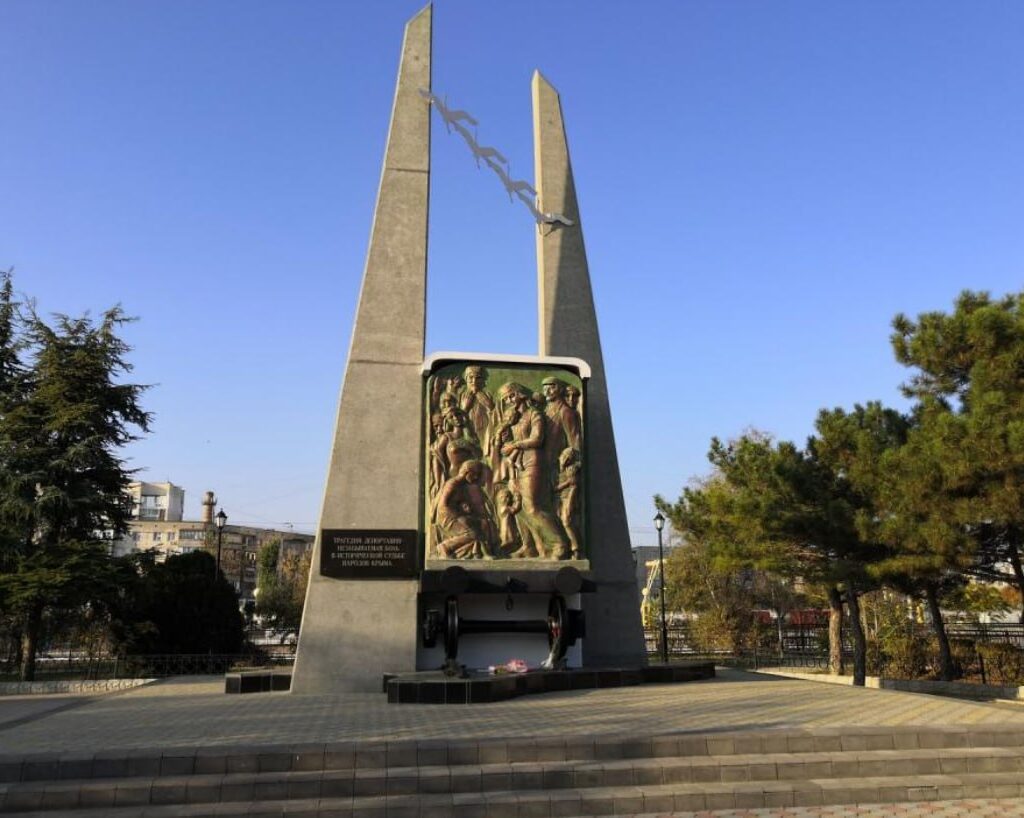
Since a new park with the selection of a site and planting trees turned out to be a “complicated matter” for the occupiers, the collaborators decided to place this propaganda location in a park planted twenty years ago near the railway station, where until 2014 a monument to the victims of the deportation of the Crimean Tatar people was erected, in order to “ideologically ennoble” it now.
And as it turns out now, in addition to installing “new, racially verified monuments” in this park, the collaborators decided not to forget “about themselves, beloved”, since a significant portion of the trees will be “at the same time” torn down to equip a large paid parking lot in a busy place near the station, in favor of characters affiliated with the town “authorities”.
The collaborators’ fight against the remains of the town’s green spaces is apparently “entering the home stretch”, since in parallel, they are planning to destroy the forest belt near Lake Moinaki for the construction of apartment buildings for Russian colonizers.
Let us recall that the park on the other side of the lake has been destroyed by the occupiers for over a year, also for “elite housing”, including under the guise of “building a federal rehabilitation center”.
Against this background, the statements of the collaborator Edip Gafarov from the criminal “state council” sounded especially cynical, who at a “personal reception” demanded that the residents of the Yevpatorian microdistricts Ismail-Bey and Sputnik-2, mainly Crimean Tatars who have settled there since 1990, “immediately re-register” their houses and plots, without which the occupiers will no longer “assist in installing” water, gas, sewerage, electricity and roads to their homes.
The fact that the occupiers will not disdain to turn off electricity and water is not news to anyone, but no one expects them to repair the streets of these microdistricts, which have been brought to ruin over the past decade, “in any weather”.