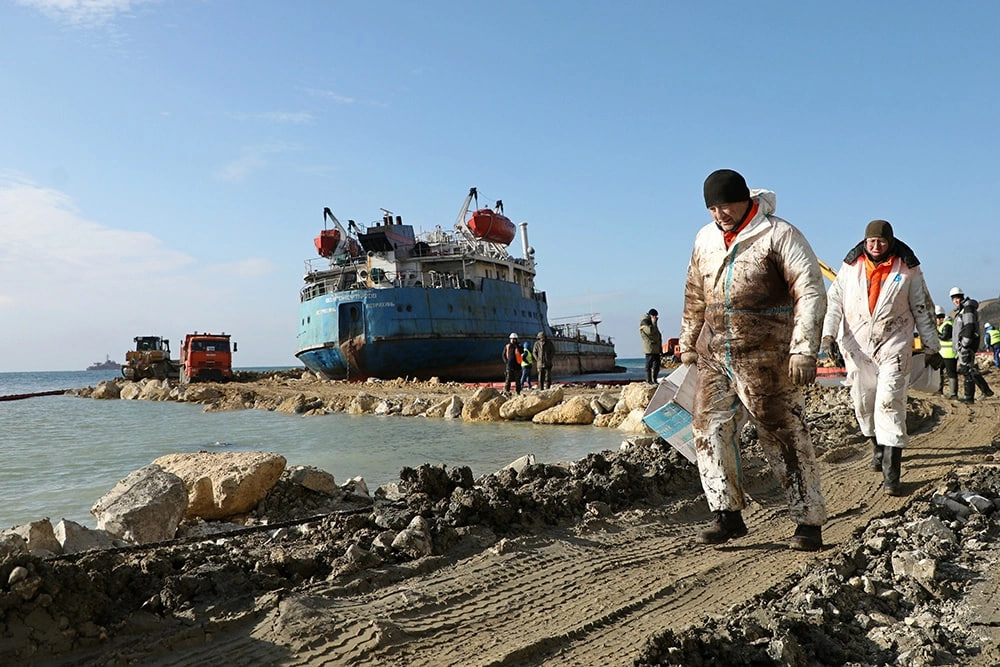
We have written repeatedly about the unfolding ecological catastrophe that began on December 15, 2024, when the Russian tankers “Volgoneft-212” and “Volgoneft-239”, both laden with fuel oil broke apart and sank in the Black Sea, not far from the Kerch Strait.
Specifically, the “Volgoneft-212” broke in two, and both sections subsequently sank; as for the “Volgoneft-239”, its bow section sank after the vessel fractured, while its stern section, which had washed ashore, was spent the entirety of 2025 being dismantled for scrap metal.
Since the spring of last year, the aggressor has claimed that they would cut away the protruding sections of the three sunken vessel fragments, after which they would enclose them within specialized engineering structures, cofferdams purportedly designed to create a hermetically sealed space around the tankers.
Initially, Vitaly Savelyev, the aggressor’s deputy prime minister, promised to install the cofferdams “before the autumn storms” of 2025; however, by October, he was speaking only of installing a portion of the piles “at the designated cofferdam sites.”
In early December, somewhat convoluted statements from the aggressor suggested that only one of the three cofferdams had allegedly been installed over the tanker wreckage. Now, however, by the end of March, same Savelyev has quite abruptly announced that there allegedly “remain 2,000 tons of fuel oil to be pumped out” of the bow section of the “Volgoneft-212”, a task to be completed, allegedly, “by the end of May.” What makes this saga intriguing is not so much the fate of the 5.8 billion rubles, including funds allocated to the Tyumen-based firm “Mostostroy-11”, that were “absorbed” under the guise of “constructing and installing cofferdams,” but rather the simple fact that, strictly speaking, no one actually witnessed the process of installing these cofferdams over the tankers or the subsequent pumping out of the fuel oil this past winter amidst the stormy conditions of the Black Sea.
Moreover, the “final deadline” now announced by Savelyev, set for the end of May. rests on a banal “political” foundation: the Kremlin administration has issued a directive to “launch the resort season” along the Black Sea coast starting June 1st, “at any cost.”
Concurrently, in the long-suffering city of Anapa, as part of this very “season launch”, all beaches are being blanketed with fresh sand atop the existing fuel-oil-contaminated layer, while any newly discovered fuel oil slicks along the coastline are being meticulously covered up.
However, this “idyllic” scenario may soon encounter some rather noteworthy “well-wishers”; for earlier, another “relevant” deputy prime minister, Dmitry Patrushev, the son of the notorious intelligence operative, security council secretary, and head of maritime board, Nikolai Patrushev was “technically sidelined” from the process of “absorbing” all the “anti-fuel-oil” cleanup budgets in favor of the aforementioned Savelyev.
It is entirely conceivable that the absence of a couple of “fuel-oil-related” billions from the Patrushev family’s “household budget” could trigger “retaliatory measures” on their part against the more fortunate “disaster liquidators”, a development that one might well expect to unfold as early as this coming summer.