A week ago, we reported that on March 1, Russian “media” announced the sale of Ivan Aivazovsky’s “Moonlit Night in Crimea” by the “Moscow Auction House” for 136 million rubles, with the buyer’s details and the painting’s provenance concealed.
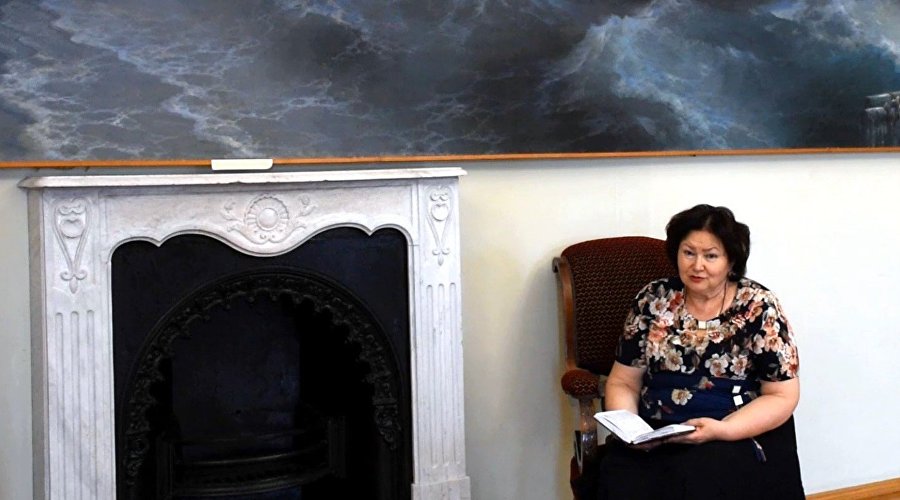
At that time, we refuted the claim by the so-called “director of the Feodosia I.K. Aivazovsky Art Gallery,” Tatyana Gaiduk, that this particular “Moonlit Night in Crimea” was allegedly “returned to Russia by an Italian collector after he confirmed its authenticity.”
These words were an obvious lie, since the painting “Moonlit Night in Crimea,” which was allegedly “lost” after World War II and which was allegedly donated “free of charge” to the aggressor by Milanese collector Paolo Polvani last November, was visually different from the one sold at the Moscow auction in March.
Furthermore, the Moscow expert’s report on the painting sold at auction in March had been signed a month before the “Milan transfer.”
And now, on March 10, the aggressor’s key Crimean propaganda outlet “suddenly” published a commentary by the same Gaiduk on this very issue.
Now the “gallery director” doesn’t mention “Italian collectors,” but says that Aivazovsky “created many different versions of images of the sea at night,” and that his artistic legacy “is so vast that there are still gaps in it.” Moreover, Gaiduk “for some reason” decided to declare not only that “many of the artist’s paintings, with similar themes, bear the same titles; sometimes incidents occur,” but also that supposedly “no official auction would taint itself by selling items that could have been stolen from a museum.”
And now it’s clear that the occupiers have clearly overdone it here. If Gaiduk had simply confused the paintings, which have no connection to occupied Crimea and have nothing to do with her personally—one “Italian,” one “Moscow”—then there would have been no practical point in the aggressor’s propaganda suddenly and hastily publishing this “refutation” of the “blank spots” of the long-suffering Aivazovsky.
It is therefore clear that the traces of works of art stolen by the occupiers from the storerooms of Crimean “museums and galleries,” as well as the exploits of their “leadership,” such as Gaiduk, their curators from the punitive forces, and their “bosses” from the collaborators, must be monitored with the utmost care.