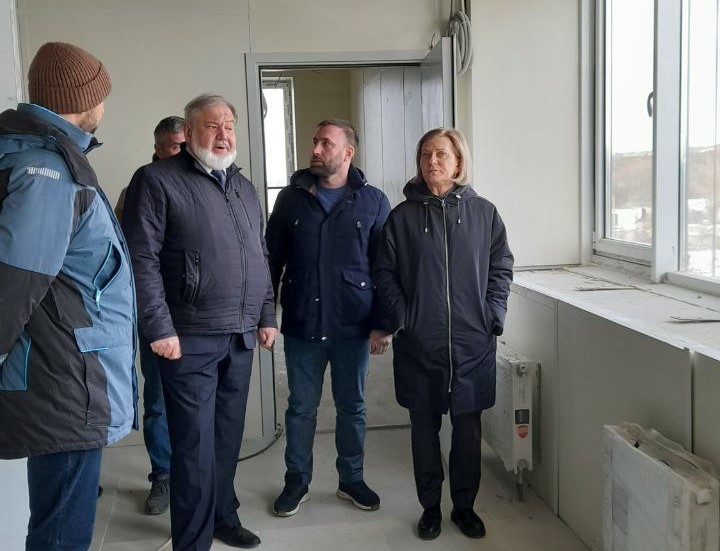
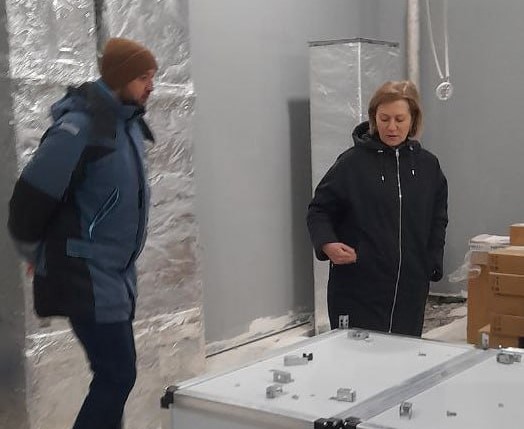
On February 21, the aggressor-controlled “media” announced an “inspection visit” to the “Crimean anti-plague station” by the head of “Rospotrebnadzor” Anna Popova, who allegedly “supervised the construction work of the facility”.
It is stated that now the “anti-plague station” will allegedly operate around the clock and “respond to threats” both in the captured Crimea and in the occupied south mainland of Ukraine.
Let us recall, that we have previously repeatedly described the aggressor’s criminal experiments with bacteriological weapons at the “Crimean anti-plague station” converted by the occupiers since 2015, and we also reported about these provocations to the OSCE, UN structures and to the specialized conventional bodies.
The illegally captured Ukrainian station was formally “subordinated” by the occupiers to “Rospotrebnadzor” as a “federal state institution”, but at the same time, its “director” for the last decade has been Sergei Tikhonov, from a family of Russian military microbiologists who were responsible for the development of bacteriological weapons; the father of the current director, Nikolai Tikhonov, once headed the corresponding Volgograd institute “Microbe”.
Earlier, in 2015-2017, the occupiers had already “updated” the “anti-plague station”, and after analyzing the relevant purchases and features of the “repair”, the experts of our Association came to the conclusion that they do not correspond in any way to the stated goal of “fighting Crimean pathogens” and most likely concern criminal experiments with bacterial infections such as tularemia.
Now, however, “new buildings are being built on the territory of the institution in Simferopol”, and earlier the “station” received at its disposal complexes of “bacteriological research of a mobile complex based on a car chassis”, and since 2017 a “laboratory of especially dangerous infections” was created there.
At the same time, from the public actions of these “epidemiologists” since 2022, the occupiers’ propaganda mentions only “monitoring the quality of Dnieper water coming through the North Crimean Canal”, which has obviously not been available in Crimea for almost two years, as well as some “research of Dnieper water”, apparently “on site”.
At the same time, all the propaganda statements made by the occupiers a couple of years ago about the “US biolaboratory”, allegedly operating at the station until 2014, were then actually refuted by the “epidemiologists” themselves. Last year, the “head of the epidemiology department of the anti-plague station”, Liliya Zinich, stated that “Crimea did not work directly with the United States”, receiving only grants from the European Union, but the station did not send any materials to the EU until 2014.
And its biosafety standards until 2014 did not correspond to some “insidious research”, but to the direct task of the station – a banal study of Crimean ticks, rodents and the like for ordinary, and not “newly invented” infections.
But now, in the new buildings “with special protection”, the aggressor will clearly not be dealing with Crimean outbreaks of borreliosis, but with something completely different.
In this context, the “Dnieper” exercises of the occupiers pose a particular danger, especially considering the aforementioned “mobile complexes based on a car chassis” which, naturally, can not only take samples, but also do the opposite, with the aim of spreading especially dangerous infections in the lower reaches of the Dnieper.
Among other things, it should be point out that such criminal experiments and provocations make the “mobile complexes” of Russian bacteriologists in uniform a legitimate military target.