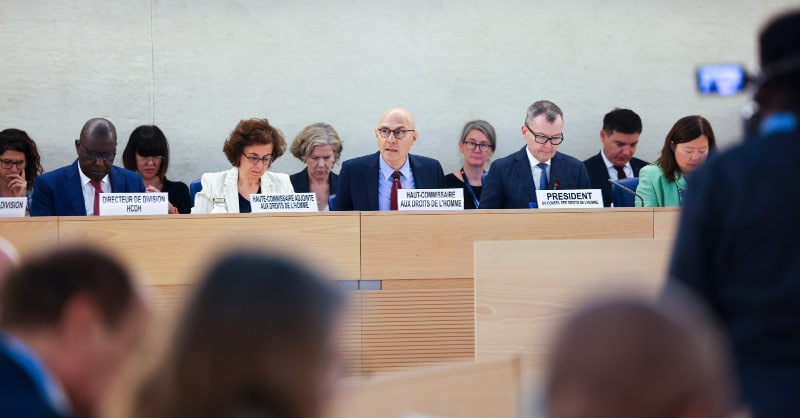
As we informed our readers, in framework of permanent cooperation with United Nations’ bodies and agencies our Association informs them on challenges, caused by Russian aggression for the human rights and sustainable development at the occupied territories of Ukraine. Our relevant communication with UN Geneva office was reflected again in materials of 59th session of the Human Rights Council that started today, June 16, including relevant reports of United Nations’ officials for that session.
For example, new Report of the UN High Commissioner for Human Rights A/HRC/59/39 “Impact of the civilian acquisition, possession and use of firearms” mentioned about our submissions, which described non-controlled firearm circumvention in the Crimea and other Russia-occupied territories.
Report stressed regarding those issues that high rates of firearms violence in society tend to affect those who are already most disadvantaged, and groups are targeted on the basis of race, ethnicity, religion, and sexual orientation or gender identity, affecting their enjoyment of the right to participate in cultural life. Among other, Report demands to redouble measures to combat corruption in the various sectors that leads to non-controlled firearm turnover and usage.
Also new Report A/HRC/59/54 of the UN Special Rapporteur on extrajudicial, summary or arbitrary executions, Professor Morris Tidball-Binz “Rights of families of victims of unlawful killings” mentioned that in Ukraine aggressor’s killing of men who were often the primary breadwinners for their families exposed widows and children to severe economic hardship.
UN Rapporteur stressed in document that families of victims of unlawful killings must always be recognized as victims in their own right, including in relevant legislation, policies and practice, and be accorded the rights to truth, justice and reparations. He demanded states also to guarantee the rights of families of victims of unlawful killings to a remedy, including restitution, compensation, rehabilitation, guarantees of non-repetition, and satisfaction; and to ensure that all families of victims of unlawful killings have access to support services, including psychosocial and financial support, to help them overcome the grief and the hardships caused by the unlawful death of a loved one.
These programmes should adopt a victim-centred approach, with a gender perspective and with special consideration for family members with special needs, including children, UN Rapporteur added. Also Professor Morris Tidball-Binz published separate Report A/HRC/59/54/Add.1 “Visit to Ukraine” about consequences of Russian aggression; our Association invited periodically UN Rapporteur before to make that visit.
In Report mentioned Professor M. Tidball-Binz stressed that previous mandate holder visited Ukraine in September 2015. At the time, at least 9,167 people had been killed, 21,044 had been injured and 1,000 remained missing following the armed conflict triggered by illegal occupation by Russia the Crimea, UN Rapporteur pointed, recognizing that exactly the attempted annexation of peninsula started the ongoing war against Ukraine.
Professor M. Tidball-Binz stressed that the reported number of civilian casualties resulting from the Russian aggression against Ukraine had reached 43,610 individuals by March 2025, caused by the Russian attacks.
Casualties included men, women and children, with a disproportionate impact on older people, UN Rapporteur added, stressing the the use of explosive weapons with wide-area effects in populated areas has not only resulted in a tragic loss of life, but also fuelled widespread fear and trauma among survivors and affected communities.
UN Rapporteur pointed on information received, including testimonies, reports and forensic evidence, regarding summary executions of civilians by members of the Russian armed forces in areas that fell temporarily under Russian control. Many of these acts amount to serious violations of international humanitarian law and constitute war crimes, they may also amount to crimes against humanity, if widespread or systematic, the Special Rapporteur summarized.
Report A/HRC/59/54/Add.1 recommended that the international community must continue to support the Ukrainian authorities, responsible for conducting investigations, resolving cases of missing persons and caring for victims and their families, in ensuring effective investigations and prosecutions of war-related crimes, notably unlawful killings, including with all the technical, forensic and advisory assistance that may be required to search for, collect, properly manage and reliably identify the dead and establish the cause and circumstances of death.
International community also must make use of universal jurisdiction to prosecute serious human rights violations, including unlawful killings, resulting from the Russian aggression, at the national and international levels – for example, through the International Criminal Court – since lasting peace cannot be achieved without truth, justice and reparations for victims of international crimes, Report added.
UN Special Rapporteur demanded from Russian authorities to uphold obligations under international human rights law and international humanitarian law and urgently adhere to principles of distinction, proportionality and precaution in the conduct of hostilities, including by refraining from using weapons that are unsuitable for populated areas and from targeting civilians and civilian objects; and to ensure the timely, effective, thorough, independent, impartial and transparent investigation of all alleged international crimes by the armed forces of the Russia or its allies.
UN Special Rapporteur also demanded from Russia to allow access to international independent monitors and investigators, including UN monitoring bodies, to assist investigations into war crimes and other violations of international law in territory controlled by Russia; stressing on duty to ensure that families of victims of unlawful killings in territory controlled by Russia have access to truth and reparation measures as required under international law.
Russian authorities did not comment that Report A/HRC/59/54/Add.1 and it was not even “by strange coincidence” translated into the Russian language as it is foreseen by common UN practice.
Aspects of defending rights of Ukrainian refugees in third countries, described before in our submissions, were reflected in the new Report A/HRC/59/56 of the UN Special Rapporteur on trafficking in persons, especially women and children, Professor Siobhán Mullally “Migrant domestic workers and trafficking in persons: prevention, rights protection and access to justice”
The UN Rapporteur noted in the document mentioned that in the context of forced displacement from Ukraine, visa-free travel and rapid access to temporary protection status, including access to the labour market, have played a significant role in reducing the risks of trafficking for refugees from Ukraine in third countries, highlighting again the importance of regular migration pathways, effective access to international protection and resettlement opportunities for refugees to prevent trafficking in persons.
UN Report A/HRC/59/56 added that regarding improvements to accountability and access to justice, UN states should ensure access to justice and effective remedies, including legal and financial aid, and consider reversing the burden of proof in relevant proceedings; and provide returning victims of trafficking with long-term assistance and protection measures, access to safe accommodation, medical and psychosocial assistance and legal aid.
Aspects of challenges to right to health, including attacks and repressions against Ukrainian health and care, also as corruption and negligence in “medical aid system” in the Crimea and other Russia-occupied territories, described before in our submissions, were reflected in Report A/HRC/59/48 of UN Special Rapporteur on the right of everyone to the enjoyment of the highest attainable standard of physical and mental health, Professor Tlaleng Mofokeng “Health and care workers as defenders of the right to health”.
This Report recognized that a pattern of aggressor’s attacks on medical infrastructure and health and care workers has been observed in conflicts in recent years, including war it Ukraine, and this Report also demanded from states to expand protections for health and care workers who expose politically or commercially driven interference in health systems, research and healthcare delivery.
Also the Report of the UN OHCHR A/HRC/59/28, devoted to results of Intersessional meeting to mark the seventy-fifth anniversary of the Convention on the Prevention and Punishment of the Crime of Genocide noted that Russia had continuously used modern technology and disinformation as a lethal weapon against Ukraine to publicly plan a war of aggression, incite genocide and deny the right of Ukraine to exist as a nation.
Our permanent cooperation with UN bodies on mentioned and other issues of countering Russian international crimes and gross human rights violations will be continued.
Professor Borys Babin