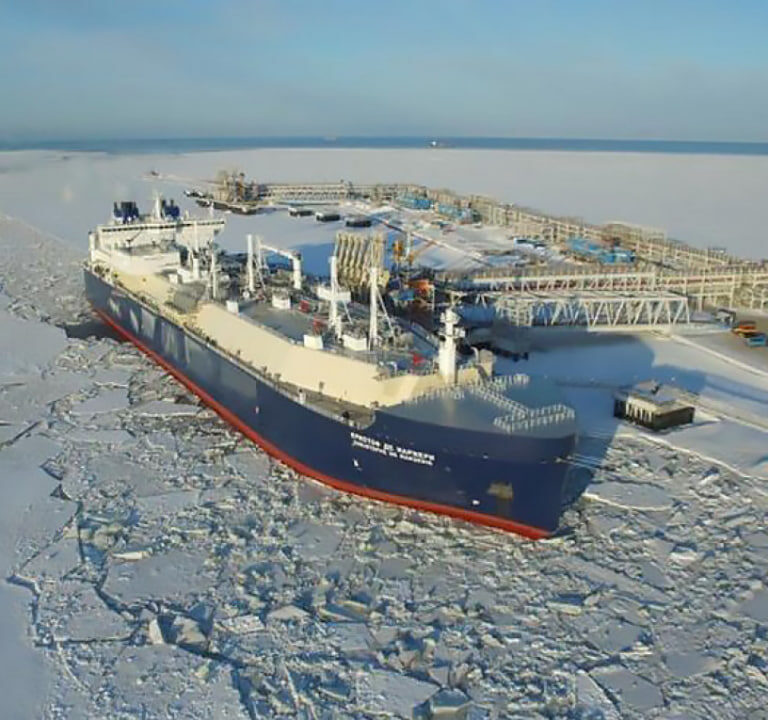
Recent investigations into the schemes surrounding the Russian shadow fleet have focused on issues such as insurance, vessel classification, documentation, crew recruitment, and the provision of pilotage services. However, the towing of these shadow fleet vessels, and other mechanisms supporting their operations, has largely remained overlooked. An analysis of the situation in Russian Black Sea ports helps to fill this gap.
It should be noted from the outset that a key role in this context is played by a purely state-owned Russian entity: the Azov-Black Sea (Azovo-Chernomorsky) Basin Branch of “Rosmorport”. This entity maintains illicit ties to the occupied territories of Ukraine, particularly Crimea.
While “Rosmorport” acts as an “official” monopolist in the realms of pilotage and icebreaking services, and the latter being particularly relevant for ports in the Sea of Azov during winter, the tugboat sector reveals some rather interesting competitors. The most significant tugboat fleet, which supports tanker operations, primarily utilizing vessels based in Novorossiysk, is owned by the “Novorossiysk Commercial Sea Port Fleet” (“Flot NMTP”) entity. This entity operates as a subsidiary of the port itself, which is jointly owned by the “Transneft” conglomerate, “Rosimushchestvo” (Federal Agency for State Property Management), “Russian Railways” (“RZD”), and the “Summa” Group, and recorded a revenue of 3.7 billion rubles in 2025.
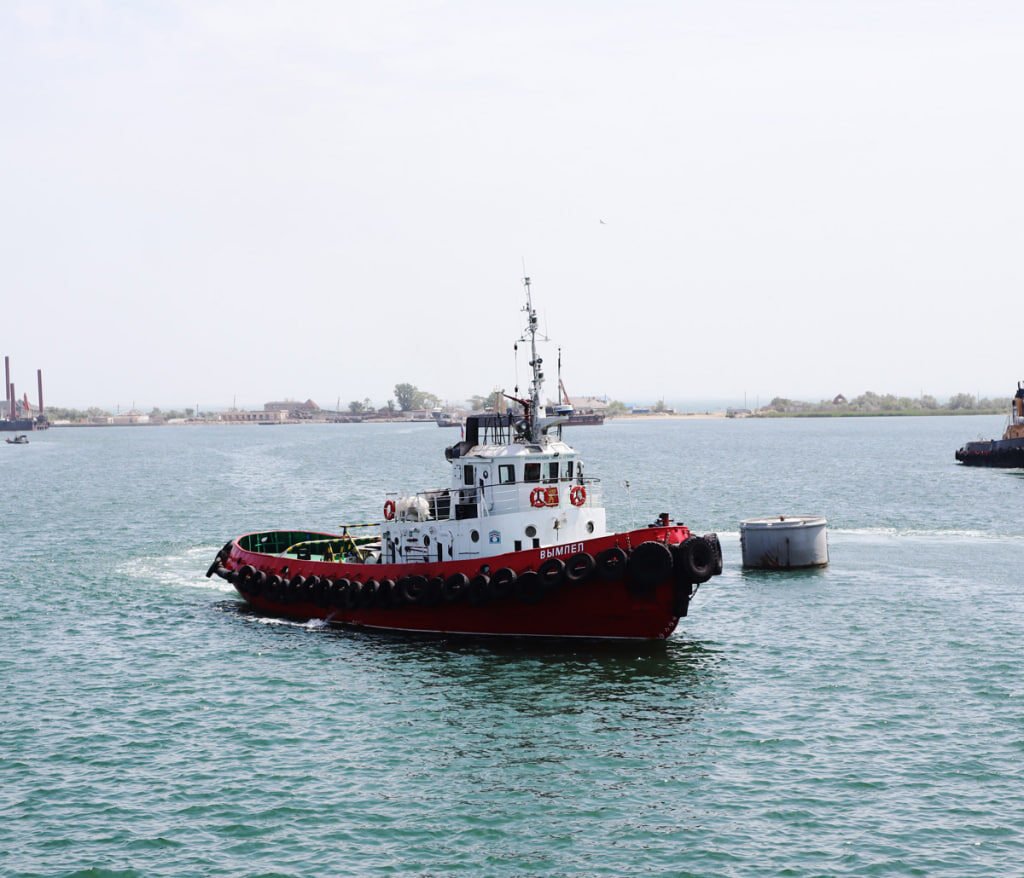
Moreover, it is the “port operators” who are, as expected, linked to multi-billion “state-budget” contracts for bunkering, towing, and waste collection, notably with entities such as “Transneft-Service”, “Rosmorport”, “Novoroslesexport”, and the “Novorossiysk Shiprepair Yard”, among others. While the Russians do not publicly disclose the number of tugboats in the aforementioned “Flot NMTP,” international search tools reveal that the fleet includes several Russian-flagged tugs, all under the supervision of the “Russian Maritime Register of Shipping” aka “RMRS”, such as the “Bodryy” IMO 9260938, “Bravyy” IMO 9260926, “Bulatnyy” IMO 9260964, “Burnyy” IMO 9260952, “Tolkovyy” IMO 9280500, “Toroplivyy” IMO 9280495, “Upornyy” IMO 8987747, “Tigris” IMO 8727032, and “Ingener Shilovsikiy” IMO 8728892, as well as the pusher tug “Tigran Martirosyan” IMO 8728880.
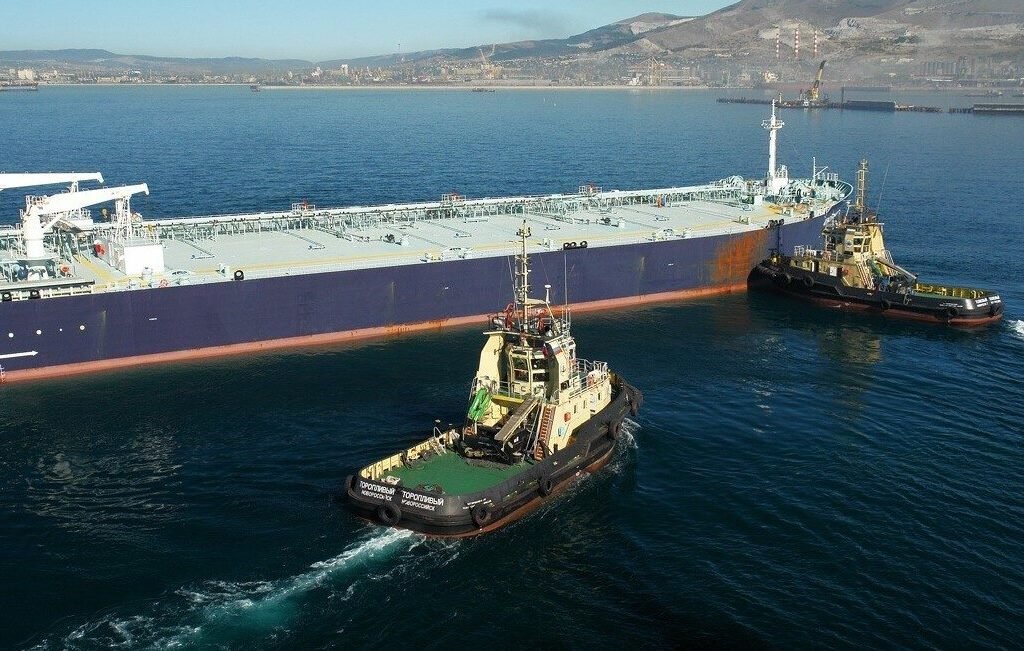
Most of these tugs, each with a tonnage of 430 tons, were built in Spain between 2002 and 2003; the others are older, including some built in the former Yugoslavia. Furthermore, “Flot NMTP” operates auxiliary vessels, including the “Portovik Novorossiyska” IMO 9076583, “Mars” IMO 8897497, and “Maslovoz 2” IMO 8846307, as well as the bunkering tankers “Inzhener Poturak” IMO 8711813 and “Inzhener Chitanava” IMO 8227628, as vessels built in Bulgaria during the Soviet era, each with a deadweight of 3,000 tonnes. Among other activities, these tugs have been repeatedly observed making unlawful port calls in occupied Crimea.
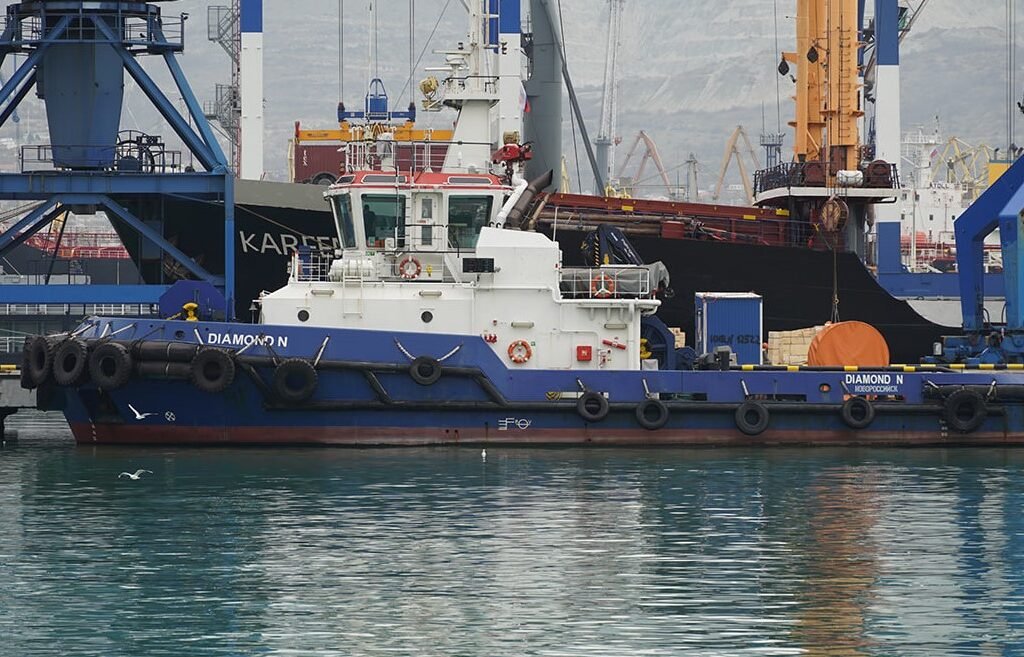
In addition to these vessels, “Flot NMTP” operates four Russian-flagged tugs owned by “Henford Logistics Limited”, a Hong Kong-based subsidiary of “NMTP” established in 2007. These vessels are the “Tornado” IMO 8897526, ”Tuman” IMO 8932340, “Diamond N” IMO 9543055, and “Topaz N” IMO 9513074.
The first two were built in 1995, while the latter two were constructed in Turkey in 2009. The “Diamond N” and “Topaz N” are classified by the “RMRS, while the “Tuman” is classified by the “Registro Italiano Navale” (“RINA”). “NMTP” has controlled this Hong Kong entity since 2009 through another subsidiary, the Cyprus-registered “Longbranch Shipping Enterprises Ltd.” Among other things, the tugs “Tornado” and “Topaz N” were also repeatedly used unlawfully in maritime operations in the ports of occupied Crimea.
Furthermore, the vessels “Diamond N” and “Topaz N” were previously at the center of a scandal involving the towing of the tanker “Delfi” in Odesa in 2020, as well as towing operations at the port of Chornomorsk. At the time, these vessels were linked to an Odesa-based shell company, “Universal Towing Company”, which involved a Panamanian nominee entity, “Pilsen Associates Corp,” and co-owner Serhiy Vlachyha, as well as the entity “Novofleet.” Both are still associated with these vessels in international search systems. Meanwhile, the Ukrainian company “Novoflot Shipping and Towage Company” was subsequently re-registered in Kyiv. Its owner is Ihor Balebrukh, a typical “nominee” who holds “ownership” of numerous firms with activities far removed from the maritime sector, ranging from the manufacture of wood products to intermediary trading.
Overall, the tugboat fleet associated with “NMTP” has shrunk somewhat over the last twenty years; in 2009, the entity operated 23 tugs and 20 other vessels, including those used for bunkering and waste collection. Even more noteworthy, however, are the towage operations in Russian Black Sea ports, which were carried out by other entities. Until February of this year, these “private firms” were grouped within the “Southern Regional Association of Marine Agents and Forwarders” (“YuRAMA”), an organization based in Novorossiysk that is now in liquidation, though a significant number of these firms had ceased operations even earlier.
These include, among others: “Inflot-BSS,” “Novoagency,” and “Mercy Shipping Agencies and Trading”; the “Cardi” entity, previously registered to Viktor Syrma and the British Virgin Islands-based offshore company “Sunvia Investment Ltd”; “Barwil Novorossiysk”, a subsidiary of the Norwegian firm “Barwil Agencies AS”; and “Novorossiyskiy Vneshreydinvest,” which has beneficiaries in Cyprus and the Netherlands. “V.T.I. Credit Limited” and “Inter Sacco Group B.V.”
Most of these entities ceased operations even before the onset of the large-scale Russian aggression. The reasons for such a withdrawal can be traced in the case of “Zim Russia”, a subsidiary of the Israeli shipping company “ZIM Integrated Shipping Services”. In 2010, these business operators complained to the Federal Antimonopoly Service of Russia, alleging that “Flot NMTP” was hindering their operations; however, this complaint ultimately yielded no results. Subsequently, the “Delo-Center” group, to which we will return later, became a co-owner of “Zim Russia.” Notably, the current owners of this entity remain undisclosed, yet in 2025, it reported a profit of 51 million rubles.
Another entity that was a member of “YuRAMA” and continues to provide agency services in Black Sea ports is “Morskoye Agentstvo EISA” (“Marine Agency EISA”). Its beneficiary is the Liberian-registered “Economou Shipping Agencies Limited”, registration number C-128648; prior to 2021, a Cypriot entity with the same name and registration number 48330 held this role. This entity also maintains a branch in Murmansk. In effect, it serves as a subsidiary of “Economou International Shipping Agencies Ltd” (“EISA”), a Greek shipping and logistics corporation registered in Piraeus. According to media reports, the ultimate beneficiary of this entity is the Greek shipping magnate Georgios Economou, who, among other interests, controls “Cardiff Marine.” Meanwhile, “Marine Agency EISA” reported a revenue of 337 million rubles in 2025; its primary public representatives in Russia are Anatoly Pazhin and Igor Murzayev.
Another member of “YuRAMA” is the Novorossiysk-based firm “Orlan”, owned by Sergey Melnik and Sergey Bunin, which likely operates a harbor launch of the same name and declared a revenue of 4 million rubles in 2025. Among other activities, these operators launder funds through services provided to Russian state entities, such as the “Marine Rescue Service of Rosmorrechflot.” However, unlike “Delo Service Co Ltd” aka “Service Company “Delo””, a firm that warrants special attention, none of the aforementioned “YuRAMA” members have operated tugboats in recent years.
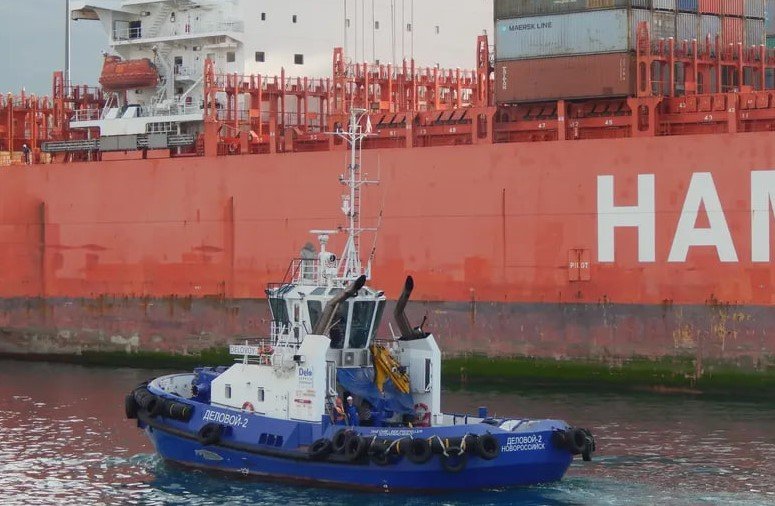
This firm actively offers towing services within the Black Sea group of Russian ports and operates a fleet of six tugboats, each weighing 410 tons and sailing under the Russian flag. Built between 2017 and 2018 at the Chinese shipyard “Damen Shipyards Changde,” these vessels are equipped with “Caterpillar” and “Rolls-Royce” engines and hold certification from the “RMRS”.
The vessels are: “Delovoy 1” IMO 9819131, “Delovoy 2” IMO 9819143, “Delovoy 3” IMO 9819155, “Delovoy 4” IMO 9823168, “Delovoy 5” IMO 9819167, and “Delovoy 6” IMO 9835240. In 2025, “Service Company “Delo”” reported a revenue of 2.11 billion rubles; while this is a decrease from the 3.24 billion rubles recorded in 2024, it remains significantly higher than the figures for any of the other entities described above, with the exception of “Flot NMTP.” This group of tugboats periodically conducts operations in the Kerch Strait, and their civil liability insurance coverage extends to the occupied Crimean ports of Kerch and Feodosia.
The founder of “Service Company “Delo”” is the firm “Deloports,” which also holds another former member of “YuRAMA”, namely “NUTEP” or “Novorossiysk Hub Transport and Forwarding Enterprise”. In turn, the founder of “Deloports” is the Moscow-based “Management Company ‘Delo'” (“UK Delo”), headed by General Director Alexey Lebedev. Until 2026, its co-founders were Sergey Shishkarev and the entity “R-Alliance”, which was also managed by Lebedev. Currently, the sole owner is listed as the “Atomic Energy Industrial Complex” aka “Atomenergoprom,” a purely state-owned Russian entity controlled by “Rosatom”.
It should be noted that “UK Delo” serves as the parent company of the “Delo” Group, a Russian transport and logistics holding. The group operates maritime container terminals and deep-water grain terminals across the Azov-Black Sea, Baltic, and Far Eastern basins, as well as a network of railway container terminals and a fleet of containers. It controls the multimodal service integrator “Ruscon,” the railway container operator “TransContainer,” and the “Sakhalin Shipping Company” (“SASCO”); the group’s IT integrator is the company “Delotech.”
Between 2016 and 2024, the “Delo” Group established control over “Global Ports”, a major Russian container terminal operator, notably by acquiring a stake previously held by the global entity “Maersk”. Until the end of 2019, Sergey Shishkarev was the owner of “Delo”; however, over the following two years, his stake was purchased by “Atomenergoprom”. By the end of 2024, Shishkarev had lost his controlling interest, though he remained with “Delo” for a time as Chairman of the Board of Directors.
It was at this juncture, in January 2025, that the aforementioned Lebedev became the CEO of “Delo”. Shishkarev spent another year and a half fighting to retain control over at least a portion of the company, securing a partial victory in February 2026. Ultimately, however, he was “politely asked to leave” the group.
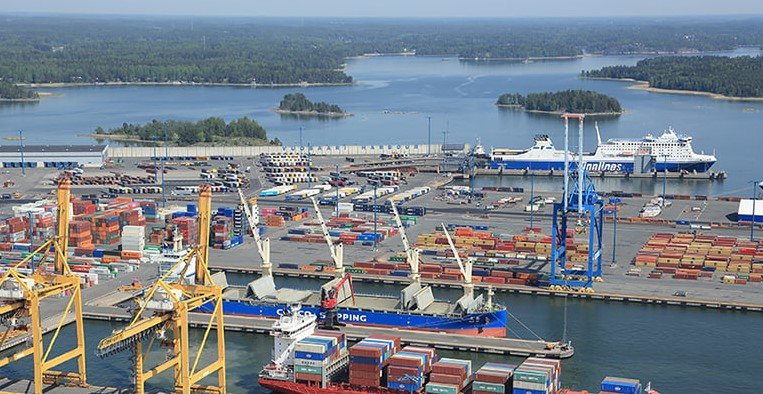
By mid-October 2026, “Rosatom”, acting through “Atomenergoprom”, had bought out all of his shares for a total of 77 billion rubles. This figure is easily explained: “Global Ports” alone controls the “Yanino Logistics Park”, the “First Container Terminal”, “Petrolesport”, and “Moby Dik”, all in or near St. Petersburg, as well as the “Ust-Luga Container Terminal”, a terminal at the port of “Vostochny” in Primorsky Krai, and the “MLT-Helsinki” and “MLT-Kotka” terminals in Finland.
Moreover, while “TransContainer” and the “Sakhalin Shipping Company” are on sanctions lists, the “Delo” Group itself and its key figures currently enjoy international impunity, even though their operations in Novorossiysk, which involve servicing the Russian shadow fleet, constitute a direct violation of sanctions imposed by civilized jurisdictions.
It should be added that in 1992, Shishkarev graduated from an institute run by the Russian Ministry of Defense as a translator of Portuguese and Hungarian. From 1999 to 2011, he served as a State Duma deputy representing the “United Russia” party. “By a strange coincidence,” he was actively involved in “international parliamentary activities”, specifically within the BSEC (Organization of the Black Sea Economic Cooperation), as well as in the transport sector. He also served on the Russian Maritime Board and the Executive Committee of the Russian Olympic Committee, where he oversaw handball.
As of 2024, he ranked 125th on the list of Russian billionaires. Colonel Shishkaryov also did not neglect such “the most important of the arts” as cinema; in 2022, he established the production center “Sdelano v ‘Delo'” (“Made in ‘Delo'”), which produced propaganda films about Soviet sports.
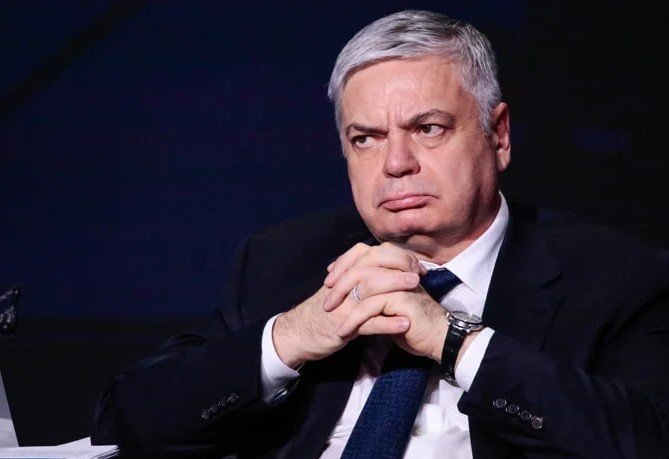
Meanwhile, the current head of the “Delo” Group, Lebedev, acts as a front for “Rosatom.” Previously, he held senior management positions at “Russian Railways” (“RZD”) and the state-owned company “Salair.” A number of Moscow-based firms are registered in his name, all of which primarily service the holding companies.
Thus, it can be concluded that a certain “balance” has emerged in the market for towing vessels belonging to Russia’s “shadow fleet” in the Black Sea, a balance between entities linked to “NMTP” (i.e., “Transneft” and “Russian Railways”) and those linked to “Delo” (currently representing “Rosatom”). Consequently, despite the ostensibly commercial nature of the towing services in question, the ultimate beneficiaries of the relevant corporations are Russian state-owned conglomerates, even if their origins lie in the “land-based” sector.
This necessitates further sanctions, primarily targeting the “Delo” Group and “Rosatom” in their entirety, as well as the key beneficiaries of these entities. Furthermore, civilized jurisdictions should extend sanctions to the notorious “Russian Maritime Register of Shipping”, which facilitates the operations of the majority of Russian tugboats in the Black Sea. The Russian Black Sea tugboats themselves should also be included on sanctions lists, not least to prevent their continued use in other countries within the Black Sea basin. Additionally, the operations in Russia of companies controlled by the Greek firm “EISA” warrant specific attention and should be the subject of further investigation.