We previously wrote about the latest wave of “nationalization” carried out by the Sevastopol “authorities” in early December, affecting the “internet provider companies” “Sevstar” and various other entities.
Moreover, Larisa Kontsebovskaya was declared the “main beneficiary of Sevstar and several other companies,” whose relatives, “according to the FSB,” allegedly “collaborated with Ukraine.”
As we later wrote, the sham nature of this process was revealed in the fate of the “Digital Innovations” (“Tsifrovyie Innovatsiyi”) group, which was also “nationalized” at the time, as a shell company created earlier by the same Sevastopol “authorities” to launder the city’s “utility bills.”
Now, however, this “nationalization” has begun to attract “lawsuits” from the beneficiaries of the expropriated property. And now the conversation is not so much about the tragicomedy of the “Ukrainian cuisine restaurant” “Glechik” being seized and hastily renamed “Gogol,” but rather about the “legal activism” of Moscow businessman Konstantin Bolshakov, a “co-owner” of Kontsebovskaya’s company “City Innovations,” (“Horodskyie Innovatsiyi”) which previously implemented the “Smart Stops” project in Sevastopol.
Bolshakov is demanding that the “authorities” return his “nationalized” house and land on Sevastopol’s Gotska Street, as well as his stake in “City Innovations.” A “court hearing” is scheduled for early March.
It’s worth noting that the “Smart Stops” PR project, which involved equipping stops with Wi-Fi hotspots and USB ports for charging phones, with subsequent advertising revenue,
was actively promoted in occupied Sevastopol since late 2014 by then-gauleiter Sergei Menyailo.
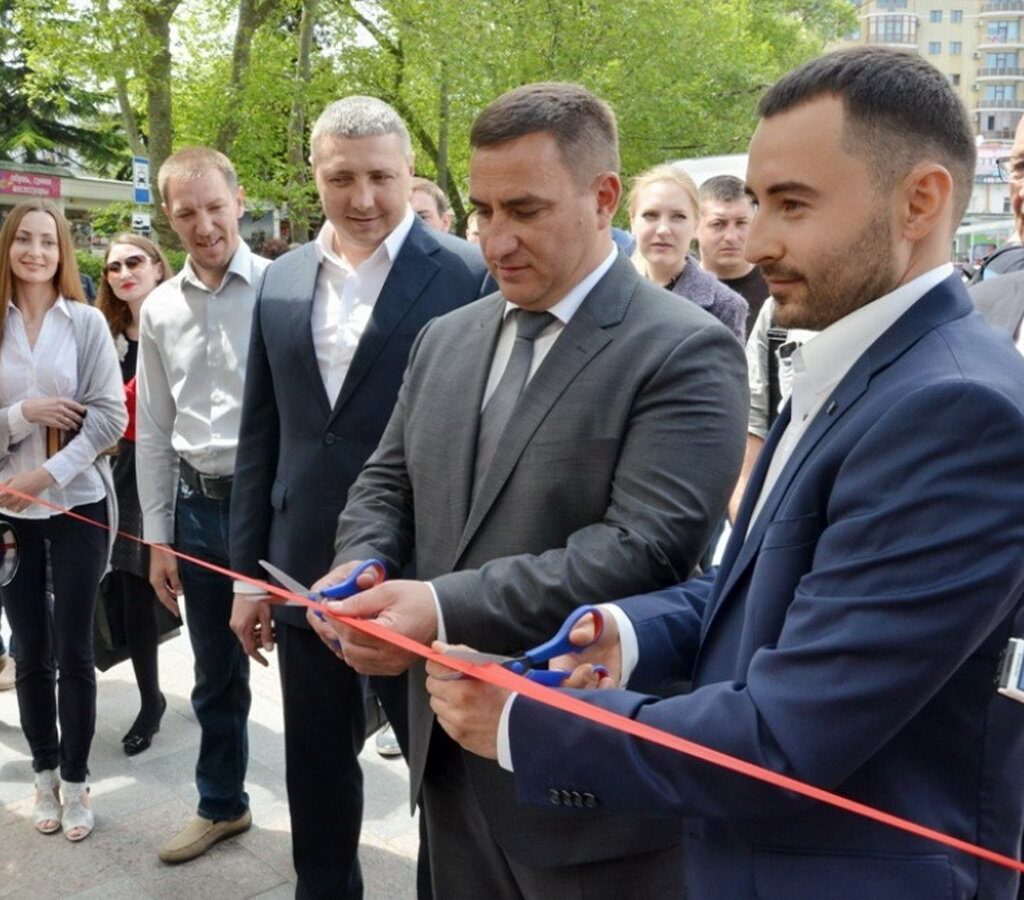
It arose with the participation of “Sevstar”, and with a “talking head” in the form of Anton Chervinsky, a former Sevastopol City Council deputy from the “Party of Regions” before the occupation.
Meanwhile, the same Bolshakov, Kontsebovskaya, and Chervinsky, who filed for “bankruptcy” in 2024, were also involved in the Simferopol-based “firm” “Smart City” (“Umnyi Horod”) and the “City Innovations SPB” (“Horodskyie Innovatsiyi SPB”) structure, registered in Noginsk, Moscow Region, which is engaged in similar “urban improvements” in St. Petersburg.
Furthermore, “Smart Stops” licensed by “City Innovations” eventually appeared in a dozen aggressor-controlled cities, where the equipment was primarily supplied. The aggressor periodically used this project as propaganda at various “housing and utilities exhibitions.”
As one might guess, the aggressor’s structures have no complaints about the activities of this business, either in Russia or even in Simferopol, which would be, to put it mildly, unrealistic if the Sevastopol gauleiter’s stories about “insidious schemes uncovered by the FSB” were taken seriously by any of his “colleagues and management.”
Therefore, this example once again proves that the “nationalization” processes on the occupied peninsula have become a real “black hole” in the process of “redistributing assets into the right hands,” and that the further development of this process is now quite difficult to predict, even for the “Kremlin curators.”