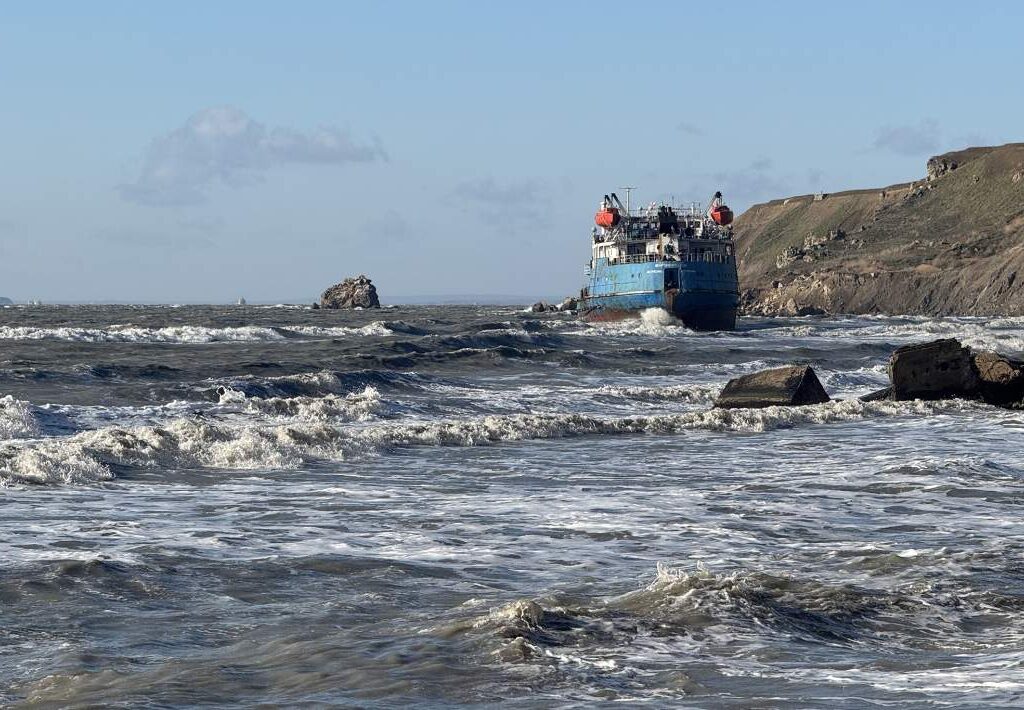
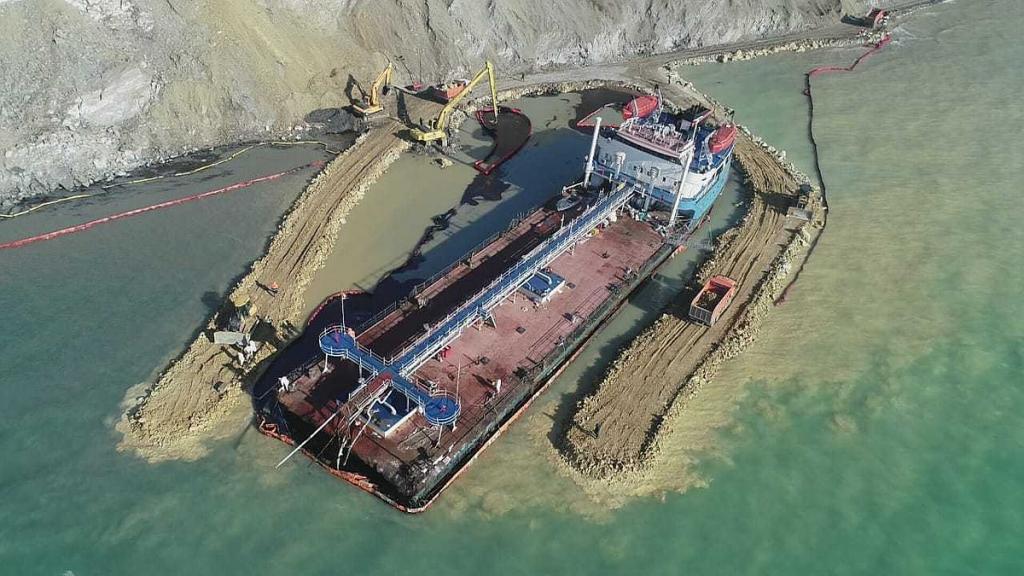
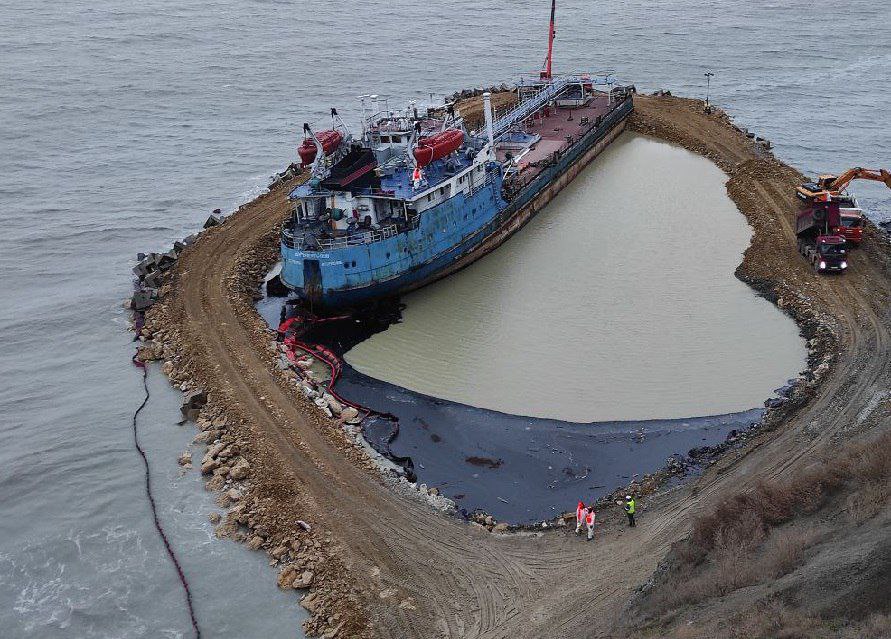
On December 15, 2024, an environmental disaster occurred in the Black Sea, not far from the Kerch Strait, during which the Russian tanker “Volgoneft-212” broke up and sank in a storm, and its sister ship “Volgoneft-239” broke up and ran aground on a rock with its stern, which was transporting fuel oil.
These vessels, intended for river and coastal transportation of petroleum products, were relatively small in tonnage at the time of the disaster and had been in operation for more than half a century, and were ruthlessly exploited, after a dubious “modernization” at the beginning of the 21st century in conditions not intended for them due to the greed of their operators and the lack of control of the aggressor’s government.
Over the course of a year, it became clear that the Russian authorities had no intention of finding the guilty among the officials of port structures and other officials of the maritime industry, who in turn allowed tankers to enter areas not intended for vessels of this type, and in the next, forbade, due to commercial interests, the captains of tankers to return the vessels to the port in stormy weather.

The classifier, namely the infamous “Russian Classification Society” (formerly “Russian River Register”), which issued obviously fake certificates to tankers, also became “innocent”. Moreover, as was later stated in the courts, since the tankers had not “maritime” but supposedly “river” certificates, the port authorities supposedly “had no obligation to check their admission to sea navigation in the winter”, which, of course, looks extremely doubtful from the point of view of generally accepted maritime practice.
At the same time, two other tankers of the same type, “Volgoneft-109” and “Volgoneft-270”, miraculously did not sink, and the lost tankers were in a convoy of about 50 vessels off the coast of the Taman Peninsula two days before the disaster. Before the storm, the Vessel Traffic Management Service of the Port Kavkaz did not let the tankers into the port, and only directed the convoy to “take shelter” off the Crimean coast, but there was not enough space for a number of vessels there and the ill-fated tankers were “sent further”.
The occupiers “hung” all the losses, which were obviously understated several times, on the owners and shipowners of the lost tankers, namely on the companies “Kamatransoil”, “Kama Shipping” and “Volgatransneft”, and made their captains the ultimate perpetrators of the actual loss of the vessels.
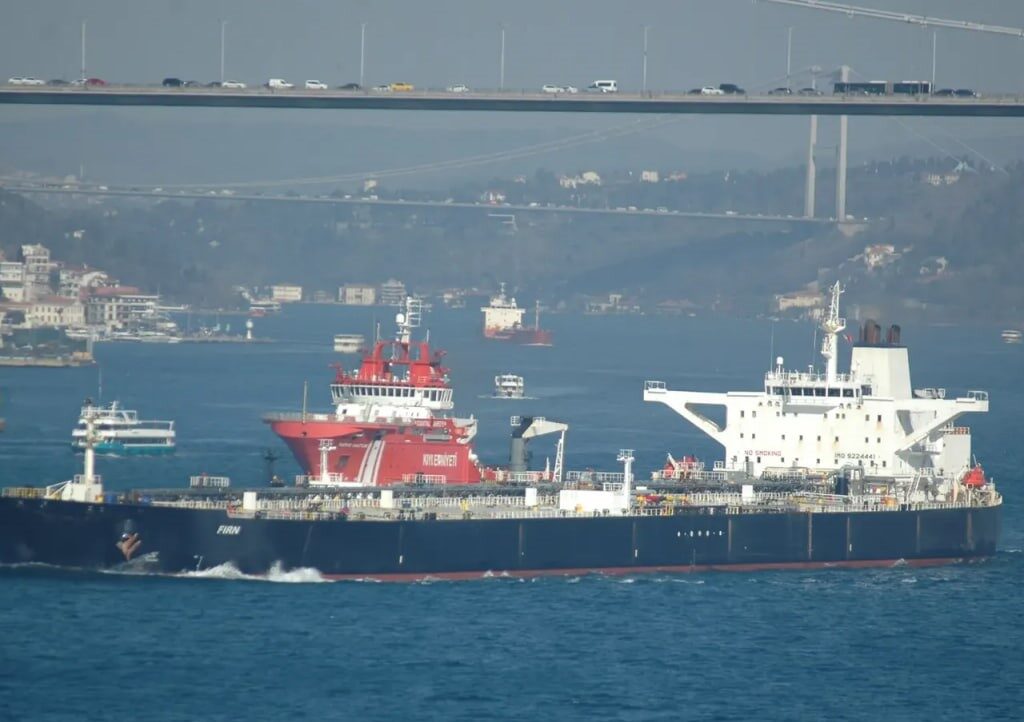
It later emerged that both of the lost tankers were to deliver fuel oil to the storage vessel “Firn” with IMO number 9224441, which was then under the flag of Panama, and during the five weeks before the disaster, the storage vessel had received cargo from more than 30 small tankers, including several of the “Volgoneft” type.
In addition, it turned out that “Volgoneft-212” and “Volgoneft-239” were transporting cargo to “Firn” which belonged to the key Russian corporation “Rosneft”, and later in the courts it was stated that the forced downtime of the lost tankers during the storm increased also because “Rosneft” allegedly “prioritized the unloading of its own tankers”, since “the order of approach and unloading of cargo is determined, among other things, by the charterer of the storage vessel “Firn”, taking into account the instructions of the cargo owner”.
But it was to “Rosneft” that the aggressor did not make any property claims after the accident, despite the fact that even in the absence of the charterer’s fault, the costs of “general average”, i.e. losses and expenses related to salvaging the vessel and cargo, are divided between the shipowner and the cargo owner.
The estimated 85 billion rubles of damage, on the one hand, is incomparable with the real environmental damage, and on the other hand, the Russian government announced that the costs of liquidating the disaster were only 10 billion, and how much of this amount was stolen is a purely rhetorical question.
On the other hand, “Kamatransoil”, “Kama Shipping” and “Volgatransneft” obviously do not have 85 billion, and the insurers of the lost tankers were the insurance companies “VSK” and “Absolut Insurance”, with a limit of “as much as” 4 billion rubles for both vessels. This disaster, which was a direct result of mismanagement in the Russian maritime industry, is only unfolding and its consequences will be long-term and irreversible.
It is still unknown how many thousands of tons of fuel oil remained at the bottom of the Black Sea in the remains of the “Volgoneft-212” and the bow of the “Volgoneft-239”, despite the fact that Russian talking heads have been accompanying the development of this disaster with systematic disinformation all year.
At the same time, back in January 2025, experts stated that the greatest man-made environmental danger to the world’s oceans is the Russian oil tanker fleet, which is in a catastrophic technical condition. At the same time, it was recognized that the environmental disaster of the “Volgoneft-212” and “Volgoneft-239” near the Kerch Strait, violated the collective interests of local communities, the principles of environmentally sound management, proper housing, a democratic and just international order and international solidarity.
Ecologists have stated that hundreds of thousands of birds of various species and several thousand dolphins died from this disaster, while stating that the further negative impact on ecosystems will be gradual, but the closure of the Black Sea will contribute to this impact on all links of biodiversity.
Experts have stated that there are corresponding threats from the consequences of the current disaster for the Black Sea coast of Bulgaria and Romania, in particular, due to the presence of constant sea currents, which was fully justified during 2025.
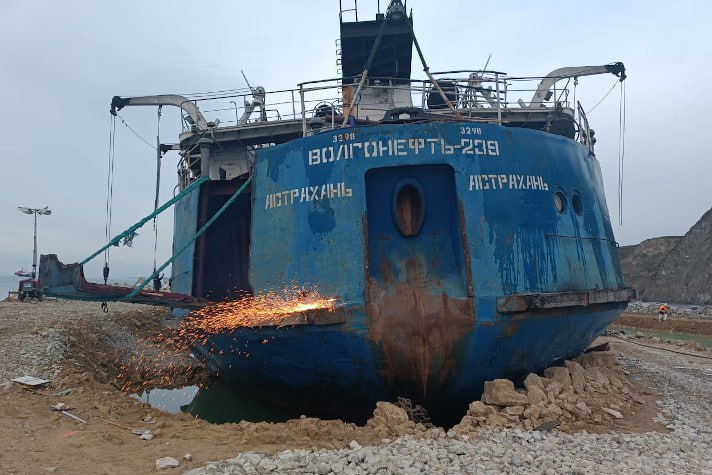
At the same time, the steps taken by the Russian authorities to eliminate the consequences of the disaster clearly contrasted with the situation of a similar accident that occurred in the Kerch Strait in November 2007 with a tanker of a similar type “Volgoneft-212”, when the Ukrainian authorities were forced to clean up the Crimean coast.
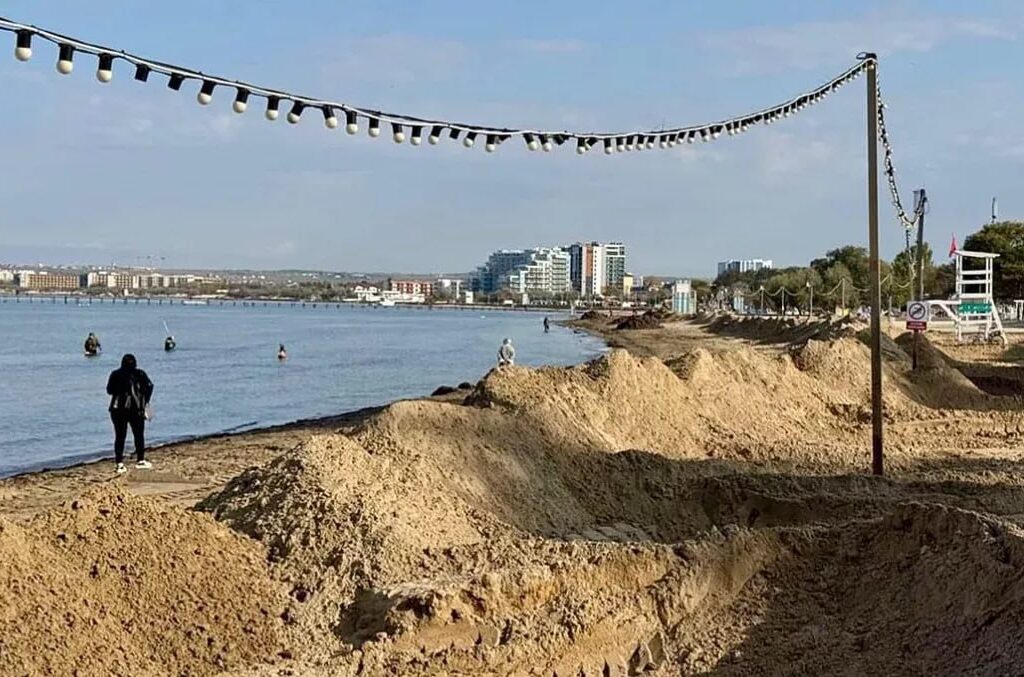
A decade and a half later, already under the conditions of the Russian occupation of Crimea, it became clear that “for some reason” there were not only effective technologies for processing contaminated sand and fuel oil, but also oil recovery vessels and special equipment – in 2025, both in Crimea and in the Kuban, the main tool of the liquidators of the coastal consequences of the disaster was a banal shovel.
And a year after the start of the fuel oil collection, Russian top-level officials are not only systematically “confused” about the figures of the supposedly collected pollution, but are also keeping quiet about the “strategic secret” about where the hundreds of thousands of tons of sand and pebbles mixed with fuel oil actually went, as well as the tons of contaminated seabirds “rescued by volunteers”, the mortality of which exceeded 90 % even according to the confessions of the Russians themselves. In fact, these consequences of the disaster were banally transferred to ordinary garbage dumps or landfills in Crimea, Sevastopol and the Krasnodar Territory.
This is exactly how the “implementation of the final version of the utilization of fuel oil from sunken tanker fragments”, promised by the Russian authorities in March 2025, ended in nothing. Its essence boils down to the fact that the protruding parts of the ships will supposedly be cut off, after which they will be closed with special engineering structures, cofferdams, which will create a sealed space around the tankers.
And then the recyclers will supposedly heat and pump out the fuel oil, after which they promise to remove both the cofferdams and the “degreased” remains of the tankers themselves. In this “stream of optimism” from Russian Vice Prime Minister Vitaly Savelyev, it was not so much the promise to install cofferdams “before the autumn storms” that was notable, but the warning that “next year, when we receive the technology, we will try to ensure the lifting of both the cofferdams and all three sunken parts”.
At the same time, in September-December, the Russians stated that “one cofferdam has already been installed” and that “work on the other two is still underway”. However, by December 2025, it became obvious that no effective shelters had been installed over the underwater remains of “Volgoneft-212” and the bow of “Volgoneft-239”, and starting in November, seasonal storms clearly affected these facilities, and fuel oil began to appear en masse on the shores of the Kuban and Crimea again.
The Russians began to fight this in the usual genre of fake “official reports” and intimidation of the local population so that “slanderous” photos and videos of the shores strewn with oil products did not appear on social networks. At the same time, they began to spread rumors that supposedly “the first cofferdam installed was damaged by the storm” and that “the second one was not suitable in size”.
Under these conditions, the international response to the disaster was quite limited. Only the Danube Commission has taken certain measures, after repeated statements by the Ukrainian delegation and experts that Russia will try to continue operating up to 80 “surviving” “Volgoneft” tankers for the needs of its shadow oil complex, of which at least 15-20 will be actively used by the Russian occupiers in the Azov and Black Seas for risky supplies of petroleum products, which could create catastrophic problems for maritime security and environmental threats to the marine environment.
First of all, this clearly influenced the approval by this body in December 2025 of the resolution on the Register of Damage Caused by Russian Aggression to the Lower Danube, which took into account the relevant environmental challenges.
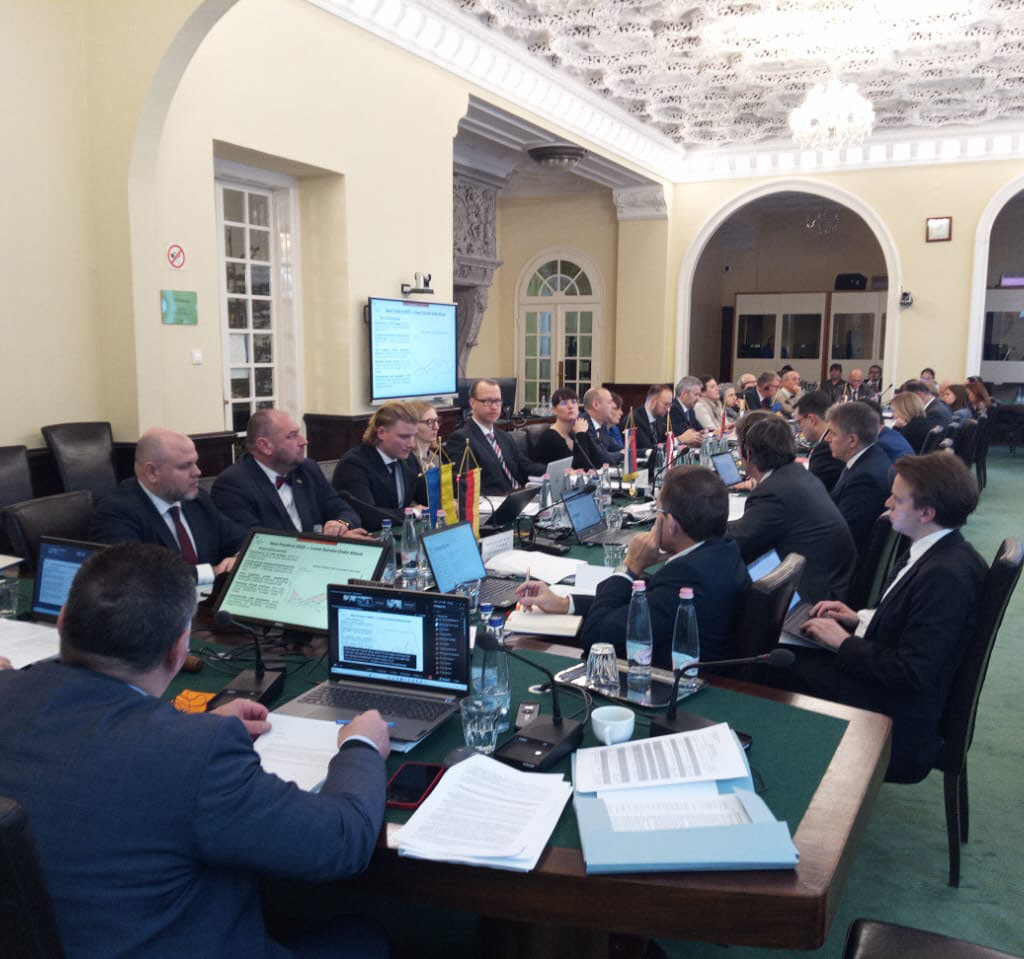
In its turn, the International Maritime Organization expressed its own concern about the situation in a separate letter, and a similar position was taken by the Inland Transport Committee of the United Nations Economic Commission for Europe.
It was stated that the Secretariat of the Committee “is fully aware of the seriousness of the accident and the scale of the disaster for the marine environment, as well as other consequences” and that it “would like to express its deepest condolences to all those affected by the accident and its consequences”.
The Secretariat also expressed hope in an official statement that “the results of the investigation and the recommendations of the relevant international organizations will provide an impetus to improve the safety of navigation and environmental protection on inland waterways, where applicable”, but this did not happen last year.
The relevant unit of the European Commission indicated to experts regarding the disaster “its commitment to resolving the complex issues of safety at sea and environmental protection in the Black and Azov Seas”, in particular in the context of measures aimed at combating Russia’s shadow fleet and against the circumvention of sanctions.
Other relevant international structures mentioned this disaster in 2025 at best indirectly, as can be seen in the report of the UN Special Rapporteur on Toxic and Human Rights on the risks of pollution by oil products.

And despite the fact that international experts demanded that the European Union and other democratic jurisdictions include in the sanctions lists the owners and insurers of the aforementioned tankers, as well as the Russian classification societies, whose activities created the conditions for the current environmental disaster, during the year, only Canada included the companies “Kama Shipping” and “Volgatransneft” in the sanctions lists, but neither sanctions for the “Russian Classification Society” nor restrictions or bans on the calls of tankers of the “Volgoneft” type occurred during the year.
Only the declared storage tanker “Firn” fell under sanctions of the European Union and the United Kingdom, but it is currently transporting, renamed “Grus I” under the flag of Cameroon, petroleum products from Novorossiysk to Indian ports.
The media, except for Ukrainian ones, also ignored this disaster and its consequences. Only Polish resources mentioned this story in the fall of 2025, and only after the Minister of Foreign Affairs of Poland Radosław Sikorski mentioned the death of the tankers, arguing that “shadow” tankers also ply the waters of the Baltic Sea, just in a worn-out and insufficiently insured condition, despite the fact that Russia receives a significant part of its income from tankers, the operation of which is an unprecedented environmental threat.
Journalists wrote that the tankers of the “shadow” fleet of Russia continue to operate under the technical supervision of both the aforementioned “companies” and the “Russian Maritime Register of Shipping”, bypassing all restrictions. The disaster was also mentioned by some Romanian media, and “on the anniversary” of the tankers’ deaths, a review material was made by “BBC”.
The next accidents with tankers of the “Volgoneft” type are a matter of time, since their technical condition is critical. At the same time, risks exist not only for the water areas of the Danube, Baltic, Black and Azov seas or the Caspian Sea, where in 2024 dozens of vessels of this type were noticed in operation, but also for the water areas of the Volga, Don or Neva, which will carry the consequences of the accidents into international waters.
It is worth recalling that the “Volgoneft”-type oil tankers combine vessels of five projects: “550” and the close “558”, “550A”, “1577” and “630”, they were built starting from 1963 and ending in 1996 at the Volgograd Ship Repair Plant, as well as at two Bulgarian enterprises, “Ivan Dimitrov” in Ruse and “Georgi Dimitrov” in Varna.
“Volgoneft” became the most massive series of small tankers, originally intended for the transportation of crude oil and petroleum products in the USSR, primarily by the river systems of the Volga, Don, northern rivers of the European part of Russia, canals and lakes connecting them.
Since the 90s, Russia, in pursuit of “easy petrodollars”, has not paid attention to the need to update its small-tonnage tanker fleet, and now we are observing the sad consequences of such inaction. At the same time, Russian state oil companies constantly allocate billions of dollars for the transportation of petroleum products to beneficiaries of vessels of the “Volgoneft” type, without worrying about the condition of these tankers.
In addition to two large-scale accidents near the Kerch Strait in 2007 and 2024 with tankers of the “Volgoneft” type, in the 21st century many incidents were noted, both due to their technical condition and the “human factor”, some of which miraculously did not lead to a large-scale leak of oil products.
This transport, despite its relatively small tonnage, which allowed it to take on board less than 5 thousand tons of oil products, for a long time had a strategic nature for the Soviet Empire, since practically the entire oil production and oil refining industry of the European zone of Russia was “tied” to this river system.
The fact that from the very beginning the “Volgoneft” tankers were intended for domestic navigation was emphasized by their control over the “Russian River Register”, where they carried the class “O-PR” and later “M-PR”.
And to this day, the absolute majority of these tankers, except for the “630” project and several vessels transferred from the Russian to the “convenient” flag, are controlled by the successor of the “rivers”, the “Russian Classification Society”, these few exceptions were attributed by the aggressor to the “Russian Maritime Register of Shipping”. As Russian sources also admit, over a thousand crew members died on them in the first thirty years of operation of the vessels of the “Volgoneft” group alone.
However, many tankers of this type were built for the Soviet Empire, and by calculating from open sources in 2025, the fate of 207 vessels of this type was established. As of 2024, at least 53 of the 71 built vessels of the project “1557”, 51 of the 65 tankers of the project “550A”, 13 of the 25 vessels of the project “550”, 13 tankers of the 36 of the project “558” and all nine tankers of the “youngest” project “630” physically existed.
The absolute, if not the complete majority of them are still owned by Russian beneficiaries, and with extremely rare exceptions, they are still registered under the Russian flag, which is not typical for the larger “tanker breeds”. At the same time, a significant part of the “Volgoneft” tankers, except for the “youngest”, are used either as floating storage facilities for oil products, or as vessels for river transportation: in addition to maximum old age, an obvious problem for Russian owners is the replacement or repair of the main engine.
Therefore, of the 13 “surviving” vessels of the “550” project in 2024, 7 were operated for their intended purpose, and all of them were on the aggressor’s river routes at the beginning of 2025, some of the tankers were not on the move and were used by the aggressor as various barges and storage facilities. Similarly, among the 13 tankers of the “558” project on the move, and also on Russian rivers, 4 vessels were noted, the rest of the owners use them as a “non-self-propelled bunker base”, “non-self-propelled oil pumping station” or “bunkering capacity”.
The slightly newer project “550A”, most of whose vessels were built in the 1970s, can “boast” 32 tankers in operation, with 25 of them on Russian rivers as of early 2025, and another seven in the same ill-fated Azov shipping route, from Rostov and Azov to Temryuk and Port Kavkaz. These are tankers with Astrakhan registration of various shipowners, “Volgoneft-105” IMO number 8727915, “Volgoneft-109” IMO number 8230651, “Volgoneft-111” IMO number 8230663, “Volgoneft-141” IMO number 8863020, “Volgoneft-150” IMO number 8866046 and “Volgoneft-152” IMO number 8898623, with only the last two being built after 1980.
If we examine the fate of the “Volgoneft” tankers of the “630” project, we can state their active use as a tool of the Russian shadow fleet even in 2025. The vessel “Kazan City” IMO number 9104782, with the owner in the form of the Rostov company “Morflot” and the ship manager “Donneftetrans” this year transported oil products between Astrakhan and Rostov-on-Don, as well as across the Caspian Sea, in particular to the Turkmen port of Ekerem.
All technical certificates on the “safety” of this tanker were issued by the “Russian Maritime Register of Shipping” (“RMRS”) in particular on “compliance with oil pollution control”, until 2028, and it was the “RMRS” that conducted an “annual inspection” of this vessel.
Another similar tanker from “Morflot” and “Donneftetrans”, “Kapitan Pshenitsin”, IMO number 8727941, was transporting Russian oil to the Turkish port of Gebze in December 2025 from the same anchorage south of the Kerch Strait, where its sister ships sank a year ago. Previously, this same “RMRS”-surveilled tanker (registration number 842975) illegally entered the occupied Port Krym near Kerch, Kerch itself, Temryuk and Port Kavkaz, as well as the Turkish ports of Haydarpasa, Pendik and Evyap.
Another tanker of this series, also from “Morflot” and “Donneftetrans”, also supervised by RMRS (registration number 862767) “Kapitan Schemilkin” IMO number 8727965 in November 2025 exported Russian oil from Temryuk to Turkish Diliskelesi. Another tanker of project 630 “Volgoneft”, namely “Astrakhan City”, registration number in “RMRS” 930907 in December 2025 carried Russian oil to Turkish Mersin from Russian river routes, probably from Volgograd, this year it was also spotted in the Caspian Sea, in the Turkmen port of Ekerem.
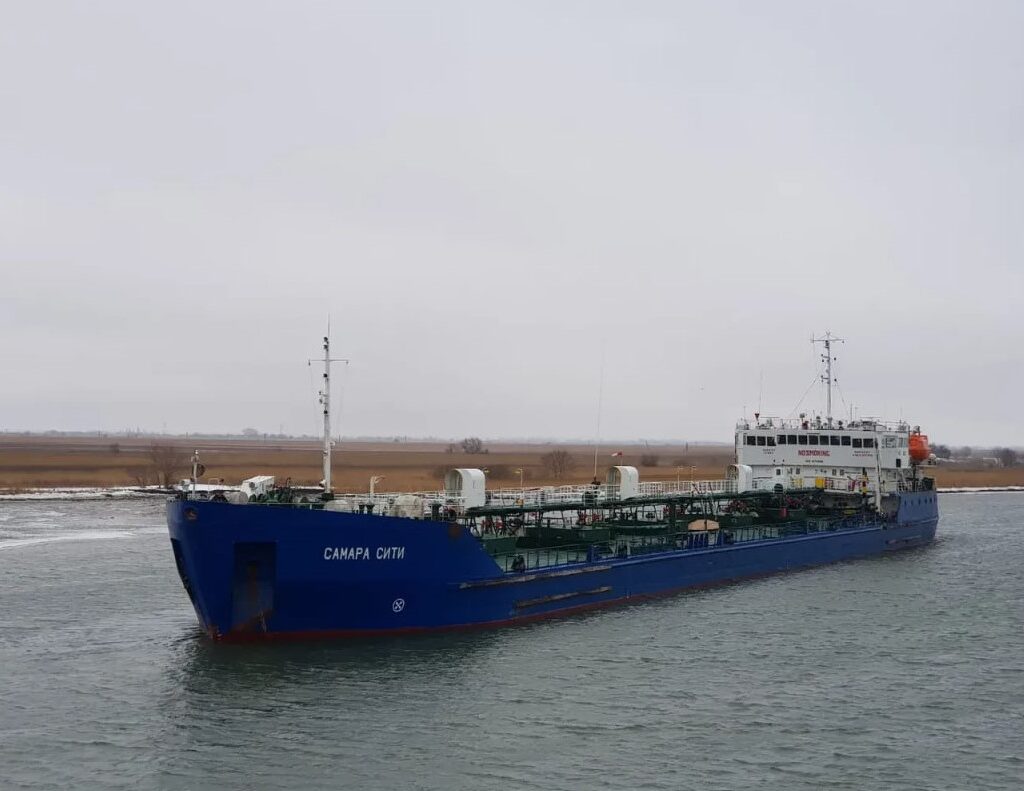
Another tanker of this series, “Samara City”, IMO number 8711966, in 2025 mostly transported oil products on Russian rivers, it was also supervised by “RMRS” and had “Donneftetrans” as its ship manager, but its nominal owner is Rostov-on-Don “Trans-Service”.
So, it is worth paying special attention to the operator of this group of tankers, namely the aforementioned “Donneftetrans”, founded in 2017. It is noteworthy that over the past three years this structure has expanded its staff from 8 to 160 people and increased its revenue fivefold, to 300 million.
At the same time, as “Donneftetrans” writes on its own website, “strong ties with the “RMRS” and the Federal Agency for Maritime and River Transport of Russia allow us to minimize the owners’ costs and the downtime of vessels”, and in this regard, it is noteworthy that this “offshore company” received an economic activity code from the Russian government back in 2017 for “storage of nuclear materials and radioactive substances”.
The heads of this structure were declared Alexei Maslov and Irina Kazmina (who was previously Irina Tyutikova), while the real beneficiaries of “Donneftetrans” are hidden behind an offshore company from the Seychelles “Castell Shipping Co”, registration number 230915. And this is clearly not director Maslov, who previously received a commercial activity code for “washing and dry cleaning of textile and fur products” in Rostov.
At the same time, the same Kazmina (Tyutikova), previously registered as an “Internet trader”, was the formal founder of “Donneftetrans” until January 2022, when someone with the “gift of foresight” transferred the company’s nominal values offshore a month before the start of the full-scale Russian invasion of Ukraine. It is noteworthy that Tyutikova was previously a director in the Rostov firms “Novograin”, where the owner was the Turkish company “Akdeniz Kimya Co.”, and “Transflot Neftegazservice”, in which the beneficiaries were hidden offshore from the Marshall Islands “Coral Sea Spirit Inc.”
It is through “Donneftetrans” that crews are hired for the above-described group of tankers “Volgoneft”, despite the fact that the level of wages there is clearly lower than for large-tonnage tankers, and employment is carried out according to Russian legislation. And the formal owner of its own tankers, the above-mentioned Rostov “Morflot” also has owners, hidden in the offshore structure “Covenant Vessels Corp.”, also from the Seychelles, and among its directors were Roman Tsvetkov and Roman Kazmin.
Both of these characters are associated with the Rostov firm “Reka-More” and its figurehead Maxim Fisun, the founders of this structure are also hidden in the Seychelles firm “Divine Passage Corp.”, and until 2024 they used the firm “Eridanus Shipholding Ltd.” as the founder from the Marshall Islands.
Another tanker of the project 630, “Volga”, IMO number 9104770, also supervised by “RMRS” under number 940330, in 2025 was seen in shipping in the Caspian Sea, with calls to Turkmen ports, and its owner and manager is declared by the structure “Trans-Flot” from Samara. This sanctioned structure is one of the notable shipping companies of Russia, which carries out cargo transportation on inland waterways of Russia and on sea routes. The main cargoes for transportation by the company are crude oil and oil products, edible oils, liquid chemical cargoes. Among other things, the vessels “Trans-Flot” transported cargoes from “Sovfrakht” to the occupied Crimea.
And another tanker of this project, “Kapitan Permyakov”, IMO number 8727953, also supervised by “RMRS”, which is registered to the Yaroslavl company “Yarbunker”, in December 2025, was involved in transshipment operations with oil products in the same port of Kavkaz.
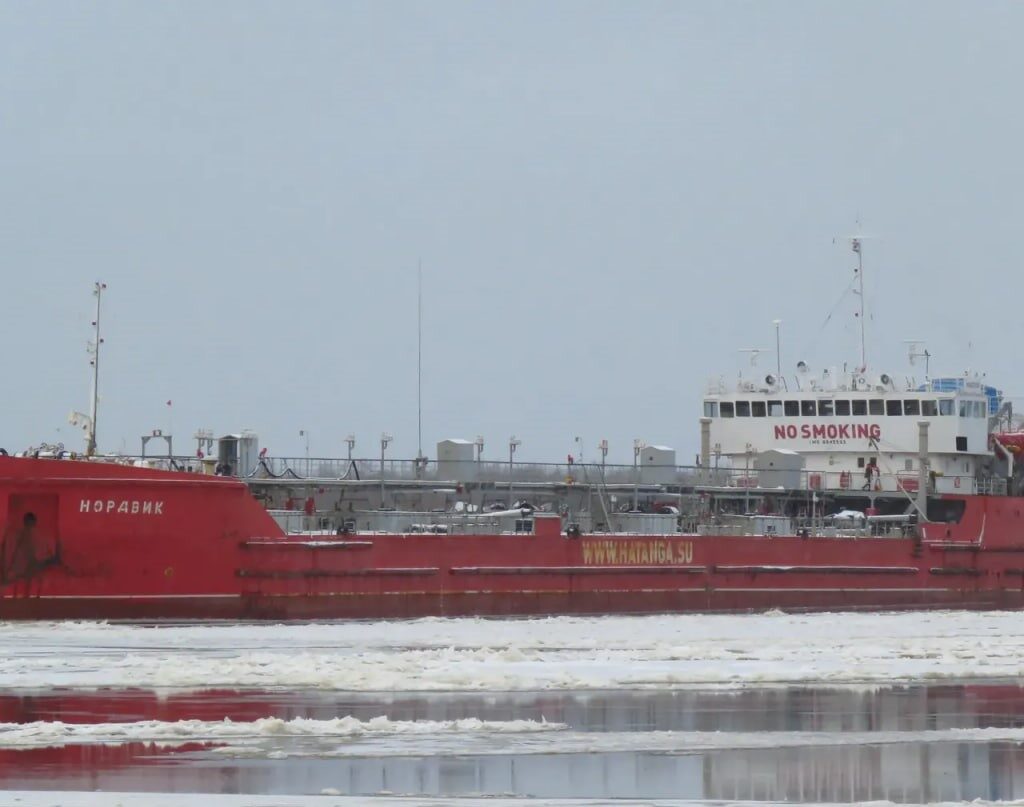
Of the above-described tankers of project 630, the tanker “Nodrvik” stands out separately, IMO number 8845523, also supervised by “RMRS” under number 836137, which belongs to the Khatanga Maritime Trade Port and in the summer of 2025 systematically transported oil products from the Kamenny Mys terminal in Yamal to Arkhangelsk and to the base in the Yakut village of Yarung Khaya. Thus, “Nodrvik”, not designated by class for Arctic shipping, can cause a large-scale ecological disaster in the most vulnerable Arctic ecosystems.
The only tanker in this group that has been identified that does not fly the Russian flag (but is still under the supervision of the “RMRS” under the number 821432) is the “Naviger-5” IMO number 8727939 under the flag of Sierra Leone, which in 2025 transported oil products between the Turkish ports of Yalova, Mersin and Greater Istanbul.
The operator of this tanker is the Istanbul-based company “Denizcilik Ve Ticaret Ltd”, and its almost complete “namesake” has been sanctioned due to its ties to the Russian sanctioned shipping company “Pola Rise”, for its activities in the maritime sector of the Russian economy, participation in increasing Russian trade with Turkey and facilitating the supply of materials to construction sites in the Arctic. We should add that the formal owner of the Naviger-5 is the Seychelles offshore company “Toledo Energy Ltd”, and as recently as 2021 this vessel still belonged to the same Yaroslavl company “Yarbunker”.
Thus, the remnants of the Soviet “river empire” of “Volgoneft” tankers continue to be a source of danger for the maritime infrastructure and environment of the Arctic, Caspian, Baltic, Azov, Black and Mediterranean seas. Although these small-tonnage tankers are “in the shadow” of the more monitored Russian shadow fleet, the risks from their operation are quite specific and proven by sad practice.
The response to the operation of vessels of the “Volgoneft” type should take place at the level of the IMO and the UN Economic Commission for Europe structures, these vessels cannot receive permission to use the Black Sea and Baltic straits and to enter ports, and their owners and operators should fall under the sanctions of civilized states.
Additional attention should be paid to the systematic falsification of ship documents committed by Russian state structures – the “Russian Maritime Register of Shipping” and the “Russian Classification Society”, the policy of recognition of whose documents should be reviewed by all maritime jurisdictions.
Monitoring the situation and impartial assessment of the damage caused by the Black Sea disaster of the “Volgoneft” tankers in December 2024 should become the subject of the activities of the IMO, the Black Sea and Danube Commissions, the BSEC, and relevant UN and OSCE structures.