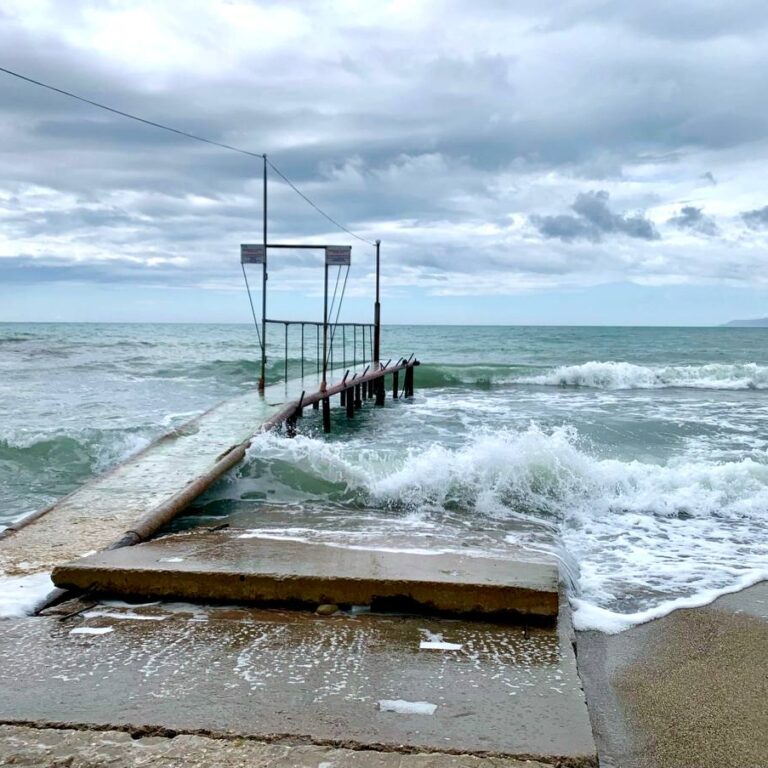
During the first ten days of October, social media on the occupied peninsula once again became awash with photos of fuel oil spills, as a consequence of the “Volgoneft-212” and “Volgoneft-239” tanker disaster in December 2024.
Among other things, photos of fuel oil stains and chunks, as well as contaminated birds, were reported from the coastal area of Alupka, the northern coast of Sevastopol, Beregovoy (Zamruk), Novofedorovka, and Frunze (Bagayly).
Simultaneously, massive fuel oil spills were reported in Taman near the village of Volna, not far from where the tankers sank.
Despite dozens of new Crimean photos and videos of fuel oil spills on beaches, Oleg Kryuchkov, the “media overseer” of the Crimean Gauleiter, traditionally dismissed the pollution as “Ukrainian propaganda,” and local “authorities” were clearly instructed to “ignore” the situation.
Only on October 12th did the Krasnodar Krai task force report alleged “minor oil spills on the coastline in Anapa,” and Mikhail Razvozhaev, the Sevastopol gauleiter, reported the day before that “spotted fuel oil stains have been discovered on several beaches on the Northern Side.”
And it’s not that some puppets controlled by the aggressor “don’t see” any fuel oil spills on the shore, while others claim the pollution is “insignificant,” since only a small portion of the fuel oil that has already spilled into the water ends up on the shore, while several thousand more tons are still trapped in sunken tankers.
As a reminder, the “Volgoneft-212” broke apart, and both its halves sank. The Volgoneft-239’s bow sank after breaking apart.
The occupiers have been systematically cutting up the beached stern of this tanker for scrap metal since February. And on March 21, the aggressor’s government commission announced the “approval of the final plan for the disposal of fuel oil from the sunken fragments of the tankers.”
The essence of this plan was that the protruding parts would allegedly be cut off from the ships, after which they would be sealed with special engineering structures called cofferdams, creating a hermetically sealed space around the tankers.
Then, the recyclers would allegedly heat and pump out the fuel oil, after which they promised to remove both the cofferdams and the “defatted” remains of the tankers themselves. What was notable in this “stream of optimism” from the aggressor’s deputy prime minister, Vitaly Savelyev, was not the promise to install cofferdams “before the autumn storms,” but the caveat that “next year, upon receipt of the technology, we will try to ensure the raising of both the cofferdams and all three sunken parts.”
We wrote that the process of installing cofferdams, especially “for wintering,” requires a thorough preliminary study of the seabed, currents, and the like, which the aggressor has not done, at the very least due to its current lack of the appropriate technology.
At the end of May, the aggressor had already “shifted” the deadline, stating that supposedly “the first protective cofferdam will be installed over the parts of the tankers sunk in the Kerch Strait by October 10.”
And now, on October 10th, that same aggressor’s Deputy Prime Minister, Vitaly Savelyev, announced that “work to drive the guide piles for the piers at the cofferdam installation site in the Kerch Strait has supposedly been completed.”
From this string of engineer-like words, it’s clear that the aggressor’s structures hadn’t installed any of the cofferdams promised in March or May on the sunken tankers before those autumn storms.
They clearly won’t be doing this until spring either. What will actually happen to the rusted hulls of the ancient tankers in the storm-tossed strait over the winter is nothing more than a rhetorical question.