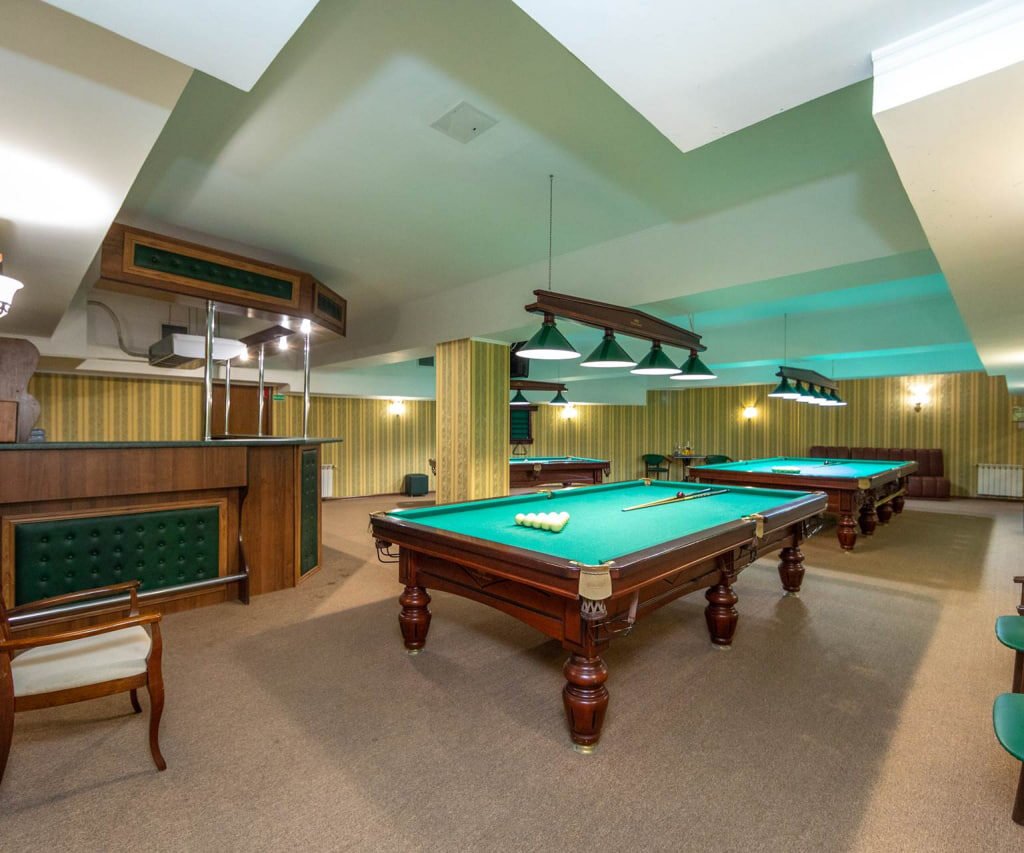
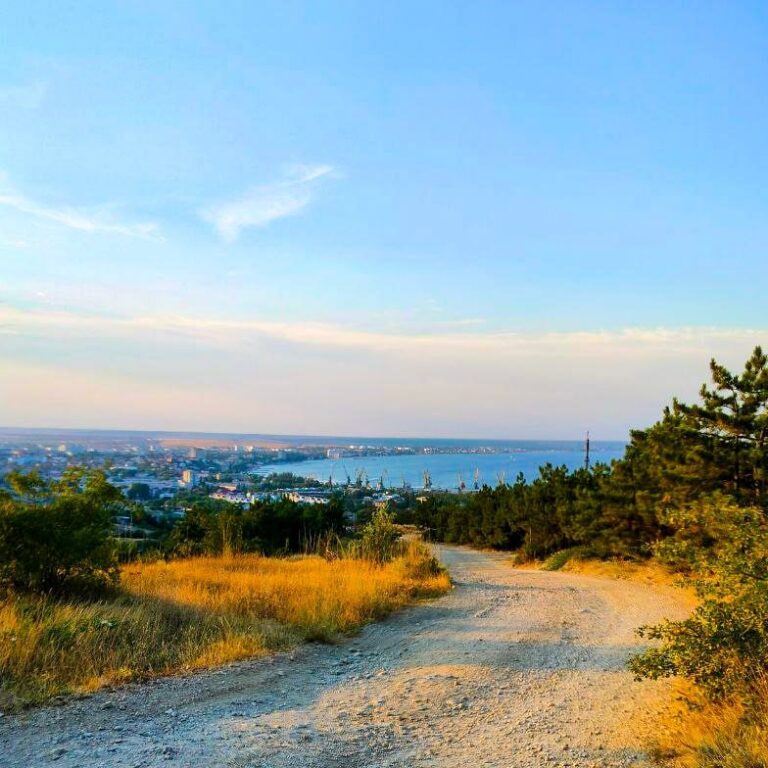
On November 12, the so-called “Administrative directorate of the Republic” announced the sale of a “property complex, including a hotel, an outdoor swimming pool, and over 120 items of movable property” located on Tokarev Street in Yevpatoria.
Judging by the photographs and the address, this refers to the “Russkoye More” (“Russian Sea”) hotel complex, which shared a “unified concept” with the neighboring “Imperia” sanatorium and health resort complex.
Notably, the occupying “authorities” never publicly announced the “nationalization” of these properties; meanwhile, the history surrounding the beneficiaries of these hotels, built back in 2008, is quite convoluted.
According to records from the aggressor state’s Federal accreditation service, the owner of “Russkoye More” is listed as Yevpatoria-based businessman Yuri Pivovarov, an individual we previously mentioned in connection with the “nationalization” of another Yevpatoria hotel, “Tsar Yevpator.”
In that instance, too, the “nationalizers” carried out the process behind closed doors. It only came to light by chance when the hotel shut down without refunding the advance payments made by several “Russian tourists,” who subsequently shared their story on social media.
Having previously investigated Pivovarov’s activities, we were able to determine that he serves as a contact person and a nominal figurehead for a number of real estate properties in Yevpatoria. Furthermore, we have established his connections, via the “Akademiya”entity and the “Korall” sanatorium, to Rostislav Shchekin, president of the Kyiv-based Interregional Academy of Personnel Management; Elbrus Tedeyev, a controversial former People’s Deputy of Ukraine; and Viktor Kreydich, a Russian propagandist who holds a Belarusian passport.
In the case of “Russkoye More” and “Imperiya”, the designated “director” is Andrey Velikzhanin. Together with Oksana Bernavskaya, he is also listed as an owner of the entity “Kryminfotur,” which likewise had an entity with the exact same name.
Velikzhanin was also listed as a “founder” of the Yalta-based “Happy Seasons Hotels Group” and the Yevpatoria-based “Imperiya-2004”, a company long controlled by Moscow residents Semyon Nayshtut and his son, Yevgeny. Moreover, both Velikzhanin and Pivovarov served as directors of the aforementioned Yevpatoria hotels, located on Tokarev Street, as far back as 2011.
In this context, the role of the aforementioned Bernavskaya is noteworthy: she is listed as a “founder” of the “Gelios” (“Helios”) sanatorium and health complex in Yevpatoria. This entity also had a “liquidated” clone with the same name and address, a clone linked to several figures: Dmitry Murakhver, a Donetsk native “legendary” in the realm of corporate raiding and debt-related schemes, who now reportedly resides in Vienna; Artur Garkavy, who shares his name with a lawyer from Kryvyi Rih; and Ramiz Radzhab Ogly Nadzhafov.
Moreover, an individual who shares the exact same name as Najafov was, in 2023, searching for a position as a chief engineer in Kyiv via Ukrainian job portals. In his resume, he cited many years of experience at the very same Yalta-based “Happy Seasons Hotels Group”, though in the capacity of chief engineer rather than administrator.
As it happens, the original “founder” of “Helios” was an entity called “Dayvis,” which utilized a Cypriot company, “Avalina Trading Limited,” as a nominee. It is therefore unsurprising that the Ukrainian registries still list “Sanatorium Helios LLC”, with “Dayvis” as its founder, and that the entity has since been re-registered to a Kyiv address under the name of Andrii Novak, a native of Nizhyn.
A man by the same name, Andrii Novak, is a former judge of the Holosiivskyi District Court in Kyiv; he was arrested for bribery in 2018 but managed to escape with little more than a scare. Now, as a lawyer, Novak is actively involved in “relevant cases” before the High Anti-Corruption Court.
Thus, this entire chain of nominees and associated legal professionals serves merely as a front for the actual beneficiaries of the “nationalized” hotels in Yevpatoria. Given the opaque nature of the process by which the Crimean “authorities” seized these properties, it is clear that the takeover took place through “mutual agreement,” involving a corresponding “redistribution of shares and roles.”