Recently, “Sevastopol media” decided to report on yet another “import substitution” project, allegedly related to weather forecasting and maritime navigation.
The occupiers complain that “a significant portion of maritime information is transmitted through someone else’s communications network,” namely, the “Iridium” satellite system.
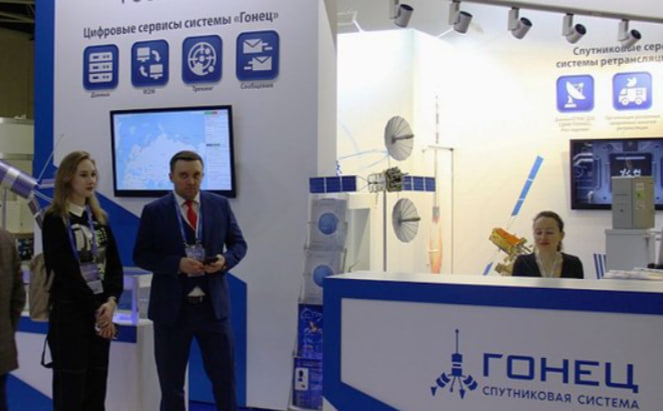
It has been stated that the so-called “Sevastopol State University” is allegedly “developing a compact satellite terminal for marine buoys and drifting stations” with an “adaptation of the Russian “Gonets” satellite system for operation at sea,” promising “expanded monitoring capabilities in coastal and remote areas.”
The occupiers are making no secret of the purely military objectives of this “meteorological initiative,” and in this context, it is worth noting that “Iridium” is a global satellite telephone operator with an orbital constellation of 75 satellites.
Interestingly, Russia has been involved in “Iridium” operations since 1993, holding a minority stake through the Khrunichev State Research and Production Space Center.
Since 2009, the satellite constellation has been controlled by “Iridium Communications Inc”, which has invested over $3 billion in new satellites, launching them on Elon Musk’s “Falcon 9” rockets.
Since 2012, “Iridium” has been officially certified in Russia, and in 2016, a Russian ground station for connecting the ground and space segments, built over three years, was commissioned in Izhevsk.
As for the “Russian alternative,” the “Gonets” satellite constellation began to be built in 1996, and, including lost satellites, by 2023 it consisted of 18 satellites.
Now the aggressor has decided to modernize this constellation, which is expected to cost 4.4 trillion rubles by 2036. The first new “Marathon IoT” satellite was planned to launch in December 2025 from the Vostochny Cosmodrome, but there have been no public announcements of a successful launch.
Given the stated amount of funds, it’s not surprising that the “Sevastopol University” decided to “make a little money” from the Kremlin’s hype around the “national satellite system.”
However, the quality and reliability of communications using the “Gonets” satellites, to put it mildly, have not been confirmed.
Under these circumstances, the described attempts at “import substitution,” in addition to the obvious large-scale corruption, will create significant risks to maritime security if aggressor-controlled vessels are required by Russian authorities to use “data from the national satellite system.”