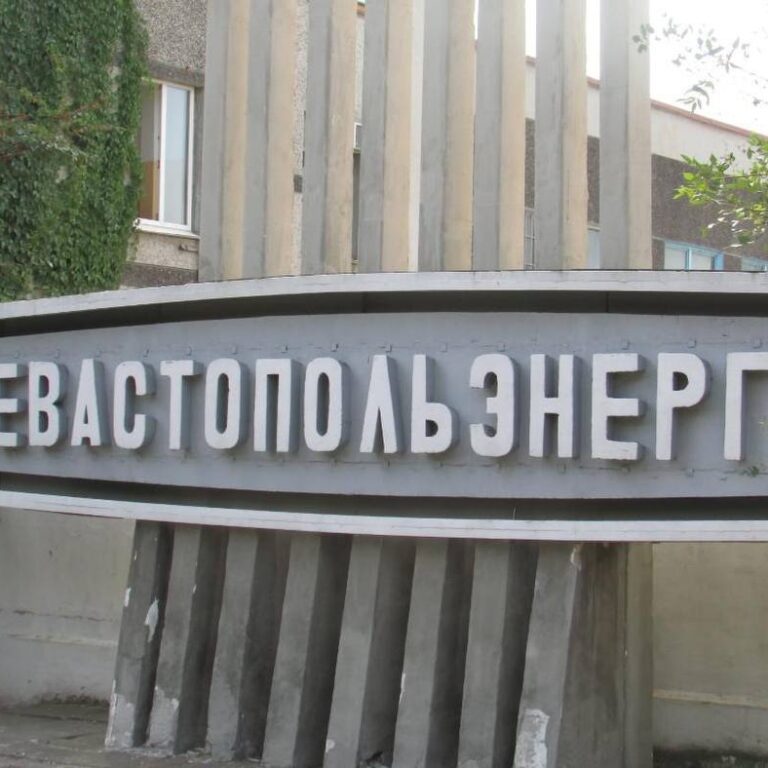
Last October, we reported that the illegal “Sevastopol State University” allegedly initiated three “lawsuits” against the St. Petersburg company “Raoproekt,” totaling approximately 75 million rubles, for allegedly “failing to comply with obligations to prepare documents for the launch of a nuclear reactor.”
As a reminder, in 2014, the occupiers seized a Ukrainian training nuclear reactor at the Sevastopol National University of Nuclear Energy and Industry, the illegal control of which by the Russians was subsequently repeatedly discussed at the IAEA.
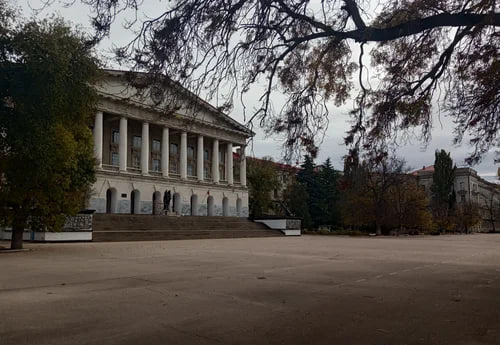
The aggressor illegally “incorporated” the educational institution itself into the so-called “Sevastopol State University,” as the “Institute of Nuclear Energy and Industry.”
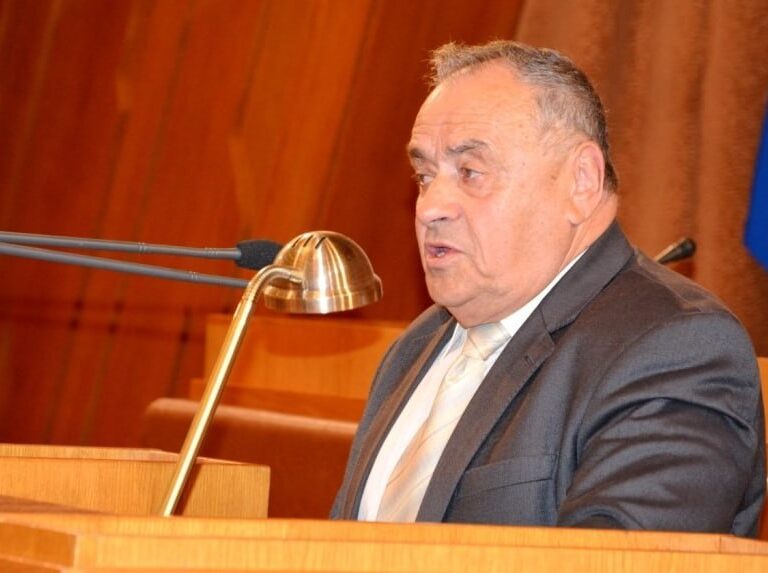
These stories about “disrupted preparations,” which RaoProekt itself vehemently denies, were preceded by a statement from the fake “rector” Vladimir Nechayev in 2022 that the “university” allegedly “plans to put all the documents” for the reactor in order, which was promised by 2026, but “for some reason” never happened.
We wrote that these “public accusations” not only create an additional “fog of war” regarding the Sevastopol reactor itself, but, by an “amazing coincidence,” arose after serious problems in the Kremlin for Elgudzhi Kokosadze and his sons Georgy and Alexander, beneficiaries of the aforementioned “RaoProekt”.
And now, in mid-March, the aggressor’s structures have “officially” stated for the first time that the operation of the Sevastopol reactor allegedly “has not been resumed” since 2014.
Against this backdrop, Sevastopol gauleiter Mikhail Razvozhaev announced the installation of an analytical simulator in the “training laboratory” of the aforementioned “Institute of Nuclear Energy and Industry,” as an “alternative to a training reactor.”
This supposed “exact replica of operating NPP systems,” allegedly running “Russian-made software,” was used to launder 70 million rubles under a “roadmap” with “Rosenergoatom”.
However, what’s noteworthy here isn’t the competition between the described corruption schemes, for “reactor startup” and “reactor simulator startup,” respectively, but the fact that the software and hardware system in question for the reactor type mentioned by the aggressor, the “VVER-1000,” is called “TOMAS-1A” and is based on the German-developed WinMod visualization and control subsystem, as well as the Windows XP operating system.
Moreover, only the Joint Institute for Power and Nuclear Research – “Sosny” of the National Academy of Sciences of Belarus was able to combine these “Russian programs” for the TOMAS-1A.
Therefore, both “Sosny” and its Moscow intermediary, the “Experimental Research and Design Association “Training Systems of Education,” following the described “Sevastopol adventures” of their products, now face every chance of being included on sanctions lists in civilized jurisdictions.