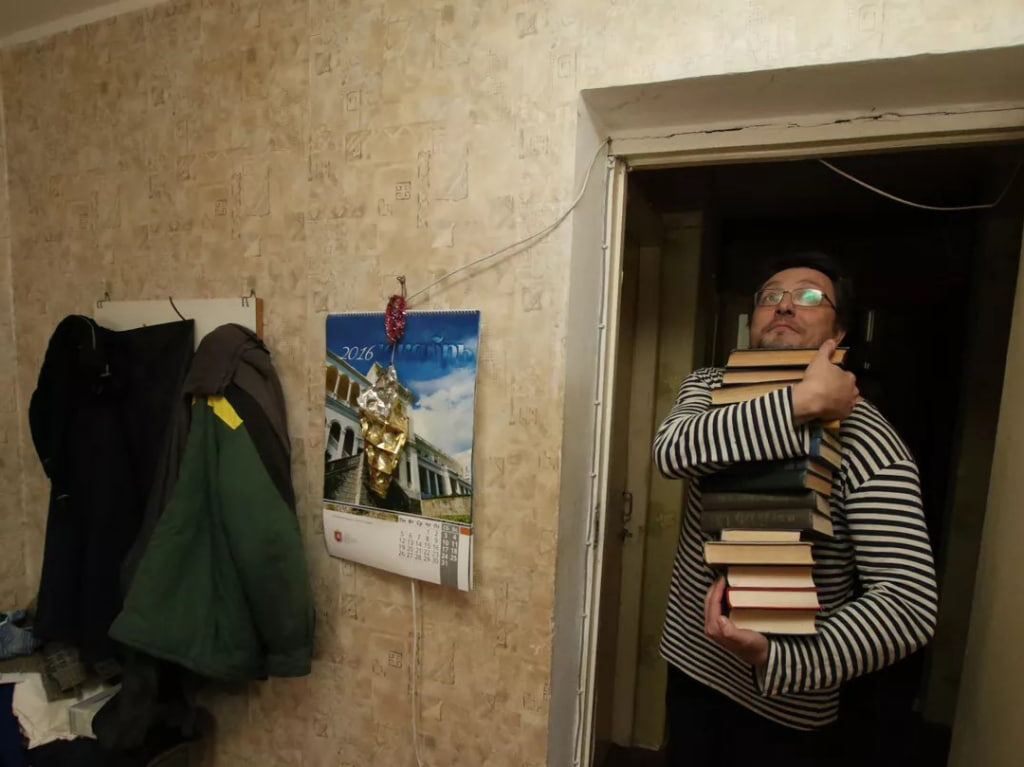
As it follows from the reports of the occupiers’ local “press”, a few days ago in Evpatoria, at the age of 51, allegedly from the consequences of a stroke suffered a year ago, the local “bright poet” Nikolai Stolitsyn died.
Before the occupation, this figure tried to demonstrate his “apoliticality” and “sell his talent” to the widest possible audience, mainly Ukrainian at that time.
However, twenty-five years ago, under the roof of the then nest of Russian special services, the Yevpatoria-located “Russian youth center”, he participated in a rather marginal “artist’s song festival” “Russian spring 2000”, which the same propaganda of the occupiers is now trying to frantically recall.
With the beginning of the occupation, Stolitsyn clearly tried to “get into the mainstream” of the aggressor’s propaganda, but his “honeymoon” ended by 2016, when his opuses about the Crimean War and poems about “Mother Russia” gradually went unnoticed by the local “authorities”, apparently as “not timely enough” and “too soft”.
Over the last decade, Stolitsyn has been trying to “find himself” in the “realities” of that very “Russian world” that he so recklessly helped to spread on the Ukrainian peninsula in his youth, but clearly without success.
As this “Crimean Siberian” later bitterly recalled, before the occupation “we sang in Russian, and this … did not need protection”, and subsequent events are well described by his own words from the song “in our Mukhosransk [Flyshitcity] everything is going great”.
Now the inglorious end of this “bright poet” may push the aggressor’s propaganda to glorify him, but Crimean residents are stating on social networks that “our Mukhosransk” has no need for any “creativity” that is even slightly different from the “general line” of the occupiers.