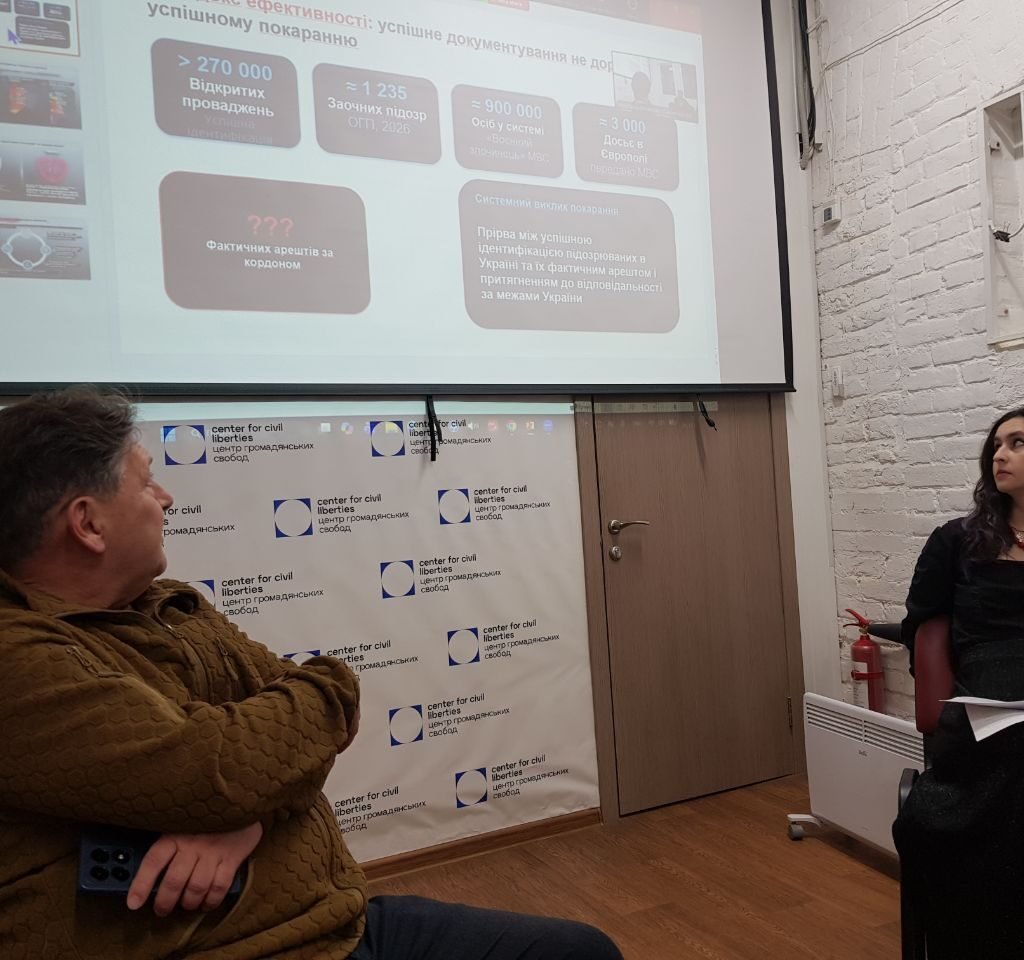
On November 24, experts from our Association, Borys Babin and Anna Prykhodko, participated in a hybrid-format human rights discussion club titled “Criminal Prosecution for Enforced Disappearances and Arbitrary Detentions: Initiating Active Practical Measures by International Partners,” organized by the Center for Civil Liberties.
The event featured a presentation on the prospects for applying the principle of universal jurisdiction in European countries against individuals involved in abductions within occupied territories, specifically in Crimea, as well as an analysis of extradition processes concerning the Russian war criminals responsible.
Professor Babin shared the Association’s experience in collaborating with the UN Working Group on Enforced or Involuntary Disappearances and the UN Committee on Enforced Disappearances. He discussed efforts to counter transnational repression and commemorate victims of enforced disappearances, as well as the Association’s work with OSCE institutions and the International Committee of the Red Cross to provide assistance to specific victims.
Borys Babin also highlighted the potential for locating victims of enforced disappearances who have been released, as well as their relatives, by leveraging mechanisms for the registration and social protection of displaced Ukrainians within European Union countries.
He further discussed the role of European investigative journalists and human rights defenders in pursuing cases under the principle of universal jurisdiction, and the prospects for holding specific perpetrators, such as the aggressor’s enforcers and “judges” involved in enforced disappearances, financially liable to the victims and their families.
The ARC expert also underscored the need for a systematic response to instances where Russian intelligence services attempt to exert unlawful influence, in pursuit of their own criminal objectives, over the relatives of abducted individuals who reside in democratic nations.