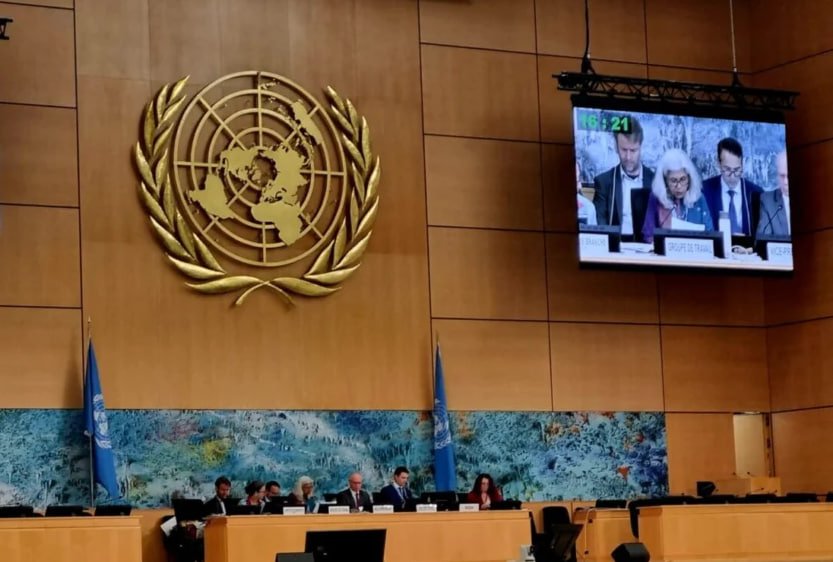
In the framework of permanent cooperation with the United Nations’ bodies, our Association sent this year the submission to the Working Group on the rights of peasants and other people working in rural areas for its fourth thematic report, addressing peasant territories of sea and land.
The ARC submission, prepared by Borys Babin, Eduard Pleshko, and Anna Prykhodko, described to the Working Group the situation in the Russia-occupied territories of Ukraine, including Crimea, and the relevant aggressor’s crimes against the environment, agriculture, and indigenous peoples.
Now the relevant Working Group’s Report A/81/211, “Land and sea territorialities under the UN Declaration on the Rights of Peasants and Other People Working in Rural Areas” was published, and it reflects the facts, described by our experts and their recommendations, as the “submissions received by the Working Group on the confiscation of agricultural lands in occupied territories”.
Regarding this issue, in point 24 the UN Report stressed that the Working Group identified “a structural global pattern: that armed conflicts and prolonged occupations operate as accelerators of peasant territorial dispossession, with effects that outlast the duration of the conflict itself”.
“Forced displacement severs community ties with territories; the destruction of agrarian infrastructure dismantles the supports of peasant production; the collapse of registration institutions creates legal vacuums exploited by actors with greater political capacity; and post-conflict reconstruction tends to privilege individualized tenure models that exclude the most vulnerable communities”, the Report A/81/211 adds,
The UN document stresses that such illicit activities violate Articles 17 (4), 17 (5), and 12 (2) of the pointed Declaration, which “prohibit evictions and agricultural destruction as methods of warfare and enshrine the rights to return, compensation, restitution and reparation, are the normative foundations of a post-conflict territorial justice agenda that this report urges states to develop as a priority”.
The Report A/81/211 stresses regarding that issue that “the destruction of the Kakhovka Dam in June 2023, which flooded 600 square kilometres of agricultural land in southern Ukraine, and the documented confiscation of agricultural properties in the temporarily occupied Autonomous Republic of Crimea and the city of Sevastopol, Ukraine, demonstrate that this pattern is not confined to the Global South”.
The Report A/81/211 adds on to this issue in point 32 that the “regular and irregular armed groups, transnational agribusiness, extractive industries and institutional investors systematically drive resource concentration by acquiring land and water rights”.
The UN Working Group recommended in point 36 of the Report the Human Rights Council to request the development of a periodic monitoring mechanism for the implementation of the Declaration on territorialities, including conflict contexts, with indicators disaggregated by type of rights holder, tenure modality and region, to be integrated into universal periodic review cycles. Our cooperation with the UN structures on those issues will be continued.