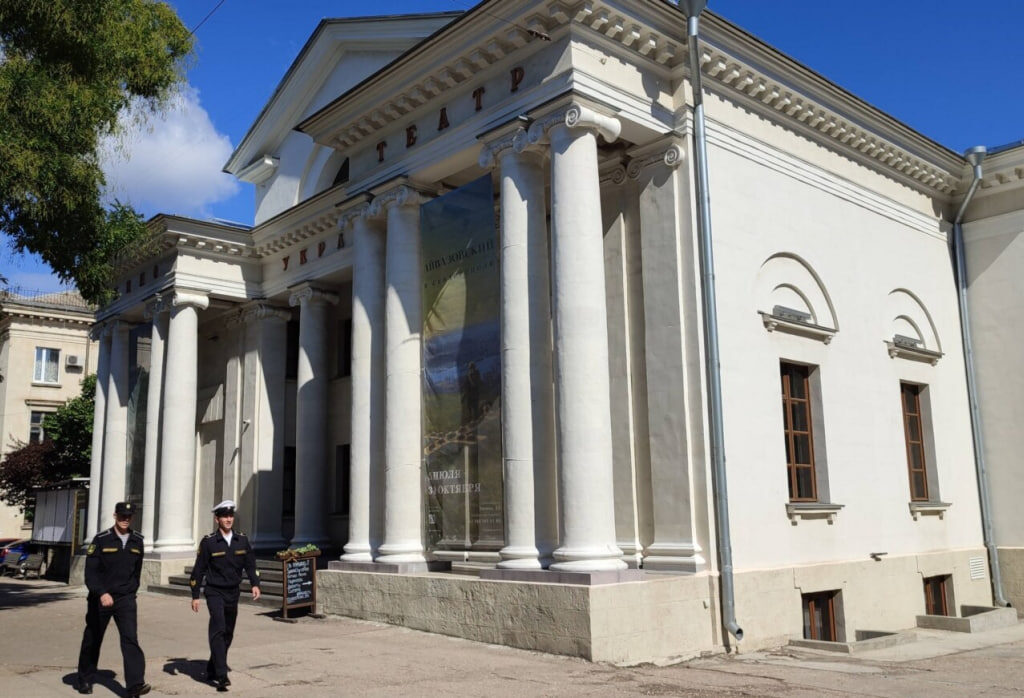
Recently, Sevastopol’s gauleiter Mikhail Razvozhayev announced plans to “rename” the “Ukraina” (“Ukraine”) cinema, located in the city center. This propaganda move by the occupiers, seemingly primitive at first glance, turned out to have not just a hidden agenda, but multiple layers of ulterior motives.
The fact is that the occupiers intend to “rename” the cinema, which has borne its current historic name since its construction in 1954, in two distinct capacities: as a “branch of the museum of the defense of Sevastopol” and as a “cultural heritage site.”
Regarding the “heritage site” status, the occupiers “may officially rename” the cinema following an “expert assessment”, a process clearly designed to launder yet another ten million or so.
However, the cinema’s role as a “museum branch” has long been a thorn in the side of the gauleiter’s clan. This is because the city’s other cinemas, which are in a sorry state and have effectively morphed into unattractive “shopping centers”, are controlled by the “department of culture.”
Corruption schemes there operate through “Sevastopol Kino” and its long-standing director, Dmitry Garnega, who originally secured the position through the patronage of his “obliging female friends” of a certain age.
We have previously reported on the scams run by Garnega’s group, involving monthly kickbacks to the “department.”
Now, it is quite possible that the “renamed” cinema, currently controlled by a rival faction, will be handed over to Garnega’s group for “mutually beneficial use.”
In this regard, the reaction of Sevastopol residents on social media is telling; they fully understand that Razvozhayev orchestrated this “renaming” PR stunt, which they view as criminal, partly to cover up the highly controversial situation surrounding the fire at the Sevastopol Panorama, allegedly caused by a “Ukrainian drone strike.”
Locals describe the “arbitrary decision” made by Razvozhayev and “director” Mikhail Smorodkin as an act of “unauthorized overreach”, an offense for which the occupiers themselves have established “criminal liability.”
Residents write that “they failed to protect the Panorama, and now they are bending over backwards just to show off their ‘patriotism’ and distract attention from the many uncomfortable questions regarding the security and protection of the lost canvas,” adding that “by removing the cinema sign, they were distracting the public so people would forget and stop asking about the Panorama’s condition prior to the strike.”
Recalling the occupiers’ past “historical” schemes, Sevastopol residents write: “Let them put the sign back! Otherwise, in a couple of months, we’ll be wondering where it’s being stored, just like the Garin-Mikhailovsky bas-relief from the Laspi Pass.”
They also add that the occupiers “have already ruined Historical Boulevard, the Panorama, and much else,” demanding that the “disreputable bourgeois”, referring to the gauleiter, “stop erasing Sevastopol’s history.”
Regarding Razvozhayev’s “historical” antics, residents remark that “at this rate, they might suggest renaming the Panorama too,” noting that such renamings are akin to “filing the letter Yat [ѣ] off the markings on Tsarist-era cannons and bells simply because we don’t use Yat in spelling anymore.”
It is also explicitly stated that “the ostentatious removal of the ‘Ukraina’ cinema’s nameplate constitutes vandalism and an attempt to incite inter-ethnic discord.”
As for the gauleiter’s role, residents remark that the governor “has nothing better to do in the city”; alluding to his popular nickname, they sarcastically suggest renaming the cinema as “Kolobok”, after the protagonist of a Russian folktale, though other wits advise against “insulting the Russian folktale hero” by comparing him to Razvozhayev.
Thus, the gauleiter’s disastrous PR stunt surrounding the “Ukraina” cinema affair has demonstrated just how infinitely removed his “administration” is from the population of the occupied city, regardless of the political leanings of Sevastopol’s residents.