Recently, much attention has been focused on the development of artificial intelligence and the use of military unmanned systems, in particular, maritime ones. At the same time, unmanned maritime systems can also have a commercial or quasi-commercial nature of activity, and the aggressor state has long been noticed in attempts to “play its own game” in the development of relevant global standards. At the same time, the Crimean trace was also noticed in the relevant maritime provocations of the Kremlin.
Therefore, our expert Eduard Pleshko reveals some interesting aspects that were previously discussed only by specialized specialists, and he will begin the consideration of this issue taking into account the situation in the International Maritime Organization (IMO).
Until 2016, the term “unmanned navigation” was used in world practice, until the IMO introduced a new generally accepted terminology that allows a clear distinction between the civil (commercial) fleet and small-sized or military platforms.
In particular, these are MASS (Maritime Autonomous Surface Ships) – marine autonomous surface ships, this term is applied exclusively to large commercial vessels that are subject to international conventions (for example, SOLAS).
Also, these are USV (Unmanned Surface Vessels) – unmanned or unmanned surface boats or devices, this term is used for small-sized vessels that are not subject to standard conventions, as well as in naval terminology for autonomous platforms.
The IMO also defined four levels of autonomy, with the following classification: level 1, a vessel with automated processes and decision support (crew on board); level 2, a remotely controlled vessel with a crew on board; level 3, a remotely controlled vessel without a crew on board; level 4, a fully autonomous vessel (Fully Autonomous), where artificial intelligence (AI) makes all decisions independently without human intervention.
Currently, military technologies allow for the confident control of third-level maritime platforms, which have become widespread.
Back in 2017, the IMO launched a large-scale regulatory screening, in essence, a revision of all major maritime conventions regarding their suitability for autonomous shipping. The review covered SOLAS, COLREG, STCW, the Load Line Convention and dozens of other documents.
In May 2021, the screening was completed, the result of which was the conclusion that the fundamental framework of maritime law generally does not hinder autonomous shipping, although a number of provisions need to be refined and detailed.
Therefore, the IMO decided not to create a completely new legal system from scratch, but to develop the MASS Code (MASS Code, or Code for Maritime Autonomous Surface Vessels), as an annex to the SOLAS Convention, which defines requirements for design, navigation, communication, as well as the role and responsibilities of operators, and clarifies how existing requirements should be implemented on unmanned or remotely controlled vessels.
Further work, as befits a global bureaucracy, was slow, with constant disputes between states, shipowners and trade unions.
In December 2024, the 109th session of the IMO Maritime Safety Committee (MSC) approved an updated roadmap, and in June 2025, the 110th session of the MSC managed to finalize 18 of the 26 chapters of the MASS Code.
The debate over the most difficult issue, the human factor, dragged on for another year. The following questions were thoroughly discussed: who would be liable for a remote operator’s error; can one captain command ten ships at the same time; should shore-based control centers be licensed like ships?
Finally, in May 2026, by decision of the 111th session of the MSC, the MASS Code entered into force, albeit in a non-mandatory status. This means that shipowners can apply it voluntarily, but this version will become the basis for future mandatory standards.
The next milestone is December 2026, when the framework for the experience-building phase will be developed at the 112th session of the MSC. From 2026 to 2028, the IMO will collect data on the actual operation of autonomous ships.
But already in 2028, the development of a mandatory MASS Code will begin, simultaneously with the introduction of amendments to the SOLAS Convention, to which a new chapter dedicated to autonomous navigation will be added. The mandatory MASS Code is planned to be adopted by July 1, 2030, and it will enter into force on January 1, 2032, simultaneously with the new chapter in the SOLAS Convention.
While international law is in a transitional stage, regulation is entirely entrusted to the national legislation of flag states, which, for example, the Russian Federation used to “legalize” its actions in closed waters.
In general, long before the full-scale escalation of the armed conflict in Ukraine, we drew attention to the unusually high activity of Russia and China in the IMO on issues of autonomous navigation.
In particular, Russia sent more than 40 notes to the IMO with proposals for the development of an international regulatory framework for autonomous vessels. An official statement from the Russian Ministry of Transport at the end of January 2026 noted that most of these proposals were supposedly “reflected in the draft International MASS Code.”
Maritime educational institutions of Russia, primarily the Admiral Makarov State University of the Sea and River Fleet and the Russian University of Transport, stated that they “have already installed autonomous navigation simulators, on which scenarios that were fantastic a few years ago are practiced, with the transfer of control from the ship to the shore center, actions in the event of loss of communication, and the behavior of AI in emergency situations”, therefore, allegedly, “it is the Russian experience” that should become the basis of the relevant chapters of the MASS Code.
The global race for leadership in the field of autonomous shipping has actually grown into a “war of standards”, which determines what the industry will look like in ten years.
In particular, China has shown an unusually active position, seeking to put forward its national rules as a further basis for international ones, and has relied on systemic regulatory expansion.
Chinese maritime academies, especially Dalian Maritime University, have taken an active part in the work of the MASS Code, especially on issues of the human factor. And it is not just about participation, but about concrete results. In April 2025, the Chinese delegation achieved the inclusion in the IMO roadmap of its guidelines for the implementation of the acts of the MASS Legal Committee, which was actively supported by Russia, the UAE, Nigeria, and some other countries.
In July 2025, for the first time in history, an entire chapter of the draft Code was adopted based on Chinese proposals. The European Union took a more wait-and-see position. In Brussels, they decided not to get ahead of the IMO standards so as not to create regulatory fragmentation.
It is impossible to unequivocally state that the European Commission is sitting idly by; on the contrary, it has proposed parallel initiatives in the form of the SEAMLESS project, which studies the legal status of autonomous vessels, and AUTOSHIP, which focuses on technologies that can later supplement the MASS Code in matters of algorithm liability and data processing.
In addition, the EU’s General Regulation on AI (AI Act) already imposes requirements on high-risk systems – and autonomous ship control algorithms may fall under its scope if properly regulated.
The United States finds itself in a paradoxical situation: on the one hand, American technology companies are leaders in the field of autonomous systems, especially maritime ones, but on the other hand, current federal legislation, including acts from the century before last, requires the presence of a crew on board commercial vessels. Among other things, this creates serious obstacles to the introduction of unmanned vessels in American waters. The US administration has a long and politically sensitive process of harmonizing national legislation with the MASS Code.
South Korea has been very active in recent years. In April 2026, “Avikus”, a subsidiary of HD “Hyundai”, received certification from the Norwegian classification society “DNV” for its HiNAS Control autonomous navigation system. This is the world’s first certification of a serial system intended for mass application on various types of vessels, and not for a single project.
The system combines recognition, decision-making and control functions, allowing the vessel to independently avoid collisions. Avikus has already installed this system on vessels built by “HD Hyundai” since 2023, and has received orders for more than 500 vessels. Moreover, at the end of 2024, the company signed a contract with H-Line Shipping to equip up to 30 vessels. That is, Korean developers are betting on practical commercial implementation, and not just on regulatory initiatives, which gives them technological advantages in the future.
Japan, in turn, is implementing the ambitious MEGURI 2040 program, launched by the Nippon Foundation in 2020 to solve the problem of aging and shortage of seafarers. In January 2026, the container ship “Genbu” IMO 1034993, built in 2025 by “Kyokuyo Shipyard Corp” specifically as an autonomous vessel, began commercial operation on medium- and long-haul coastal routes. The plan is for autonomous navigation to provide 50% of the country’s domestic transportation by 2040.
Norway already operates the world’s first fully electric autonomous container ship, 80 meters long and with a capacity of 120 TEU, which transports finished products (mineral fertilizers) from the Yara production plant in Porsgrunn to the port of Brevik on a route of approximately 11 nautical miles, which takes about an hour. And from Brevik, the fertilizers are already sent to international markets.
Singapore should be added to these leaders, a city-state that is actively creating its own infrastructure for testing autonomous ships. The port of Singapore, one of the busiest in the world, has been operating a maritime portal for testing MASS Code since 2021, where companies can test their technologies in real conditions. The local Maritime and Port Authority has also developed its own regulations and guidelines for such tests.
However, let’s return to Russia, whose government in December 2020 issued Resolution No. 2031 on conducting an experiment on the operation of autonomous (unmanned) vessels by the end of 2025 and declared “massive application of autonomous navigation technology throughout the Earth’s water area”.
Traditionally for Russians, the document pompously defined the goal and objectives of the experiment, in particular “determining the actual efficiency of the autonomous navigation system” and “confirming the possibility of operating an autonomous vessel in designated areas”. In practice, shipowners participated in the experiment voluntarily and at their own expense, and were required to report the operation of such a vessel to cargo owners, insurers, as well as port captains and operators of control systems in the area where the unmanned vessel was sailing.
In addition to shipowners, the participants in the experiment are the Russian Ministry of Transport, the Ministry of Industry and Trade, and “Rosmorrechflot”.
At the same time, the Russian interdepartmental working group under the government commission for economic modernization and innovative development approved “state support for the development of unmanned navigation technologies using computer modeling in a virtual environment” with a total project budget of 439 million rubles, of which “state investment” was envisaged in the format of 60%.
According to the comments of Alexander Pinsky, the general director of the “MariNet” industry center of the national technological initiative, i.e. the so-called “program for global technological leadership of Russia until 2035”, due to drones, shipping companies will allegedly “be able to reduce 15-30% of operating costs”.
It will also supposedly “make it possible to fill the shortage of highly qualified seafarers, which currently reaches 20% of the required number of employees, and working conditions will become more attractive, since it will be normal office work in comfort and safety”. For a shipping company, this means a significant reduction in crew costs due to savings on life support, insurance, payment, and so on.
Testing of Russian systems was organized in real conditions on four vessels under the Russian flag: in the Arctic on the tanker “Mikhail Ulyanov” operated by “Sovcomflot”, IMO number 9333670, in the Black Sea on the dry cargo ship “Pola Anfisa” IMO number 9851115 from the company “Pola Group”, as well as for a dredging caravan as part of the dredging barge “Rаbochaya” in conjunction with the dredger “Redut” of the Azov-Black Sea basin branch of “Rosmorport”.
It was in the waters close to the occupied Crimea that the experimental operation of equipment for unmanned navigation was carried out on the barge “Rаbochaya” as part of the research and development work of the Ministry of Industry and Trade of the Russian Federation “Development of a single technological platform for unmanned control of commercial and technological marine vessels”.
The project was implemented jointly with the working group of the “national technological initiative” “MariNet” and the group “Kronstadt Technologies”, which prepared documentation for the equipment to ensure its unmanned operation.
The complex system “Caravan Control” was tested in the caravan of ships, where the control and management of the barge is carried out from the lead ship of the caravan of ships – the dredger “Redut”, which is actually a hydraulic excavator “Liebher-992”, which is mounted on a pontoon with three support columns and equipped with several buckets of different volumes.
The trial operation involved movement through the Kerch Strait under the general guidance of the working group of the industry center “MariNet”. The distance from the dredging area to the sea dump was about 30 kilometers, which the barge was to travel in remote or automatic control modes.
However, the results of these experiments were “modestly” ignored by the Russians in their own propaganda, and in the context of large-scale Russian aggression, they did not announce new tests of autonomous systems in civilian shipping in the Black and Azov Seas. At the same time, since 2017, the “Sevastopol State University”, controlled by the Russian occupiers, has been announcing “training specialists” specifically for “MariNet”.
Sevastopol “vice-governor” Maria Lytovko stated in 2020 that the “university” supposedly “implements projects in the field of unmanned shipping and digital navigation, intelligent energy, digital engineering, digital design and testing of drones, communication and sensor systems for drones, drone swarm control systems, and “a decision was made to create a world-class scientific and educational center in the direction of “MariNet”.
In turn, in the so-called “Strategy for the socio-economic development of the Republic of Crimea”, the activities of “MariNet” were included in the “development” of the so-called “information technology cluster”, supposedly for the “formation of a competitive information technology cluster”.
At the same time, there are objective risks that it is the “gray zone” of the Russian-occupied maritime spaces of Ukraine in the Azov-Black Sea basin may soon become an area in which the desire of Russians to test automatic systems in supposedly “merchant shipping” will grow significantly. As the analytical documents of the same “MariNet” wrote in 2024, “work continues on the modernization of seaports in new regions, plans are being formed to increase supplies through the ports of Mariupol and Berdyansk”, with a simultaneous mention of the ferries “Marshal Rokossovsky” and “General Chernyakhovsky”, to which we will return in due course.
Objectively, it is the commercial, technical and social benefits of replacing the current fleet with an autonomous one that were not as obvious as stated. A ship that has been at sea for weeks will inevitably encounter a lot of obstacles, so it will have to be equipped with devices that may be much more expensive than the crew. River vessels also have significant difficulties on routes, for example, if the fairway has changed and etc. Uninterrupted satellite communication channels, ground surveillance and control systems – all this is a huge amount of money, and whether companies will spend such expenses is another question. There are also legislative obstacles on the way to fleet automation, which will also have to be overcome.
In particular, international rules for preventing ship collisions oblige that the ship should monitor the current situation, ship crews must participate in rescue operations, and so on. Perhaps, as unmanned navigation technologies develop, the legislation will be significantly changed. That is why the project raised questions in Ukraine, where people are already used to seeing what the aggressor is hiding behind beautiful words.
From a military point of view, significant threats and risks were predicted in the event of the illegal use of such objects as means of terrorist activity, with an attempt to avoid responsibility by the official operator when claiming the hijacking of an unmanned maritime system, so it was the Russian project to ensure the mass application of autonomous navigation technology in the region that attracted attention.
Later it turned out that the outsourcing operator “Oboronlogistika” was actually operating in a closed mode, as a transport and logistics company, created in 2011 within the structure of the Ministry of Defense, and as a key element of the logistical support of Russian military operations, in particular, disguising military transportation as civilian and interacting with a circle of about 70 vessels that cooperate with the company or the Ministry of Defense of the Russian Federation.
Subsequently, the group of companies “Oboronlogistika” was created, including with aviation and automotive components.
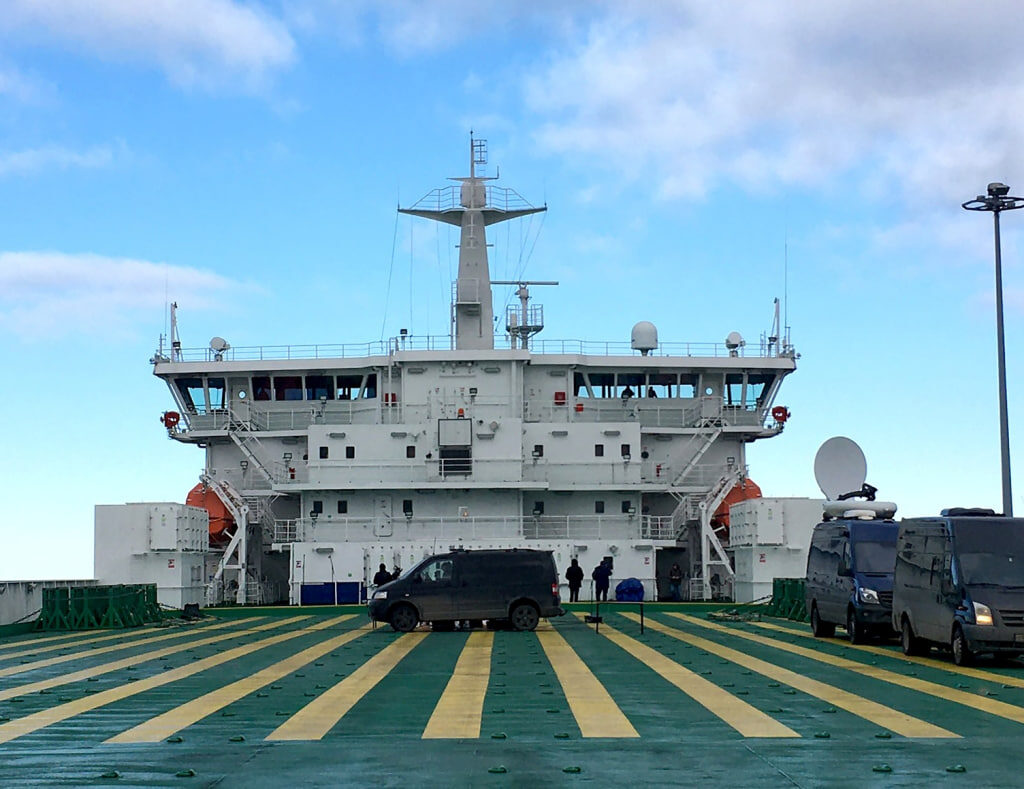
This structure became the sole general agent and operator of the aforementioned ferries “Marshal Rokossovsky” and “General Chernyakhovsky” on the Ust-Luga – Baltiysk line. The mentioned vessels are almost 200 meters long and 27 meters wide, capable of transporting up to 80 railway cars, 78 cars and 12 passengers. They are equipped with two dual-fuel engines with a capacity of 6 thousand kilowatts, which allows them to operate on both diesel fuel and liquefied natural gas.
In 2023, as part of the federal project “Autonomous Shipbuilding”, the ferries were equipped with “Russian autonomous navigation technology” developed by “Sitronics KT”. The system was called “a-Navigation” and includes an autonomous navigation system, optical complexes for analyzing the surrounding environment, and intelligent traffic control systems.
Management is carried out not from the bridge, but from a specialized remote control center located in the passenger port of St. Petersburg, from where captains-operators control the movement of vessels along a route 518 nautical miles long.
The entire route is conventionally divided into four sections, in port areas where pilotage is required, local control mode with decision-making support is used, in the open sea, ferries operate in remote control mode from the St. Petersburg center. As of November 2023, the total time of vessel control in remote mode was more than two thousand hours for each vessel.
At the same time, since the sea crossing is carried out outside the territorial sea of Russia, the use of technology has not yet led to the automatic disappearance of the crew, each ferry has a ship’s crew of 22 people, ready to take over control at any moment in the event of an emergency. And this is a direct illustration of the second degree of autonomy according to the IMO classification – a remotely controlled vessel with a crew on board.
It is also worth noting the Russian initiative, which is currently being formulated as a concept for the use of autonomous tugboats; designs for such vessels are already being developed, and the construction of the first series is planned for 2030.
The Association’s experts propose to decide on the following issues at the international level: can an aggressor recognized by a UN resolution be the main control center for autonomous shipping; is it possible to provide a flag of convenience to such a vessel if the country’s legislation does not provide for proper responsibility and the adoption of effective control measures.
It should also be decided how a warship can be sure that such a vessel is not captured or is operating under intercepted control; how to eliminate doubts that unauthorized persons and illegal cargo were not delivered to the vessel on its way and then unloaded in the selected area; how an autonomous vessel is responsible for providing assistance to other vessels in distress; how to generally ensure control over real safety.
Russia’s covert militarization of autonomous shipping has forced the Association’s experts to develop proposals for measures to enhance maritime security and mitigate “hybrid” threats from Russia, including the introduction of international monitoring, for which it is considered appropriate to initiate the creation of a special monitoring mission for the testing of autonomous vessels under the Russian flag with the IMO and partner countries of the Black Sea region.
It is also necessary to ensure the formation of an electronic archive (Data Logging) in order to create a single database and digital monitoring (AIS, radar control) of all vessels declared in the Russian government experiment, which will allow for a clear evidence base in the event of incidents.
It is also necessary to strengthen cyber control, given that vessels subject to the MASS Code are critically dependent on communication channels, therefore it is necessary to develop means of electronic surveillance to detect signals from the control of such vessels.
In addition, legal pressure should be continued and insisted at the level of the IMO Maritime Safety Committee that any commercial vessel (MASS) of the 3rd and 4th degrees of autonomy be equated with sources of increased danger with mandatory strict insurance of third-party risks directly by the state that authorized the vessel’s departure. And the sanctions imposed by the European Union on the ban on the supply of modern navigation technologies to Russia should be supported by other civilized jurisdictions.