In January 2025, our Association sent information to the UN Working Group on the issue of human rights and transnational corporations and other business enterprises for the Group’s report to the Human Rights Council in June 2025 regarding challenges in the field of artificial intelligence (AI).
This information, prepared by Professor Boris Babin and Associate Professor Andrey Chvalyuk, now published on the official UN web resources, reminded UN structures about the ARC studies on Russia’s activities in the field of AI in Crimea in various areas.
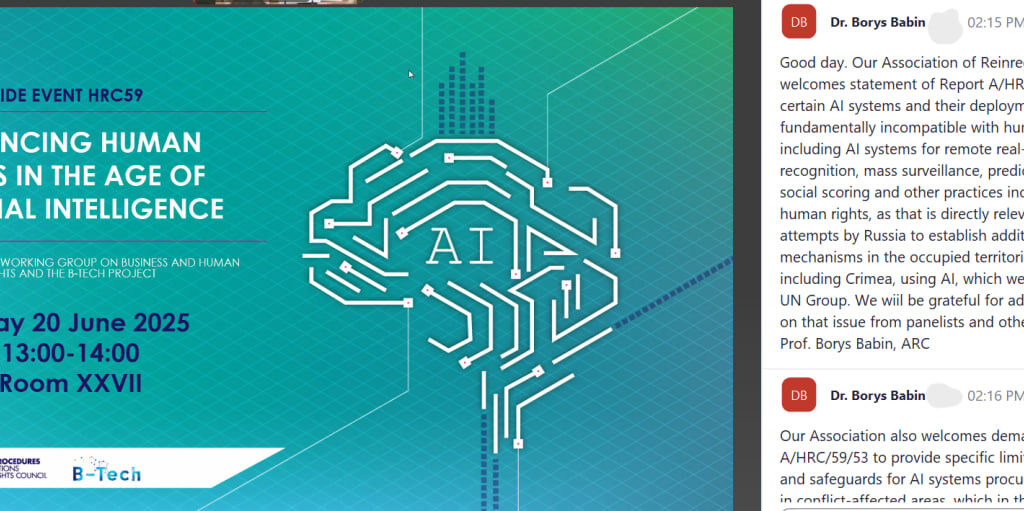
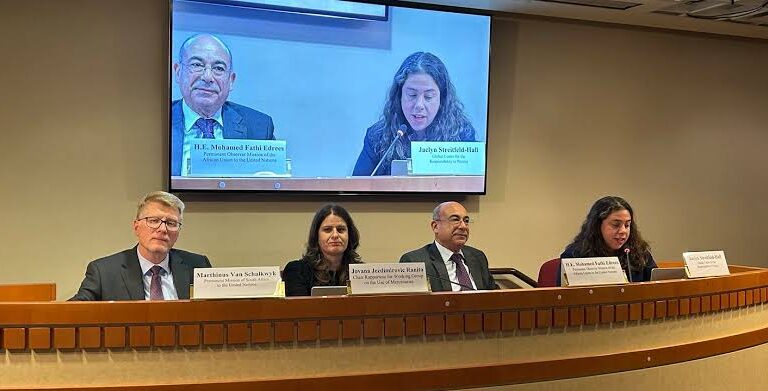
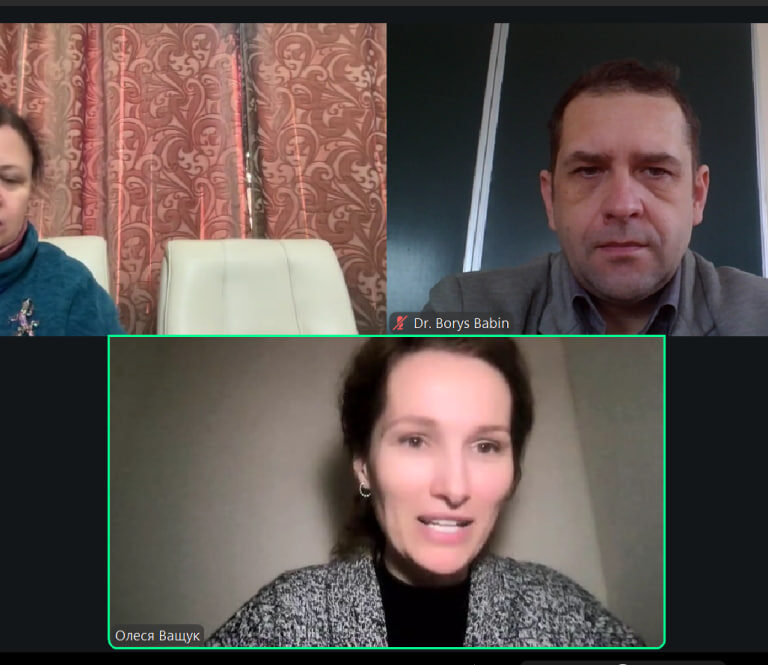
Now the Working Group has published Report A/HRC/59/53 “AI procurement and deployment: ensuring alignment with the Guiding Principles on Business and Human Rights”, which was further discussed at the UN online meeting on June 20, to which experts from our Association were invited, as well as Ukrainian scientists collaborating with us in preparing reports to the UN.
As stated in Report A/HRC/59/53, “some AI systems and their applications are fundamentally incompatible with human rights, which requires the international community to urgently join efforts to define the boundaries beyond which AI systems are prohibited, including AI systems for remote facial recognition in real time, mass surveillance, predictive policing, the creation of social ranking and other activities incompatible with human rights.”
This is directly relevant to the attempts by the aggressor to establish additional repressive mechanisms in the occupied territories of Ukraine, including Crimea, using AI, which we described to the UN Group.
Report A/HRC/59/53 also calls on states to “provide specific limitations, guidance and safeguards for AI systems procured and deployed in high-risk sectors and areas such as justice, law enforcement, migration, border control, social protection and financial services, and in conflict-affected areas,” which in the conflict dimension certainly includes the challenges of Russian aggression.
The Report also calls on states to shift the burden of proof to businesses and public authorities regarding AI-related harms to facilitate access to remedy for victims of human rights abuses or violations.
The described and other issues related to the risks of AI in the context of Russian aggression were again proposed for discussion at the UN online-meeting by the ARC’s experts Borys Babin and Anna Prykhodko, and at this event the relevant developments of Associate Professor Yana Tytska, dedicated to the reflection of AI challenges in modern legal standards of scientific activity, were also discussed.