Last week, U.K. media “Britpanorama” published the research on the role of third countries’ oil terminals in the issues of Russian shadow fleet activities. Developing a relevant, extremely actual topic, we may agree that terminals in third countries continue processing Russian petroleum products while benefiting from complex corporate structures that span multiple jurisdictions.
The resignation of Sultan Ahmed Bin Sulayem, the head of the world’s third-largest port operator, “Dubai Port World” which controls almost 80 marine terminals, including in the UK and other G7 countries, announced on February 13, has exacerbated the issue of attempts by destructive regimes to control the global maritime business.
The head of “DP World” lost his chair due to the documents released by the US Department of Justice revealing his ties to the notorious American financier and pedophile Jeffrey Epstein. These facts indicate that Ahmed Bin Sulayem is maximally compromised regarding the activities of Epstein and his puppeteers, who most experts believe are the Kremlin and Russian special services.
Against this background, it is not surprising that it was Ahmed Bin Sulayem who signed a cooperation agreement in St. Petersburg in the summer of 2023 with the Russian state corporation “Rosatom” and a subsidiary of “DP World”, “DP World Russia FSE”, formed specifically for operations in the Russian Federation but registered in Dubai.
Later, these two structures formed a joint venture, “International Container Logistics” (“Mezhdunarodnaya konteynernaya logistika”), which has had a daughter since 2024, namely “Western Transport and Logistics Hub” (“Zapadnyi transportno-logisticheskyi uzel”), which announced plans to build a container terminal in the port of Murmansk.
And although in 2022 “DP World” was temporarily included in the list of “international war sponsors” by the Ukrainian Anti-Corruption Agency, all of the above structures have not yet been included in the sanctions lists, and even the prospect of imposing sanctions on “DP World”, which is managed by the UAE state corporation “Dubai World”, is extremely vague.
It is just as difficult to imagine a sanctions policy towards port terminals controlled by such market giants as Singapore’s “PSA International” with its control over port complexes in more than 40 countries, or Hong Kong’s “Hutchison Ports”, which owns port terminals in Amsterdam, Barcelona, Brisbane, Gdynia, Sydney, etc.
Another Hong Kong port concern, “COSCO Shipping Ports”, is generally state-owned by communist China and, among other things, owns port terminals in Antwerp, Bilbao, Hamburg, Piraeus, Istanbul, and so on. Less global, but also influential in a number of countries, is a similar Chinese state-owned concern with Hong Kong registration, “China Merchants Ports”.
Among the European concerns that own dozens of port terminals, we can mention the German “Eurogate Intermodal GmbH” and the Dutch “APM Terminals”, a daughter of the global corporation “Maersk”. Separately, it is worth mentioning the owner of a hundred port facilities in the world, the American structure “SSA Marine”, which is actually controlled by the Mexican oligarch Fernando Chico Pardo.
Against this background, the announcements of EU officials about the twentieth package of sanctions, which were to be introduced against Russia on February 24, 2026, on the fourth anniversary of its invasion of Ukraine, were quite noteworthy. The package was to include two port terminals that handle Russian oil, the Georgian Kulevi and the Indonesian Karimun, and this news immediately received a heated discussion after the announcement.
It is worth noting that in the Georgian Kulevi there is both an oil terminal, the construction of which began in 2006, and a relatively new oil refinery; both structures are considered by the local authorities as strategic objects.
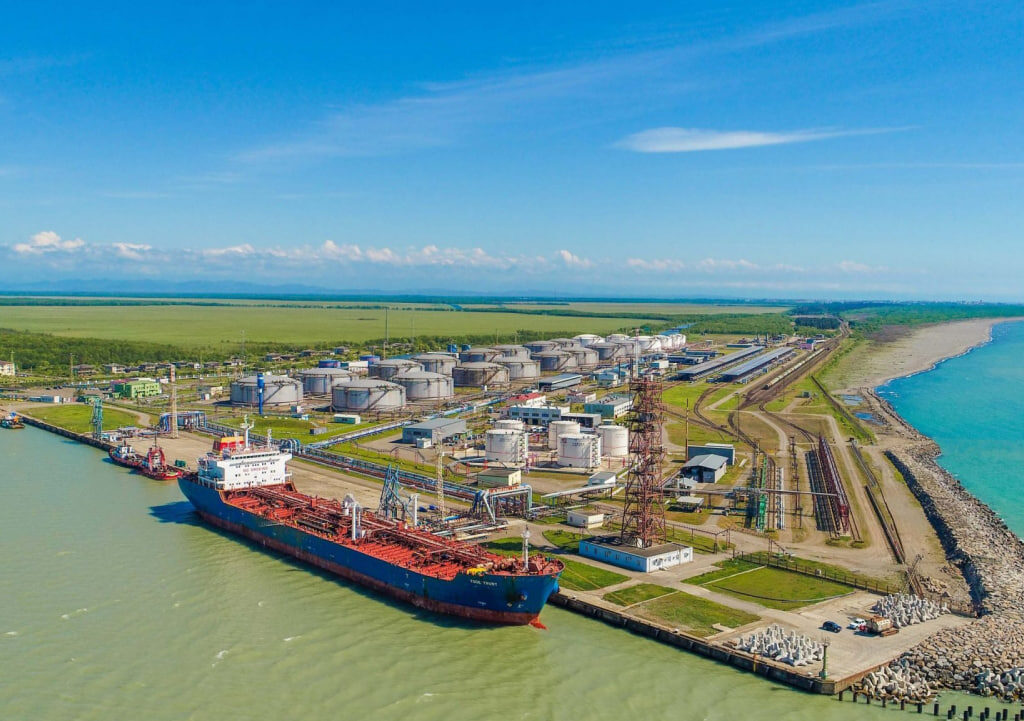
The oil terminal has three berths for tankers with a capacity of up to 100 thousand tons, operates its own port fleet, and has up to 30 tanks for storing oil products with a capacity of over 400 thousand cubic meters on its territory, as well as a railway freight station.
The owner of the terminal is the company “Black Sea Terminal LLC”, which is a subsidiary of the state-owned Azerbaijani energy corporation “State Oil Company of Azerbaijan Republic” (SOCAR), registered in Georgia (code 204892170), even the terminal’s tugboats are named “Socar” and “Socar 2”.
It is highly likely that the announcements of EU sanctions arose in the Kulevi dimension due to the activities of the aforementioned oil refinery, which belongs to the “Black Sea Petroleum LLC” structure, code 405572394, exposed by journalists. Until December 2024, this company and the plant belonged to the Georgian figure Maka Asatiani, in particular through her company “Trade Stone Iberia LLC”.
But later the ownership of the plant was transferred first to another Asatiani’s company, “MK Capital LLC”, and in February 2025 about 30% of the shares were transferred to “Dunamis LLC”, which belongs to David Potskhveria. At the same time, the former Minister of Economy of Georgia, Levan Davitashvili, Vakhtang Chakhnashvili, and Asatiani’s husband, Konstantine Gogelia, were included in the board of directors of the plant.
It was on Gogelia, who has a Russian tax code 504903379197, that the company “Arctic Bunker” was registered in Russia, which is engaged in the supply of fuel (bunkering) to ships in the port of Murmansk.
Georgian journalists also indicate that Asatiani’s son from his first marriage, Kakhi Zhordania, owned the Russian oil trader “Oil Energy Group” and has had a 25% stake in the company “SDO-Logistics” since 2018, where the controlling stake is owned by Sergey Alekseyev, the son of the first deputy commander of Russian military intelligence, Lieutenant General Vladimir Alekseyev, who was recently assassinated in Moscow.
In addition, the aforementioned Sergey Alekseyev previously worked for the “Russneft” corporation of Russian oligarch Mikhail Gutseriev, and by “coincidence” it is this structure that has now begun to supply oil to the oil refinery in Kulevi.
For example, in early October 2025, the tanker “Kayseri” with IMO number 9292199 delivered 105 thousand tons of Siberian oil from the port of Novorossiysk to this plant through the aforementioned SOCAR’s port terminal. After this fact was exposed by “Reuters” on October 21, the Georgian authorities stated that “sanctions were not violated” because at that time the tanker, its owners, and its operators were not on the sanctions lists; however, they were included in these lists of the European Union on October 24, 2025.
Thus, in this story, the main trigger that caused the announcements of sanctions against the terminal was the fact of the mass processing of Russian oil products at the plant, the owners of which are clearly affiliated with the Russian energy model of the economy. It would seem that the above Georgian business cannot be called global; however, the company “Global Marine Fuel (GMF)” LLP code NC001167 has been registered in London under the same Maka Asatiani since 2018.
Further, this structure, where Sophio Tavartkiladze is a co-owner, was re-registered to a “convenient address” in the city of Antrim in Northern Ireland, and this structure has an annual turnover of several million pounds. At the same time, the aforementioned Tavartkiladze is a minority shareholder of Asatiani, in the Georgian company “Trade Stone Iberia LLC”.
No less characteristic is the story with the oil port terminal in Indonesian Karimun. It was built in 2013 by the corporation “Keller ASEAN” for the German concern “Oiltanking GmbH” as a subsidiary of “Marquard & Bahls AG” – a family business currently controlled by Daniel Weisser.
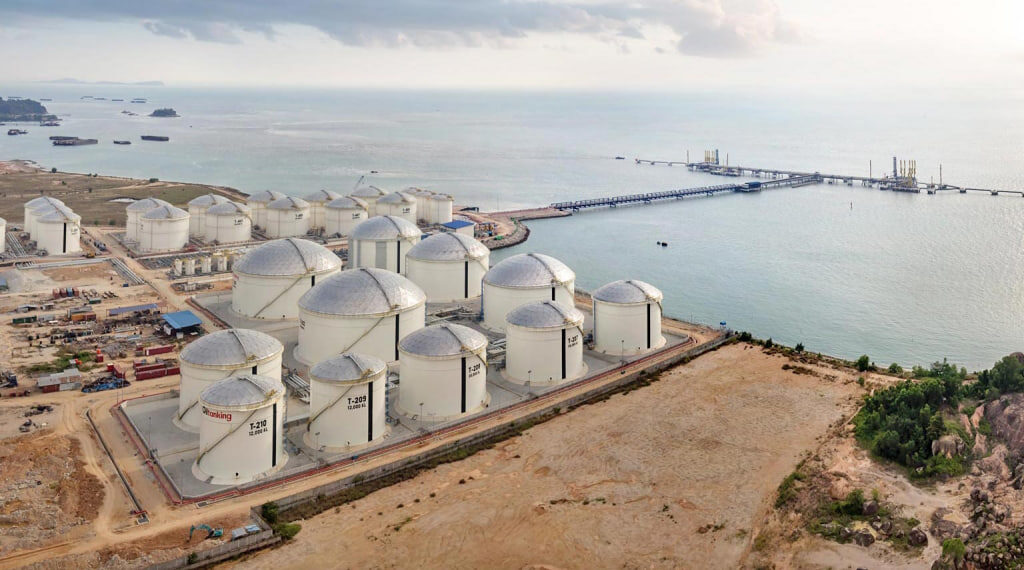
“Oiltanking GmbH” controls approximately 70 oil terminals in more than 20 countries, but in October 2024, the company sold its “PT Oiltanking Karimun Terminal” to Dubai-registered “Novus Middle East DMCC”, after which the plant was renamed “PT Oil Terminal Karimun”.
The terminal in Karimun has four deep-water berths, 12 mooring pipelines, and more than 30 tanks for storing petroleum products with a total capacity of approximately 720 thousand cubic meters, while petroleum products can not only be stored at the terminal but also mixed with each other, which makes the terminal a unique hub located in a free economic zone on the shores of the Strait of Malacca less than 30 miles from Singapore.
After the acquisition of the terminal from Karimun by the aforementioned Dubai-based company, a flow of oil products from Russia began to flow through it, as was already reported in a Reuters investigation on May 8, 2025.
The journalists indicated that Russian oil was processed at Karimun even before the change of owner, but from October 2024 to spring 2025, its share gradually amounted to 100% of the plant’s work, from a quarter of its volumes, as it was before, despite the fact that in the spring of 2025, at least three sanctioned tankers delivered oil products from the Russian Federation to the terminal.
The investigation indicated that in the first 4 months of 2025 alone, the terminal processed 500 thousand tons of fuel oil from the Russian port of Ust-Luga, more than 210 thousand tons of Russian diesel, etc. The ability to mix fuels allows the terminal to continue shipping petroleum products not as Russian, but as “Indonesian”, in particular to the markets of Southeast Asian countries.
Later, in October 2025, “Novus Middle East DMCC” was sanctioned by the UK for “conducting business in a sector of strategic importance to the Russian government, namely the Russian energy sector, including through its operations with vessels designated” in the UK’s sanctions lists.
Notably, “Novus Middle East DMCC” claims on its website to specialize in “petrochemicals, lubricants, and oil refining products,” including hydraulic fluids, engine and transmission oils, and bearing greases.
A number of investigative reports have alleged that the company is linked to Azerbaijani businessmen Tahir Garayev and Etibar Eyyub, who are under UK and US sanctions for their involvement with “Rosneft” in sanctions evasion schemes and shadow fleet operations.
However, after the transfer of ownership from “Oiltanking GmbH” to this Dubai-based structure, there were no management changes at the terminal in Karimun, and even Pak Yos Effendy remained the head of the company, as he had been until 2025.
At the same time, the reasons for the sale of the plant were announced by the management of “Oiltanking GmbH”, namely the CEO Bas Verkooijen, back in the spring of 2024, but they explained it as vaguely as possible; it is highly likely that such an alienation was of a formal nature and aimed at avoiding the sanctions expected by the corporation due to the transition to Russian raw materials, while maintaining control over the terminal through a “related” offshore company.
Such considerations are prompted by another story with “Oiltanking GmbH”, which for a long time was a co-owner of the Iranian terminal “Exir Chemical Terminal” in the port of Bandar-Khomeini through the structures “Oiltanking ME Holding GmbH” and “OMEA GmbH”, and in 2018 announced the “sale of investments” to its “Iranian partners”, clearly to circumvent sanctions, and these operations also had signs of fictitiousness.
It is noteworthy that a year before the full-scale invasion of Ukraine by the Russian Federation, “Oiltanking GmbH” did not hide its focus on processing Russian oil products at its own terminals in the Finnish ports of Kotka and Hamina, “due to their proximity to the border,” as “gates to and from Russia.”
Thus, the obvious prerequisites for the possibility of imposing sanctions on port terminals of third countries that process Russian oil should be the periodic processing of sanctioned products by these facilities, as well as the provision of services for unloading and loading tankers of the shadow fleet.
An additional factor that may affect the realism of such sanctions is the specifics of the specific beneficiaries and formal owners of the terminal.
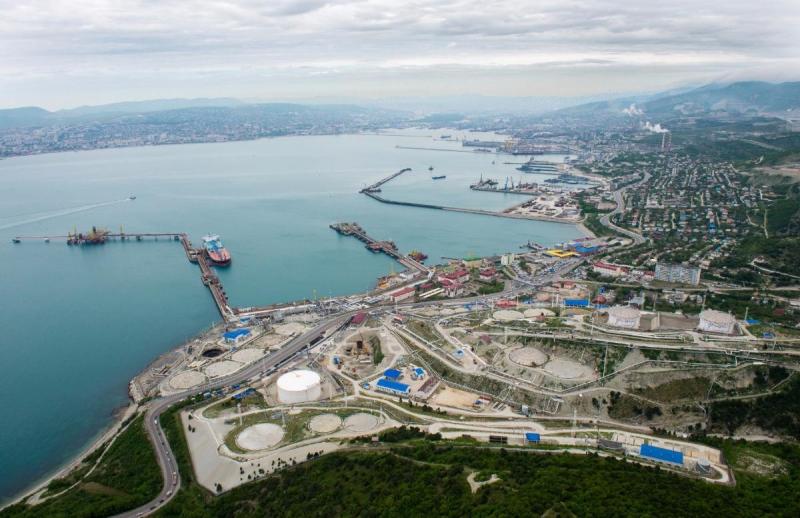
It is worth recalling that earlier, in the 16th package of sanctions, the European Union introduced them in February 2025 against the Russian ports of Ust-Luga, Primorsk and Novorossiysk (due to the transportation of oil), as well as Astrakhan and Makhachkala (for the transportation of military cargo); the Novorossiysk port is also under sanctions by Australia and New Zealand.
According to the relevant regulation, the EU “prohibits carrying out any operations, directly or indirectly, with ports and harbors” and the above ports are indicated in the acts of the European Union precisely as logistical and geographical objects, and not as enterprises, for example, not as the existing PJSC “Novorossiysk Commercial Sea Port” or not as JSC “Commercial Sea Port Ust-Luga”, tax code 4707018000.
At the same time, for example, the oil terminal in the port of Ust-Luga is controlled by a completely different structure, namely JSC “Ust-Luga Oil” code 4707013516, which at least formally has other beneficiaries and managers and is separately included in the sanctions lists of Canada and Ukraine, but not the EU.
At the same time, it is the Russian maritime practice, according to which the port is associated with a certain enterprise, which is at the same time part of the public maritime administration, that is not widespread in the world, where ports can have a purely logistical and managerial significance, and cargo turnover occurs through the terminals of various operators, which are often controlled by the transnational corporations described above.
Oil terminals, through which Russian oil is transshipped and processed, can be completely separate structures autonomous from traditional multifunctional ports, as evidenced by the example of the Georgian Kulevi and the Indonesian Karimun.
Thus, the imposition of sanctions on ports as infrastructure facilities should at least be accompanied by sanction pressure on the enterprises that control the oil port terminals, on the beneficiaries of such enterprises and on their top management.
An effective example of such sanctions pressure could be the inclusion in the sanctions lists of the structures we previously investigated that contribute to the aggressor’s maritime economy, such as the “Crimean” “NIKIMP” or the “Caspian Pipeline Consortium.”