Recently, the aggressor began the process of “adopting a federal law regulating the activities of rehabilitation centers for wild animals.” Under this guise, among other things, the systemic “dolphin rehabilitation” scams, which have a billion-dollar turnover in Kremlin-controlled territory and involve the occupied peninsula, will be “legalized.”
It should be noted that until 2018, Russia was the world’s largest supplier of marine mammals to foreign markets, with official export figures alone reaching up to $30 million per year. Meanwhile, the Federal Agency for Fisheries traded catch quotas, and the subsequent announced “fishing moratorium” has transformed these schemes into pure corruption.
Starting in September 2024, “officially” dolphin capture is permitted only “by decision of a special government commission,” but both black and gray markets for this activity continued to flourish in both Russia and occupied Crimea. Under this “illegal” scheme, the captured dolphins were not publicly disclosed and were sold to dolphinariums using the documents of previously deceased animals. This resulted in Crimean dolphinariums receiving “long-lived” animals, registered long before the occupation.
Under the “gray” scheme, dolphins “accidentally caught” or “stranded” were transported through “rehabilitation centers” as being unable to be released into the sea due to “injuries” and “illness.” These animals were also transferred to dolphinariums.
Dozens of such animals were transported each year through the “Crimean” “dolphin rehabilitation center” “Bezmyatezhnoye More” alone, and it is this scheme that the aggressor now intends to legalize. It is noteworthy that the main “voice of protest” against these “legal innovations” is being led by businessmen operating under the “gray” scheme.
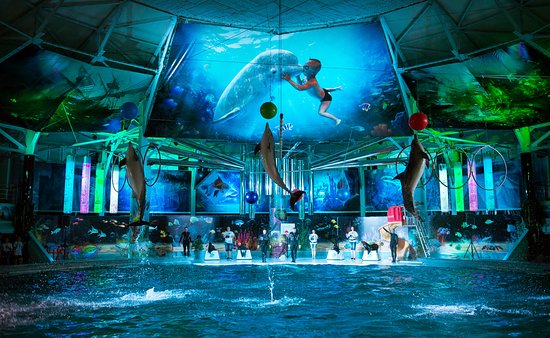
In Crimea, this includes the “state-owned” Karadag Dolphinarium, which competitors had previously “stormed,” apparently with the goal of “privatizing it into the right hands,” using such “animal rights activist” as propagandist and war criminal Alexander Talipov.
Talipov’s tragicomic portrayal of “dolphin lover” has a simple explanation: the beneficiary of his “eco-campaign” was Albert Kurshutov, the owner of the Aquatoria marine animal theater in Alupka, through his “Aquatoria+” structure, and the current “minister of internal policy, information, and communications” of the occupiers.
This structure, like the Alushta dolphinarium “Akvarel,” controlled by Viktor Zhilenko, a collaborator close to the Aksyonov clan, operates under the “rehabilitation” scheme that the Kremlin is now seeking to “legalize.”
Interestingly, not only the owners of the Alupka and Alushta dolphinariums are linked to the aggressor’s propaganda, but also Igor Masberg, co-owner of the Yevpatoria dolphinarium through the “Akvamarin” research and production enterprise, who is also playing the role of “Yevpatoria’s main German” in the aggressor’s propaganda shows with the “Wiedergeburt” “community.”
And another co-owner of “Akvamarin,” Ruslan Pavlovsky, was for a long time the “head of the public chamber” for the occupiers in Yevpatoria. While another dolphinarium, “Koktebel”, controlled by Alexander Shapovalov and Lyudviga Frondzhulo, prefers to keep a low profile, other similar institutions in Crimea have become the subject of a series of scandals.
We previously wrote about the tragicomic activities of Vladimir Kalnibolotsky, who controlled the “Flipper” dolphinarium in Sevastopol and participated in the “raider takeover” of the Sevastopol dolphinarium in Artillery Bay in 2017. For two years, various groups of “businessmen” fought for control of the “live goods,” resulting in the deaths and illnesses of several animals due to neglect.
In the fall of 2022, Kalnibolotsky was responsible for dumping four “processed” dolphins directly into Sevastopol Bay, allegedly intending to “save them from starvation.” Then gauleiter Mikhail Razvozhaev used these corpses for publicity, and the dolphinarium in ArtBay was demolished “to accommodate” a group of businessmen from his circle.
However, Kalnibolotsky himself escaped with a “minor degreasing” and is now actively working under the umbrella of the “Life of the Sea” structure, registered to Matvey Filippov, which controls another Sevastopol dolphinarium, “Pobeda,” as well as the Tarkhankut dolphinarium on Bolshoy Atlesh in Olenevka (Kara Adzhi).
The most colorful situation, however, involved the “Nemo” dolphinariums in Alushta, Feodosia, and Sudak, long controlled through the Odessa firm “Nerum” by the notorious Odessa City Council deputy Andrei Kislovsky.
“Nerum,” registered to the deputy’s mother, Raisa Kislovskaya; former Odessa Deputy Mayor Mikhail Kuchuk; his brother Vyacheslav; married couple Sergey and Natalia Kelyushok; and Dmitry Uryvsky, controlled the Crimean dolphinariums through the Alushta-based “Dolphinarium Nemo.”
Also, with the assistance of the aforementioned Uryvsky, who lives in Anapa and presents himself as the founder of the “International association of oceanariums and dolphinariums in crimea,” the media-reported interactions between “Nemo” beneficiaries and dolphinariums in Anapa, Dzhubza, and Golubitskaya took place through the entities “Chudnoe More” and “Ecological Center.”
In January 2025, Crimean collaborators from Vladimir Konstantinov’s clan announced the “nationalization” of “Nemo” Dolphinarium property, including three Crimean dolphinariums. However, these entities are currently still operating under their previous guise, and the “multi-task” Alexander Shvyrev has been declared the nominal “head of the temporary administration.”
Thus, the question of who is actually operating the three Crimean “Nemo” dolphinariums remains open. However, in the current “challenging business environment,” the Crimean dolphinariums, with the exception of a small one in Partenit and the one mentioned in ArtBay, show no signs of closing.
This “enviable resilience” is easily explained: the schemes described at the beginning of our study for “laundering” dolphin poaching and their subsequent sale on the black market, both to dolphinariums in Russia and third countries, including China, have not been abolished, and Crimean structures have become the hub for this criminal scheme.
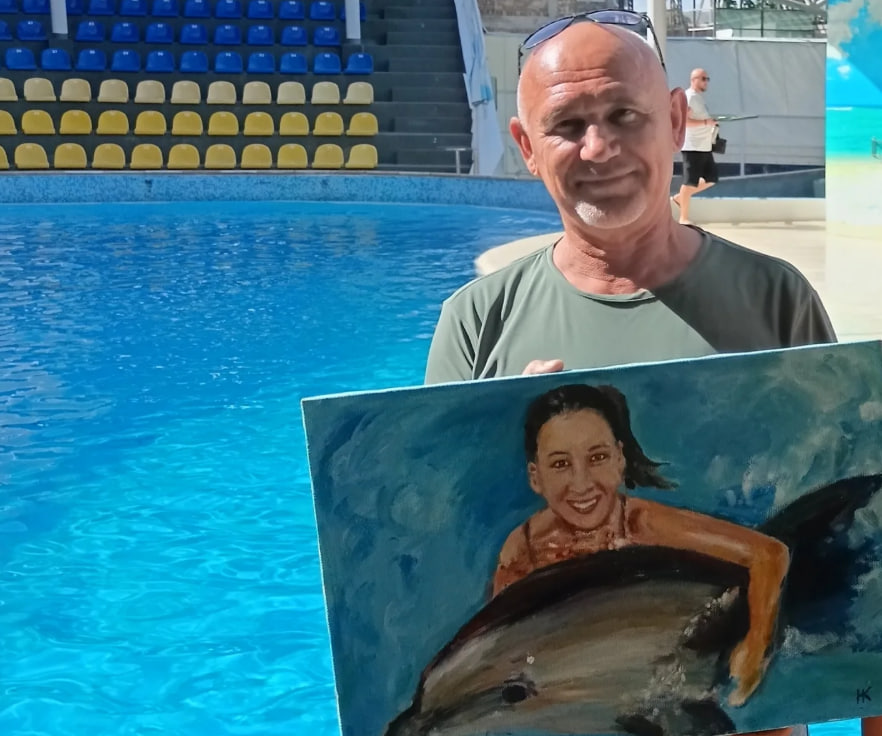
Proof of this is the fate of the “Oscar” dolphinarium, which we previously described, opened in 2010 in Kyrylivka, a town near the Sea of Azov. Since 2022, this part of the Zaporizhzhia region has been occupied by Russians, and Kyrylivka has been virtually devoid of mass tourism for several years.
At the same time, the occupiers claim that the Kyrylivka dolphinarium is operating under a company called “Pinacolada,” registered to Simferopol resident Leonid Yaremko, a former “retailer of flowers and other plants, seeds, fertilizers, pets, and feed.”
We reported that Yaremko, through the “Melitopol fiscal fata operator,” is connected to Donetsk swindlers Tatyana and Yaroslav Tibekin, who amassed their fortune through an illegal coal mining business in the “kopanki” mines, together with former “Crimean state duma deputy” Andrei Kozenko.
Let’s recall that Kozenko, who had ties to Sergei Aksyonov, Denis Pushilin, and the former “mayor” of occupied Yalta, Andrei Rostenko, had previously surfaced among the occupiers in the criminal role of “deputy chairman of the council of ministers for economy and finance of the Zaporizhzhia Region,” among other things “becoming famous” in 2023 for “squeezing” Melitopol gas stations in favor of his “Crimean friends.”
And the Tibekin family, even before the large-scale aggression, had moved from Donetsk to the “quieter” Crimea, where they began the rapid construction of their “empire,” which included the “agricultural firm” “Mengir” from the Karasubazar’s Yablochne, the Feodosia structure “Neftyanik,” the “Nizhnegorsk Cannery,” “Krymtrade,” and “Yaltamorstroy,” linked to Rostenko’s large-scale scams.
For PR and their own “political significance,” the Tibekins also control such entities as the “Crimean Racing Team,” whose “lead pilot” their son, Alexander, is listed as, as well as the “Figure skating federation of the republic of Crimea.”
In addition to the dolphinarium, the Tibekins have seized quarries in the Tokmak and Melitopol areas, under the umbrella of the “Tokmak Granite Quarry” and “Mineral Mining Company”, as clearly indicated in the “registers.” The Tibekins are also “registered” in Melitopol as the owner of the “Solar Wind” company, through which the clan is cultivating solar and wind power plants seized in southern mainland Ukraine.
It is clear that these businessmen need the Kyrylivka dolphinarium specifically for their “real business,” namely as a hub for the black market for dolphins, which are currently caught in the Sea of Azov without any oversight. And so, Crimean dolphinariums will continue to operate productively under this same model even now, when there are no mass tourists on the peninsula, and none are expected.